

A single institutional-grade building can be divided into thousands of digital tokens that eligible participants across countries can hold in fractional amounts. That is what real estate tokenization does, and the category has moved from concept papers to working products quickly. Property exposure used to require substantial capital and the obligations that come with direct ownership. Tokenization lowers the entry point and removes most of the management.
The timing reflects a wider shift. The tokenized real-world asset market surpassed $19.6 billion in Q1 2026 and is projected to reach $9.4 trillion by 2030 (Boston Consulting Group x Ripple, 2025). Tokenized real estate is still an early slice of that total, at roughly $202.6 million across 104 assets as of August 2, 2026 (RWA.xyz), which is under one percent of all tokenized RWA value. The infrastructure is arriving faster than the property supply.
What follows is a step-by-step breakdown of how a property goes from title to token to distributed rental income. One running example, a $10 million building divided into 1,000,000 tokens at $10 each, is used throughout to keep the mechanics concrete. It covers both the issuer's workflow and the participant's path, plus the risks most overviews leave out.
This guide is educational and does not constitute financial, legal, or tax advice. Tokenized real estate carries risk, including possible loss of capital. Figures referenced are examples rather than guarantees. Do your own research and speak to a licensed professional.
Key Takeaways
- Real estate tokenization converts ownership rights in a property into blockchain tokens, each a fractional claim on the asset's value and income, anchored legally by an SPV.
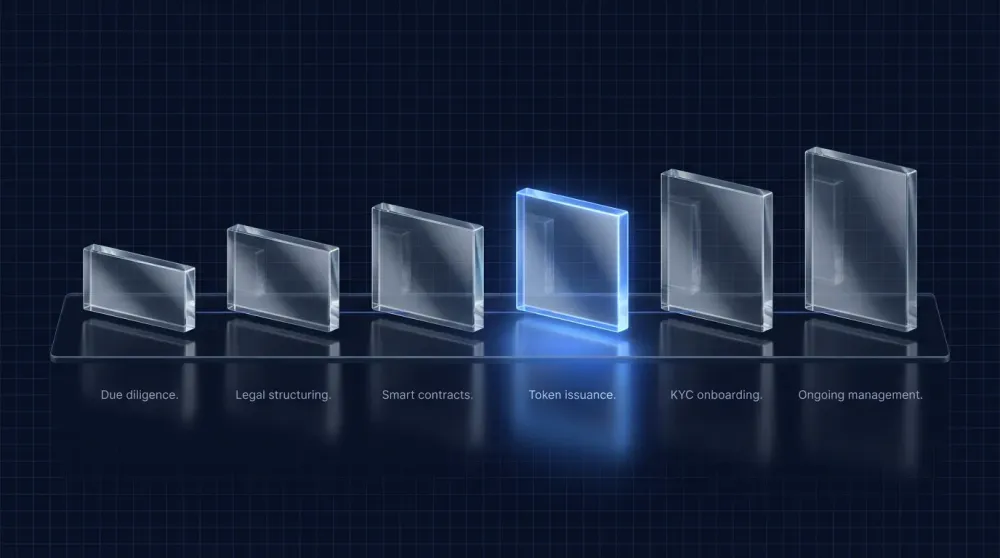
- The pipeline runs through six steps: due diligence, legal structuring, smart contracts, token issuance, KYC onboarding, and ongoing management with on-chain rent distribution.
- Permissioned standards such as ERC-3643 (T-REX) and ERC-1400 enforce compliance by tying transfers to verified, whitelisted identities.
- The market is scaling quickly, with Ripple and BCG projecting tokenized real-world assets at $9.4 trillion by 2030, though liquidity, regulation, and smart-contract risk remain real.
- Mey Network's Property Token Offering (PTO) model and MeyFi show how one ecosystem connects these steps end to end.
What Is Real Estate Tokenization? (Plain-English Definition)
Real estate tokenization is the process of converting ownership rights in a property into blockchain tokens that represent fractional shares. Each token is a fractional claim on the property's value and, in most structures, its income. Hold 10,000 tokens out of the example building's 1,000,000 supply, and you have a 1% economic interest in the asset.
The closest analogy is equity in a company, with one difference: the underlying entity usually holds a single building. A share represents a claim on a business. A property token represents a claim on one specific asset and the cash it generates.
A quick comparison frames it. A REIT gives you exposure to a professionally managed portfolio of many properties through a normal brokerage account. Direct ownership gives you full control along with full responsibility for tenants, maintenance, and management. Real estate tokenization sits between the two: asset-specific, like direct ownership, low-minimum, and passive like a fund, and transferable in a way neither traditional option offers. A fuller comparison appears further down.
What a real estate token actually represents
A well-structured real estate token bundles three things. Economic rights give you a proportional share of rental income and of any change in the property's value. Governance rights can include voting on decisions such as a sale or a major renovation. Transferability is the ability to move or dispose of the token, subject to compliance rules.
The legal wrapper is what gives the instrument substance. The token references an ownership or interest claim held by a Special Purpose Vehicle (SPV), a dedicated legal entity that holds the actual property. Without that wrapper, a "property token" is just an entry on a ledger. With it, the token connects to an enforceable claim in the physical world. That distinction separates credible platforms from marketing, and it deserves close attention during due diligence.
The Building Blocks: What Makes Tokenization Possible
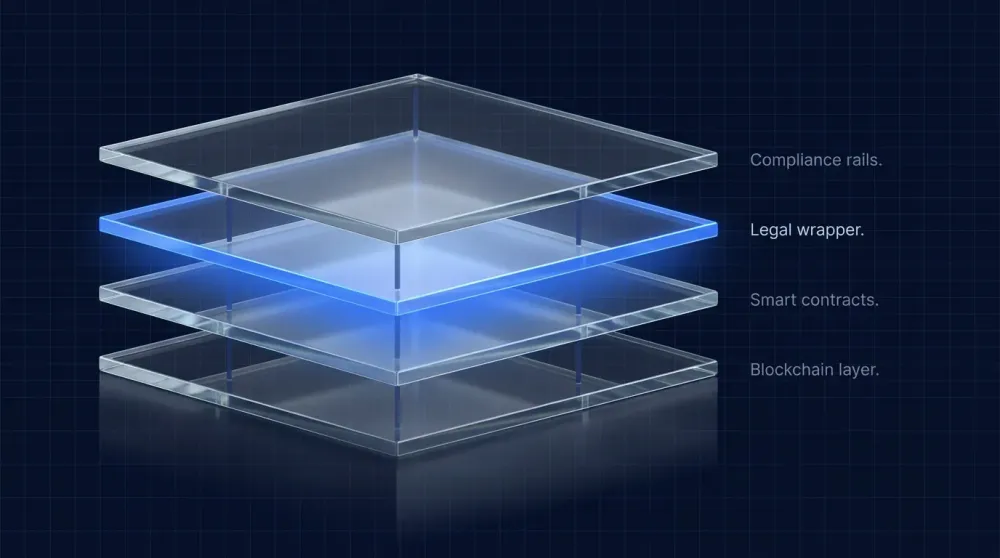
Four components make real estate tokenization work. Remove any one, and the model breaks.
The blockchain layer
Tokens are recorded and transferred on a blockchain around the clock, without waiting on a title company or a bank's settlement window. Some issuers use general-purpose Layer 1 and Layer 2 networks. Others build purpose-fit infrastructure for real-world assets, aiming to embed compliance and asset servicing into the base layer instead of bolting it on afterwards. That matters when the tokens represent regulated property.
Smart contracts
Smart contracts are self-executing code that handle the operational logic: minting tokens, enforcing transfer rules, checking compliance whitelists, and distributing rental income on schedule. When a tenant's rent clears, and costs are deducted, a distribution contract can allocate the net amount across every token holder automatically. That removes the manual reconciliation a large holder base would otherwise require.
The legal wrapper (SPV)
The SPV isolates the asset and its risk. The property sits inside its own entity, so the building's liabilities don't reach the issuer's other holdings, and token holders' claims flow cleanly through the vehicle. This is standard practice in traditional real estate finance, and tokenization borrows it directly because it works.
Compliance rails (KYC/AML + token standards)
Most property tokens are treated as securities, so they can't circulate like an anonymous, permissionless coin. Permissioned token standards govern who is allowed to hold or receive them.
ERC-3643, also known as the T-REX standard, is the leading example. It ties transfers to on-chain identity (ONCHAINID) and embeds KYC/AML and eligibility checks directly in the contract, so a transfer to a non-whitelisted wallet fails by design. ERC-3643 reached "Final" status as an Ethereum standard on 15 December 2023 (ERC-3643 Association, EIP-3643).
ERC-1400 is a related security-token framework, and ERC-1404 adds simpler transfer restrictions. These standards are what separate a compliant offering from a regulatory problem.
How Real Estate Tokenization Works: The 6-Step Process
Here is the full pipeline. The running example, a $10 million property divided into 1,000,000 tokens at $10 each, applies throughout. These are the real estate tokenization steps that turn a building into on-chain shares.
Step 1: Property selection & due diligence
It starts with the asset. A sponsor identifies a property and runs legal and financial assessment: independent valuation, title search, cash-flow analysis, and a jurisdiction and compliance review. Income-producing assets with stable tenancy are usually preferred, because reliable rent supports demand for the tokens.
The main risks at this stage are overvaluation, such as a $10M price on an $8M building, undisclosed title defects, or cash flow too weak to support the marketed distributions. A credible platform publishes the valuation and lease data instead of relying on a headline figure.
Step 2: Legal structuring (SPV + rights definition)
The sponsor then sets up the SPV that will hold the property and defines what token holders actually get, including distributions, governance, and exit terms. This stage also determines whether the token counts as a security in each relevant country, which governs who can participate and how it can be marketed. Weak structuring here is a common source of regulatory trouble later.
Step 3: Choose blockchain & write smart contracts
With the structure set, the team picks the chain and the issuance and transfer rails, then encodes ownership, transfer restrictions, and payout logic in smart contracts. Reputable issuers put those contracts through independent security audits before deployment.
Step 4: Token creation & issuance (the offering)
The tokens are minted to a standard such as ERC-3643 or ERC-1400, each mapped to a defined share of the asset. The worked example is simple: $10,000,000 divided by 1,000,000 tokens equals $10 per token, with each token representing one-millionth of the building and its net rent.
Mey Network is an RWA tokenization ecosystem that converts verified real estate into onchain Property Token Offerings (PTOs), giving participants borderless, transparent access to real estate through MeyFi's staking, lending, and marketplace tools. This stage maps directly to that PTO model, Mey Network's standard for converting a verified property into assignable on-chain participation units.
Step 5: Participant onboarding & distribution (KYC + whitelisting)
Before anyone can hold a compliant token, they complete KYC/AML verification, and the associated wallet is whitelisted.
Tokens are then acquired through the primary offering. The main advantage becomes clear at this point. Instead of a six-figure down payment, the entry point can run from a few dollars to a few hundred, which is the foundation of fractional real estate access.
Step 6: Ongoing management, rent distribution & secondary transfers
Once tokens are held, the property keeps operating. Professional managers handle tenancy, maintenance, and physical-asset compliance, while smart contracts distribute net rental income, often in stablecoins such as USDC or USDT, on a monthly or quarterly schedule. Holders stay passive. The code and the property managers do the work.
Secondary transfers complete the model. Subject to compliance checks, tokens can move around the clock and across borders, unlike the multi-week closing process of a traditional property sale.
Two Views of the Same Process: Issuer vs. Participant
The six steps look different depending on where you stand. Seeing both makes the full real estate tokenization process clear.
The issuer's path (build the offering)
Sourcing, SPV setup, smart contracts, token issuance, and ongoing reporting. The issuer's job is to package a real asset into a compliant, well-documented offering and then service it: collect rent, deduct costs, execute distributions, and keep auditable records.
The participant's path (access and receive distributions)
Find an offering, complete KYC, acquire tokens, receive distributions, then decide whether to hold or transfer. The obligations are lighter: check the asset and the platform, get whitelisted, hold, and collect.
Mapped side by side, each issuer action has a matching participant action. Token minting in Step 4 corresponds to acquisition in Step 5. A distribution in Step 6 corresponds to receiving rental income. The design puts the operational burden on the issuer and the code rather than on the participant.
Tokenization vs. REITs vs. Direct Ownership
Seven factors separate the three routes.
Minimum to start. Tokenized real estate, a few dollars to a few hundred. REIT, the price of one share, often under $1 fractionally. Direct ownership, a large down payment.
Liquidity. Tokenized real estate, improving, with around-the-clock transfers, compliance-gated, but markets are thin. REIT, high for public REITs. Direct ownership, low, taking weeks to months to sell.
Control. Tokenized real estate, asset-specific, with some governance rights. REIT, none over specific assets. Direct ownership, full.
Distribution frequency. Tokenized real estate, monthly or quarterly. REIT, quarterly dividends typically. Direct ownership, monthly rent, after expenses.
Fees. Tokenized real estate, platform and management fees. REIT, fund management fees. Direct ownership, transaction, management, and maintenance costs.
Global access. Tokenized real estate, borderless, subject to eligibility. REIT, often domestic brokerage. Direct ownership, local and jurisdiction-bound.
Transparency. Tokenized real estate, on-chain, auditable records. REIT, periodic disclosures. Direct ownership, private.
Each model suits a different goal. A REIT works for diversified, liquid exposure with no preference for specific buildings. Direct ownership works for people with capital who want control and are willing to manage. Real estate tokenization works for asset-specific exposure at a low entry point, with on-chain distributions and none of the day-to-day management.
Benefits of Real Estate Tokenization
Each benefit maps to a step above.
- Fractional access and low minimums, from Steps 4 and 5, where a $10M building becomes $10 tokens.
- Improved liquidity, from the secondary transfers in Step 6, relative to selling a whole property.
- Automated, transparent payouts, as the smart contracts from Step 3 distribute rent on schedule, on-chain, and auditable.
- Global reach, through compliant cross-border participation rather than a single local market.
- Faster settlement, as on-chain transfers clear in minutes rather than the weeks a traditional closing takes.
- Auditable records, since every holding and distribution is verifiable on the blockchain.
Risks & Limitations to Understand
Any accurate account of how real estate tokenization works has to cover the constraints.
Regulatory uncertainty. Securities classification varies by country and keeps changing. The Ripple and BCG report points to regulatory clarity in the EU, UAE, and Switzerland as a growth driver, which also means the rules elsewhere are still moving.
Liquidity is improved, not assured. Secondary markets can be thin, and a willing buyer at your preferred price is not guaranteed, particularly for niche assets. The $202.6 million currently tracked across all tokenized real estate (RWA.xyz) shows how young this market still is.
Smart-contract and custody risk. Code can contain defects, and keys can be mismanaged. Audits reduce this risk without removing it.
Valuation and oracle reliability. A token is only as sound as the off-chain valuation behind it, and enforcing rights against a physical asset still depends on courts and contracts.
Tax treatment. The IRS treats digital assets as property, and income derived from them is taxable (IRS, Digital Assets). Cross-border holdings add complexity.
Serious platforms reduce these exposures through independent audits, licensed and clearly disclosed legal structures, permissioned standards such as ERC-3643, custodial oversight, and conservative documentation.
How to Get Started with Tokenized Real Estate
The path from evaluation to holding is short.
- Pick a compliant platform with audited contracts and clearly disclosed legal structures.
- Complete KYC and wallet whitelisting.
- Fund the wallet, typically with a stablecoin.
- Review the specific offering, including SPV documentation, valuation, distribution history, and fees.
- Acquire the tokens.
- Track distributions and decide whether to hold, reinvest, or stake through a platform such as MeyFi for an additional layer.
That last step is where understanding how to tokenize real estate turns into holding it. Mey Network's Property Token Offerings and MeyFi are one route from analysis to on-chain participation.
FAQs
What is real estate tokenization in simple terms?
It converts property ownership into digital tokens on a blockchain. Each token represents a fractional share of the building's value and income, held through a legal entity called an SPV. Participants access a slice rather than the whole property, and rental income can be distributed automatically on-chain.
How does real estate tokenization actually work, step by step?
A sponsor selects a property, sets up an SPV to hold it, deploys audited smart contracts, mints compliant tokens mapped to shares, onboards participants through KYC and whitelisting, then distributes net rent on-chain and enables secondary transfers. Six steps carry a building from title to transferable token.
Do token holders legally own the underlying property?
Holders usually have an economic interest through the SPV that owns the asset rather than title directly. The token represents a claim on that entity's value and income. How strong that claim is depends on the legal structure, so read the offering documents carefully before participating.
What's the difference between tokenized real estate and a REIT?
A REIT is a traditional, professionally managed portfolio accessed through a brokerage. Tokenized real estate is usually one specific property, held on-chain, with lower minimums, potential secondary-market transfers and transparent automated distributions. Tokenization offers asset-level selection. REITs offer diversified, hands-off exposure with far better liquidity.
Is real estate tokenization legal and regulated?
In most countries, property tokens are treated as securities and must follow securities and KYC/AML rules, which standards such as ERC-3643 enforce on-chain. Regulatory clarity is furthest along in regions including the EU, UAE, and Switzerland, and is still developing elsewhere, so compliance varies by jurisdiction.
How much capital do you need to begin?
Far less than traditional real estate. Entry points commonly run from a few dollars to a few hundred, and Mey Network's Chuong My offering is structured at 50 USDC per token. The exact minimum depends on the platform and the specific offering you are looking at.
Can real estate tokens be sold at any time?
Not always instantly. Compliant tokens transfer on secondary markets subject to KYC checks, and liquidity depends on how many active participants a given asset has. Tokenization improves liquidity compared with selling a whole building, though thin markets can still delay an exit.
How is rental income paid to token holders?
Smart contracts calculate each holder's share of net rental income and distribute it automatically, generally in stablecoins such as USDC or USDT, on a monthly or quarterly schedule. No invoicing or tenant management is involved; and the distribution is allocated in proportion to tokens held.
