

The RWA (real-world asset) tokenization ecosystem has exploded past $24.8B in on-chain value locked as of early 2026, and the options available to participants have grown just as fast. Fractional real estate, tokenized Treasuries, private credit pools, DeFi collateral plays. Each carries a different risk profile, distribution expectation, and entry barrier. Choosing the wrong strategy for your goals is not just a missed opportunity. It can expose you to risks you never anticipated. This article breaks down the top RWA Investment strategies for both retail and institutional participants, compares them side by side, and gives you a clear framework for deciding which approach fits your portfolio.
Key Takeaways
- Understand tokenization essentials — Grasping legal, technical, and distribution-layer basics is key before joining any RWA strategy.
- Diverse strategies for all participants — Both retail and institutions can benefit from options like tokenized real estate and Treasuries, depending on scale and goals.
- Risk management is critical — Awareness of custodial, legal, and distribution-layer risks helps protect your portfolio from edge-case failures.
- Ecosystem growth presents an opportunity — RWA sector growth is accelerating, offering early adopters unique distributions and diversification potential.
- Future-proof through distribution-layer focus — Sustainable success depends on robust ecosystem structures and distribution-venue depth, not just compliance.
Understanding RWA tokenization: foundation for smart Investment
Before you evaluate any strategy, you need to understand what you're actually acquiring. RWA tokenization converts ownership rights in physical or financial assets like real estate into blockchain units, using legal wrappers such as SPVs (special purpose vehicles) or trusts, custody arrangements, smart contracts, and on-chain issuance. The result is fractional interests and dramatically deeper distribution-layer activity compared to traditional ecosystems.
An SPV is a separate legal entity created specifically to hold an asset, isolating it from the issuer's other liabilities. This structure, often called bankruptcy-remote, protects participants if the issuing company fails. Understanding this legal layer is not optional. It is the foundation of any credible RWA position.
Tokenization mechanics enable 24/7 transfer activity and programmability, but success hinges on robust off-chain links. Prioritize bankruptcy-remote SPVs for real estate.
The tokenized RWA mechanics that matter most include how the asset is, how oracle feeds are maintained, and how redemption works when you want to exit.
Here are the core asset classes being tokenized today:
Real estate: residential and commercial properties, fractional interests via property units.
Government securities: tokenized U.S. Treasuries and sovereign debt instruments.
Commodities: gold, silver, and energy assets represented on-chain.
Private credit: loans to businesses or individuals, pooled and tokenized for distributions.
- Real estate
- tokenization method: SPV + property unit
- Main benefit: Fractional interest, rental rate
- Treasuries
- tokenization method: Trust or fund wrapper
- Main benefit: Stable distribution rate, low risk
- Commodities
- tokenization method: Custodied backing + unit
- Main benefit: Inflation hedge, distribution-layer activity
- Private credit
- tokenization method: Pool smart contract
- Main benefit: High distribution rate, diversification
These basics matter because every strategy you'll evaluate below is built on this infrastructure. If the infrastructure is weak, the strategy collapses regardless of the distribution rate advertised.
Top strategies for retail RWA participants: distributions, access, and diversification
Once you understand the fundamentals, here are the top RWA strategies available to everyday participants. The good news is that entry barriers have dropped significantly. Some platforms now allow you to start with as little as $100, making these strategies genuinely accessible.
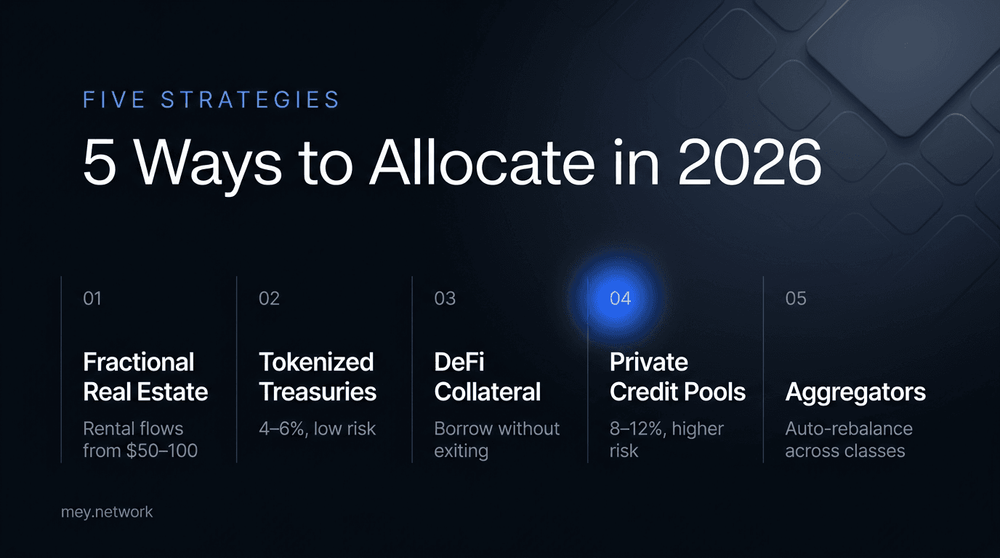
Retail Investment strategies span three main approaches: fractional real estate interests (platforms like RealT), tokenized government bonds (BlackRock BUIDL, Ondo OUSG), and using RWA units as DeFi collateral to borrow against your holdings without exiting them.
Here is a breakdown of each:
Fractional real estate (e.g., RealT): acquire units representing a share of a rental property. Receive proportional rental flows. Entry from ~$50-$100. Pros: distribution flows, tangible assets. Cons: limited distribution-venue depth on some platforms, property-specific risk.
Tokenized Treasuries (BlackRock BUIDL, Ondo OUSG): distribution rates typically range from 4 to 6% annually, backed by U.S. government debt. Pros: low risk, stable distribution rate, institutional-grade backing. Cons: requires KYC/AML verification, some platforms restrict retail access.
DeFi collateral strategies: deposit RWA units into lending protocols to borrow stablecoins. Pros: capital efficiency, no need to exit your position. Cons: liquidation risk if collateral value drops, smart-contract exposure.
Demand for tokenized real estate from retail participants has surged in 2026, with wallet counts across major RWA platforms crossing 400,000 globally.
Pro tip: evaluate platform reputation, legal clarity, and distribution-venue depth before committing. A 12% distribution rate means nothing if you cannot exit your position when you need to.
Institutional strategies: efficiency, distribution optimization, and aggregators
Retail offerings are just part of the landscape. Institutions take a different approach, optimizing for scale, security, and distributions. The minimum thresholds are higher, but so are the tools available for risk management.
Institutional strategies center on three main plays: large allocations to tokenized Treasuries for stable, compliant distribution rates; Investment in private credit pools targeting 8 to 12% annual rates; and using aggregators like Ondo Finance to rebalance across asset classes and manage risk-distribution dynamics actively.
Here is a comparison of the leading institutional approaches:
- tokenized Treasuries
- Expected distribution rate: 4-6%
- Risk level: Low
- Min. entry: $100K+
- Lock-up period: None to 30 days
- Private credit pools
- Expected distribution rate: 8-12%
- Risk level: Medium-high
- Min. entry: $250K+
- Lock-up period: 90-180 days
- RWA aggregators
- Expected distribution rate: 5-9% blended
- Risk level: Medium
- Min. entry: $50K+
- Lock-up period: Varies
- tokenized real estate
- Expected distribution rate: 6-10%
- Risk level: Medium
- Min. entry: $10K+
- Lock-up period: 6-24 months
Key benefits for institutions include access to entirely new asset pools, programmable compliance (automated KYC/AML checks baked into units), and 24/7 settlement that eliminates traditional clearing delays.
Unique risks to watch:
Regulatory reclassification: an asset deemed a security post-allocation triggers compliance obligations.
Distribution-layer gaps: private credit pools may freeze redemptions during ecosystem stress.
Operational overhead: managing multiple platforms and legal jurisdictions adds complexity.
Pro tip: aggregators can help institutions rebalance and optimize distributions across asset classes while mitigating some operational overhead. Think of them as automated portfolio managers purpose-built for the RWA ecosystem.
Risk factors and edge cases: what every participant should know
The best strategies require not only high distribution rates but also robust risk management. The RWA space carries risks that are genuinely different from traditional finance, and some of them are not obvious until something goes wrong.
Here are the five most critical RWA risks every participant should evaluate:
Custodial risk: if the entity holding the physical asset fails, unit holders may face lengthy legal battles to recover value. Example: a tokenized gold platform that went insolvent left participants waiting months for redemption.
Smart-contract bugs: code vulnerabilities can be exploited, draining pools instantly. Example: multiple DeFi protocols lost tens of millions in 2024 due to unaudited contract upgrades.
Regulatory reclassification: regulators may decide a unit qualifies as a security, forcing platforms to delist or restrict transfers. This happened to several platforms in the U.S. under earlier SEC guidance.
Oracle discrepancies: price feeds connecting real-world valuations to on-chain data can lag by 1 to 3%, creating windows of mispricing during volatile conditions.
Counterparty defaults: private credit pools like those on Goldfinch have experienced borrower defaults, reducing distributions or causing principal losses for lenders.
Compliance is table stakes, not moat. Distribution-venue depth is the real endgame.
Mitigation steps are straightforward but require discipline: diversify across providers and asset classes, prioritize platforms with clear legal structures, and actively track distribution-venue depth rather than assuming it exists.
Ecosystem growth, benchmarks, and how to build a balanced strategy
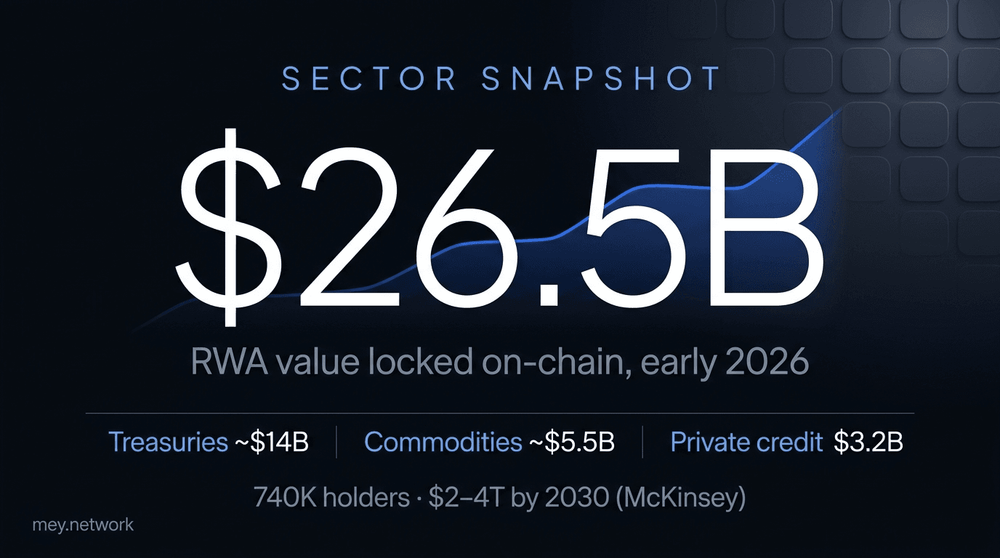
On-chain RWA TVL grew to $24.83B by February 2026 and crossed $26.48B by late March 2026. Tokenized U.S. Treasuries alone account for roughly $14B, tokenized commodities for about $5.5B (driven mostly by gold-backed tokens like XAUT and PAXG), and on-chain private credit for $3.2B. Holder counts have climbed past 740,000 as of early May 2026. Looking ahead, McKinsey projects $2–4 trillion in tokenized value by 2030 in its base and bull cases, though forecasts from BCG and others run substantially higher.
- Total on-chain RWA TVL — $26.48B (March 23, 2026)
- Tokenized U.S. Treasuries — ~$14B
- Tokenized commodities — ~$5.5B
- On-chain private credit — $3.2B
- Holders (active addresses) — 740,000+
- 2030 projection (McKinsey) — $2–4T
Building a balanced RWA portfolio requires a clear process. Here is a practical framework:
Step 1: Define your risk tolerance. Are you prioritizing capital preservation, distribution flows, or growth?
Step 2: Choose asset classes that match. Low risk: Treasuries. Medium: tokenized real estate. Higher: private credit.
Step 3: Check RWA distribution data and platform compliance status before allocating.
Step 4: Diversify across at least two to three asset classes and platforms to reduce single-point-of-failure risk.
Step 5: Set a review schedule. Regulations and ecosystem conditions in this space shift fast. Quarterly reviews are a minimum.
The participants who outperform in this space are not necessarily the ones chasing the highest distribution rates. They are the ones who build structured, diversified positions and stay informed as the regulatory landscape evolves.
Our perspective: what most miss about RWA strategy and future-proofing your portfolio
Most participants entering the RWA space fixate on two things: distribution percentages and regulatory headlines. Both matter, but neither tells you whether a platform will still be operating in three years. The real differentiator is something far less glamorous: distribution-venue depth and legal-structure resilience.
Platforms with robust venue makers, active incentive programs for distribution providers, and bankruptcy-remote SPVs are positioned for long-term outperformance. The ones that survive ecosystem cycles are those that treat distribution-layer depth as a core product feature rather than an afterthought.
Here is the uncomfortable truth: compliance is the price of admission, not a competitive advantage. Every serious platform will eventually meet regulatory requirements. What separates winners from losers is whether you can actually transfer your position when you need to.
Pro tip: use multi-agent AI tools or aggregator research platforms to assess ecosystem momentum and rapid risk shifts across RWA protocols. The space moves too fast for manual tracking alone.
Sustainable distribution rates, built on real cash flows from real assets, will outlast high-volatility DeFi incentives. Prioritize platforms that can demonstrate consistent, asset-backed distributions over those chasing attention with inflated APYs.
Explore RWA strategies with Mey Network
Ready to take the next step in your RWA Investment journey? Mey Network is built specifically for participants who want to move beyond theory and into real, tokenized asset positions. The platform offers fractional real estate units (PTOs), staking through MeyFi, and DeFi collateralization tools designed for both retail and institutional participants.
Join the platform today to stay ahead of emerging opportunities in the tokenized real estate ecosystem and the broader RWA super cycle.
Frequently asked questions
What are real-world asset (RWA) units?
RWA units are digital representations of ownership rights in physical or financial assets like real estate or bonds, issued on a blockchain for accessibility and distribution-layer depth.
How can retail participants access RWA Investment strategies?
Retail participants can acquire fractional real estate units, allocate to tokenized Treasuries, or use DeFi platforms to access distributions with relatively low minimums, sometimes starting at $100.
What are the main risks of RWA Investment?
Key RWA risks include custodial failures, regulatory reclassification, smart-contract bugs, illiquid distribution venues, and counterparty defaults that can affect asset redemption or distributions.
What are current ecosystem trends in RWA Investment?
The RWA space is growing rapidly, with over $24.8B locked on-chain by early 2026 and projections to reach $2 to 4 trillion by 2030.
How important is regulatory compliance for RWA positions?
Compliance is essential, but distribution-venue depth and robust legal safeguards are equally crucial for long-term success.
