

Institutional participants face a persistent challenge: accessing diversified, high-quality real estate portfolios while maintaining liquidity and flexibility.
Traditional property participation locks capital for years, limiting opportunities to rebalance or exit positions quickly. Tokenized real estate is transforming this landscape by enabling fractional interests through blockchain technology, allowing institutions to transfer property-backed digital units 24/7. This innovation opens doors to global portfolios, deeper distribution-layer activity, and granular exposure previously unavailable in conventional ecosystems.
In this article, you'll discover the essential criteria for evaluating institutional moves in tokenized real estate, explore leading institutional projects reshaping the sector, and learn how to select strategies aligned with your participation goals.
Key Takeaways
- Distribution layer through tokenization — Tokenized real estate enables fractional interests and 24/7 distribution-layer activity on digital platforms, expanding access beyond traditional property participation.
- Regulatory SPV framework — Platforms typically structure ownership through Special Purpose Vehicles and register securities under Regulation D or Regulation S to clarify eligibility for institutional participants.
- Governance matters — Governance models affect decision speed, risk exposure, and alignment with institutional processes.
- Tech reliability and security — Smart contracts require audited code, robust security measures, and reliable custody to prevent asset loss or misdirection of funds.
Criteria for institutional participation in tokenized real estate
Before committing capital to institutional moves in tokenized real estate, you need a rigorous framework for evaluating opportunities. The ecosystem potential is substantial: Deloitte predicts a $4T tokenized real estate ecosystem by 2035 with significant institutional participation. This projection reflects growing confidence in blockchain's ability to solve long-standing distribution-layer problems in property allocation.
Regulatory compliance forms the foundation of any credible tokenized real estate offering. Platforms must implement robust KYC and AML procedures to verify participant identities and prevent illicit activity.
Most institutional projects structure ownership through Special Purpose Vehicles that hold physical properties and issue units representing fractional interests. These SPVs typically register securities under Regulation D or Regulation S frameworks, ensuring legal clarity for qualified institutional participants. Without a proper regulatory structure, units' risk classification changes could restrict transfers or trigger compliance violations.
Distribution-layer depth represents tokenization's core value proposition but varies dramatically across platforms. Units enable 24/7 transfer activity on digital venues, theoretically allowing you to exit positions instantly rather than waiting months for traditional property transfers. However, distribution-venue depth remains inconsistent. Some platforms maintain active venue makers to ensure continuous distribution-layer activity, while others rely on organic counterparty matching that can leave you waiting for buyers during stress periods.
Governance structures directly impact operational efficiency and risk exposure. Centralized management models assign property decisions to professional teams, simplifying tokenization but concentrating control. Decentralized governance distributes voting rights to unit holders, opening decisions but introducing tokenization costs and potential conflicts among diverse stakeholders. You must assess whether governance mechanisms align with your institution's operational preferences and risk appetite.
Technological reliability cannot be overlooked. Smart contracts automate rent distribution, voting, and transfers, but bugs or oracle failures can freeze assets or misdirect funds. Prioritize platforms with audited code, insurance coverage, and proven operating records. Security measures, including multi-signature wallets and institutional-grade custody solutions, protect your units from theft or loss.
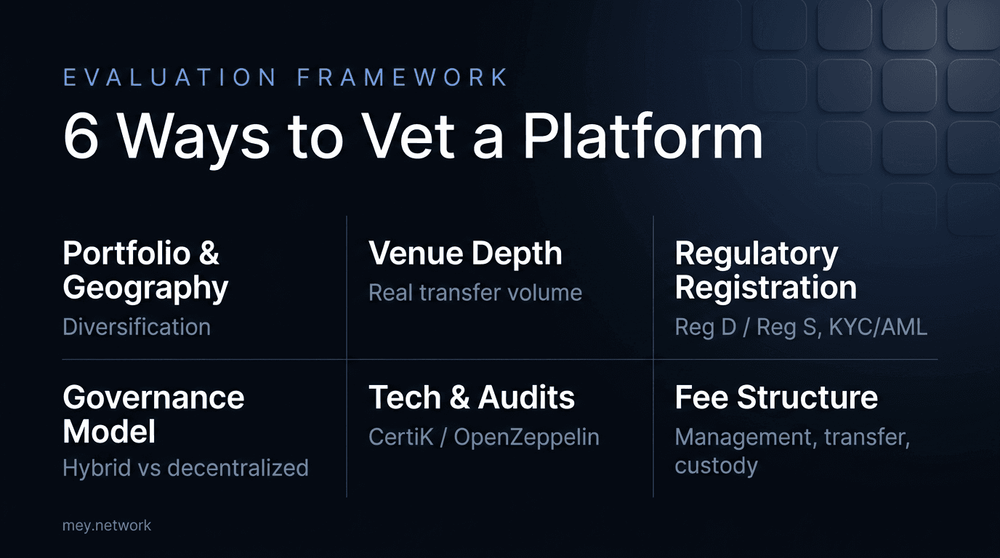
Key evaluation factors include:
Portfolio composition and geographic diversification.
Unit distribution-layer metrics and venue activity.
Regulatory registration status and compliance infrastructure.
Governance model and decision-making processes.
Technology stack security and audit history.
Fee structures covering management, transfer, and custody.
Pro tip: Request detailed audit reports and security assessments before committing capital. Platforms unwilling to share this documentation may lack institutional-grade safeguards.
With these criteria established, examining real institutional projects illustrates how leading players apply these principles in practice.
Leading institutional moves in tokenized real estate
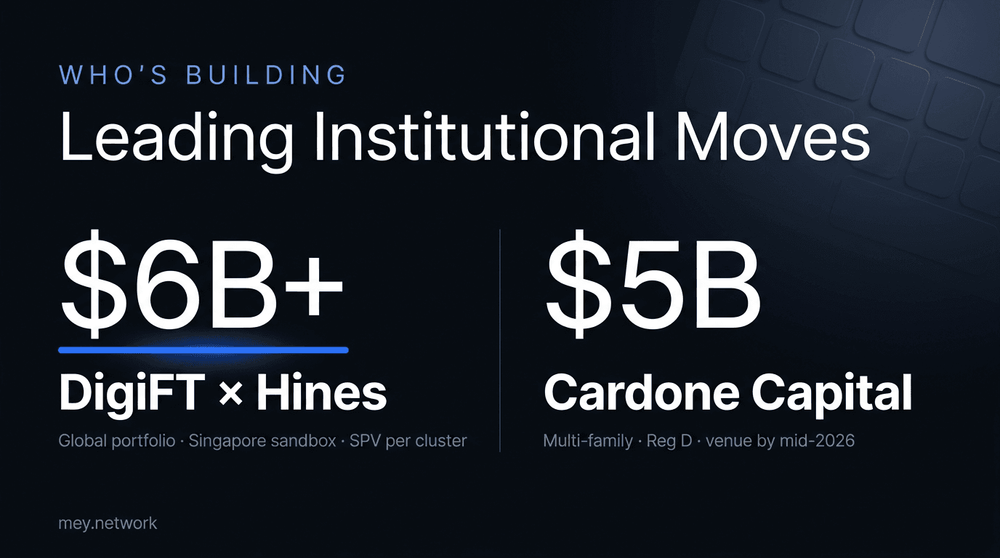
These institutional moves in tokenized real estate demonstrate the sector's institutional viability and reveal how major players structure their offerings. DigiFT and Hines collaborated to provide tokenized access to a $6B+ global real estate portfolio for institutional participants. This partnership combines Hines' property management expertise with DigiFT's blockchain infrastructure, creating a regulated platform where qualified participants can acquire fractional interests in premium commercial and residential assets across multiple continents. The structure uses SPVs for each property cluster, issuing units that represent ownership stakes and entitle holders to proportional rental flows.
Cardone Capital pushes scale even further. The firm plans to coordinate a $5B portfolio targeting distribution-venue launch by mid-2026. This ambitious project focuses on multi-family residential properties, offering participants exposure to cash-flowing apartment complexes without minimum thresholds typical of traditional syndications. Cardone's approach emphasizes retail and institutional accessibility, with plans for a dedicated distribution venue to deepen circulation. The platform registers offerings under Regulation D, limiting participation to accredited participants but streamlining compliance.
Both initiatives prioritize regulatory frameworks to ensure participant protection and legal clarity. DigiFT operates under Singapore's regulatory sandbox, while Cardone Capital adheres to U.S. securities laws. These compliance measures build confidence among institutional allocators who require clear legal standing for portfolio holdings.
Tokenization enables granular single-property exposure that competes favorably with traditional REIT distributions while offering more control. Instead of acquiring shares in a diversified REIT with hundreds of properties, you can select specific buildings or portfolios matching your participation thesis. This precision allows tactical allocation to high-growth ecosystems or property types without dilution from underperforming assets.
Distribution-layer challenges persist despite technological capabilities. While units can move instantly, finding counterparties at fair prices during ecosystem downturns remains difficult. Platforms innovate by partnering with venue makers, creating redemption mechanisms, or establishing minimum distribution pools. However, distribution-venue depth typically lags traditional REIT activity, requiring you to plan holding periods accordingly.
Notable platform features include:
Automated rent distribution via smart contracts.
Real-time portfolio performance dashboards.
Fractional interests starting at $500 to $5,000 minimums.
Staking mechanisms for additional distribution generation.
Integration with DeFi protocols for collateralized lending.
Pro tip: evaluate distribution-venue volumes and bid-ask spreads before allocating. Platforms with thin distribution-layer activity may force you to accept steep discounts when exiting positions.
Understanding these institutional moves in tokenized real estate provides context for comparing options and identifying which structures best serve your institution's needs.
Comparing institutional moves in tokenized real estate: a side-by-side analysis
Directly comparing tokenized real estate platforms reveals critical differences in structure, risk, and potential distributions. The following table summarizes key factors across major institutional offerings:
- Portfolio size
- DigiFT/Hines: $6B+ global assets
- Cardone Capital: $5B multi-family
- Traditional REITs: Varies widely
- Regulatory status
- DigiFT/Hines: Singapore sandbox
- Cardone Capital: Regulation D
- Traditional REITs: SEC registered
- Distribution-layer depth
- DigiFT/Hines: 24/7 activity, moderate depth
- Cardone Capital: Planned venue by mid-2026
- Traditional REITs: High, daily activity
- Minimum entry
- DigiFT/Hines: $5,000 to $10,000
- Cardone Capital: $500 to $5,000
- Traditional REITs: Single share price
- Governance
- DigiFT/Hines: Centralized management
- Cardone Capital: Centralized management
- Traditional REITs: Board oversight
- Technology
- DigiFT/Hines: Audited smart contracts
- Cardone Capital: Blockchain-based
- Traditional REITs: Traditional systems
- Geographic focus
- DigiFT/Hines: Global diversification
- Cardone Capital: U.S. residential
- Traditional REITs: Varies by REIT
- Distribution
- DigiFT/Hines: Automated quarterly
- Cardone Capital: Automated monthly
- Traditional REITs: Quarterly dividends
Tokenized real estate units deliver competitive distributions versus REITs with 24/7 transfer activity and granular exposure. Research indicates tokenized offerings can match or exceed REIT distribution rates while providing superior flexibility. You gain the ability to enter and exit positions outside traditional venue hours, responding quickly to portfolio rebalancing needs or ecosystem opportunities. This operational advantage matters most during volatile periods when immediate distribution-layer access prevents forced holding of depreciating assets.
Operational complexity varies significantly across platforms. DigiFT's global portfolio requires navigating multiple jurisdictions, currency exposures, and regulatory environments. This complexity introduces tokenization costs but delivers diversification benefits. Cardone Capital's U.S.-focused approach simplifies legal and operational management while concentrating geographic risk. Traditional REITs offer the simplest operational model with established management teams and transparent governance, but sacrifice the customization and direct property selection tokenization enables.
Governance differences impact your control and influence. tokenized platforms typically grant voting rights proportional to unit holdings, allowing you to participate in major decisions like property transfers or capital improvements. However, tokenization among dispersed unit holders can prove challenging, potentially delaying critical actions. REITs concentrate governance in professional boards, streamlining decisions but limiting individual participant influence.
Key advantages of tokenized options include:
Lower minimums enabling portfolio diversification.
Instant settlement and 24/7 transfer capabilities.
Direct property selection matching participation thesis.
Transparent blockchain-recorded ownership and transactions.
Potential for DeFi integration and additional distribution strategies.
Significant risks and limitations include:
Regulatory uncertainty potentially affecting unit classification.
Smart-contract vulnerabilities or oracle failures.
Limited distribution-venue depth during stress periods.
Operational complexity in multi-jurisdictional portfolios.
Governance tokenization challenges among unit holders.
Balancing these factors requires an honest assessment of your institution's capabilities and priorities. Platforms offering superior distribution-layer activity may charge higher fees or accept narrower property selection. Those with lower costs might impose longer lock-up periods or limited redemption rights.
Selecting the right tokenized real estate move for your institution
Choosing the optimal tokenized real estate strategy demands alignment between platform characteristics and your institutional objectives. Follow this systematic approach to evaluate options:
Define your participation goals precisely. Are you seeking stable distribution flows, value progression, portfolio diversification, or distribution-layer management? Distribution-focused strategies favor platforms with established properties generating consistent cash flow. Growth-oriented approaches might target emerging ecosystems or development projects with higher risk-distribution profiles.
Assess your distribution-layer requirements realistically. If you need the ability to exit positions within days, prioritize platforms with active distribution venues and venue-making support. Institutions comfortable with 6 to 12 month holding periods can access opportunities with higher distribution rates but less fluid transfer activity.
Evaluate your governance preferences and operational capacity. Centralized management models reduce tokenization burdens but limit control. If your institution values active participation in property decisions, seek platforms with robust voting mechanisms and responsive governance structures. Consider whether your team has the bandwidth to engage in frequent governance activities or prefers passive ownership.
Examine technology infrastructure and security measures thoroughly. Request smart-contract audit reports from reputable firms like CertiK or OpenZeppelin. Verify custody solutions meet institutional standards with multi-signature requirements and insurance coverage. Platforms should demonstrate disaster recovery plans and incident response protocols.
Understand risk factors comprehensively. Regulatory developments could reclassify units, affecting distribution-layer activity or tax treatment. Smart-contract bugs might freeze assets temporarily or permanently. Distribution-venue depth can evaporate during crises, forcing you to hold positions longer than planned. Geographic concentration exposes you to localized economic downturns or natural disasters.
Plan for ongoing monitoring and operational engagement. Tokenized participations require active oversight of smart-contract performance, governance proposals, and platform health. Allocate resources for continuous due diligence rather than treating tokenized real estate as a passive holding.
Pro tip: start with a small allocation to test platform operations and distribution-layer depth before committing significant capital. This pilot approach reveals operational friction and governance effectiveness in practice.
Operational centralization remains necessary despite the fractionalization promise, creating governance risks. The idea that thousands of unit holders will effectively coordinate property management decisions is unrealistic in most cases (the fractionalization fallacy in real estate tokenization).
This expert perspective highlights a critical tension in tokenized real estate: the promise of opened ownership often clashes with practical management needs. Successful platforms balance decentralization ideals with operational efficiency, typically through hybrid governance models that reserve routine decisions for professional managers while granting unit holders authority over major strategic choices.
Due diligence on platform transparency and audit practices cannot be overstated. Request detailed financial statements for underlying properties, including occupancy, rental flows, operating expenses, and capital expenditure plans. Platforms unwilling to provide this documentation lack the transparency that institutional participants require. Verify that third-party auditors review both blockchain operations and physical property performance regularly.
Your institution's technological readiness also matters. Tokenized participations require digital wallets, private key management, and blockchain interaction capabilities. Assess whether your existing systems integrate smoothly with chosen platforms or whether significant infrastructure outlay is necessary. Some institutions partner with specialized custody providers to handle technical operations while maintaining ultimate control.
Explore tokenized real estate solutions with Mey.Network
Navigating institutional moves in tokenized real estate requires a platform designed specifically for institutional needs. MEY Network offers a comprehensive ecosystem that supports your journey. Our infrastructure combines regulatory compliance frameworks, audited smart contracts, and institutional-grade security to deliver the reliability you demand.
MEY Network’s platform addresses the governance and operational challenges highlighted throughout this analysis. Our hybrid governance model balances professional property management with unit holder oversight, ensuring efficient operations without sacrificing participant control.
Built-in compliance tools automate KYC and AML processes while maintaining detailed audit trails for regulatory reporting.
FAQ
What is tokenized real estate, and why is it important for institutions?
Tokenized real estate represents property ownership as digital units recorded on blockchain networks, enabling fractional interests and instant transferability. For institutions, this innovation solves long-standing distribution-layer problems in real estate participation while lowering minimum thresholds and enabling precise portfolio construction. Units can transfer 24/7 on digital venues, providing flexibility unavailable in traditional property ecosystems.
How do regulatory considerations affect tokenized real estate positions?
Most tokenized real estate offerings structure ownership through Special Purpose Vehicles that hold physical properties and issue units as securities under Regulation D or S frameworks. Platforms must implement mandatory KYC and AML processes to verify participant identities and prevent illicit activity. Regulatory classification affects transfer permissions, tax treatment, and distribution-layer options, making compliance infrastructure a critical evaluation factor.
What are the main risks and challenges institutional participants should be aware of?
Smart-contract vulnerabilities or oracle failures can disrupt unit functionality, potentially freezing assets or misdirecting payments. Distribution-venue depth often remains limited compared to traditional REITs, restricting exit options during ecosystem stress. Governance tokenization among dispersed unit holders introduces operational complexity and potential decision-making delays. Regulatory changes might reclassify units, affecting legal status and transfer permissions unexpectedly.
How can institutional participants choose the best tokenized real estate strategy?
Start by defining your institution's specific participation goals, distribution-layer requirements, and risk tolerance clearly. Evaluate platform compliance status, governance models, and technology security through detailed due diligence, including audit reports and financial statements. Prioritize platforms with transparent operations, proven operating records, and active distribution venues matching your needs. Consider starting with small pilot allocations to test operational efficiency before committing significant capital.
