


Holding a slice of a rental property in Miami or a commercial building in Dubai used to require hundreds of thousands of dollars and a team of lawyers. Today, real estate tokenization platforms have distributed millions in flows to participants who never set foot in the properties they hold.
Digital property NFTs and tokenized real estate are rewriting the rules of who gets to access real estate, how much they need to start, and how quickly they can move their capital. This guide breaks down the mechanics, the real numbers, and what savvy participants need to watch.
Key Takeaways
- NFTs redefine real estate — Digital property NFTs allow a fractional interest in real estate, making participation more accessible.
- Fungible units offer circulation — ERC-20/ERC-3643 units bring deeper distribution-layer activity and easier compliance compared to pure NFTs.
- Participant distributions and risks — Platforms deliver average distribution rates of 6-16%, but participants face distribution-layer and platform risks.
- Regulation evolving quickly — Regulatory changes are shaping the NFT property ecosystem, affecting compliance and participant protection.
- Platforms bridge the gap — Trusted platforms like Mey Network facilitate participant onboarding and fractional property access.
What are digital property NFTs?
A digital property NFT is a blockchain-based unit that represents ownership rights in a real-world property. Think of it as a digital deed, recorded on a public ledger, that proves your stake in a specific asset. Unlike a stock certificate locked in a brokerage, this unit lives in your crypto wallet and can be transferred, moved, or used as collateral in decentralized finance (DeFi) protocols.
The term NFT stands for non-fungible token, meaning each unit is unique and not interchangeable with another. This makes NFTs well-suited for representing a whole property, since no two properties are identical. Here is what makes digital property NFTs distinct:
Unique identification: each unit maps to a specific property with its own metadata, address, and legal documentation.
Blockchain transparency: ownership history and transaction records are publicly verifiable.
Programmable rights: smart contracts can automate rent distribution, voting rights, and re-transfer conditions.
Global accessibility: anyone with a crypto wallet can hold a digital property NFT, regardless of geography.
However, there is an important nuance. The ERC-721 standard that powers most NFTs is designed for uniqueness, not divisibility. A single NFT representing a $2 million building cannot be split into 10,000 pieces for smaller participants.
NFTs (ERC-721) suit unique whole-property representation but limit distribution-layer depth, since a single indivisible unit is harder to transfer than fungible shares.
This is exactly why most serious platforms layer fungible units (ERC-20 or ERC-3643) on top of or alongside NFTs, enabling fractional interests while keeping the NFT as the root legal anchor. Understanding this distinction is the foundation for everything that follows.
How digital property NFT fractionalization works
Fractionalization turns a single property into thousands of transferable units. The core mechanics involve legal structuring, unit minting, smart contracts, and ongoing platform oversight. Here is how the process unfolds step by step:
Property valuation: an independent appraiser values the property and produces documentation that anchors the unit price.
SPV formation: A Special Purpose Vehicle (SPV), a separate legal entity, takes title to the property. Participants hold shares in the SPV, not the physical building directly.
Unit minting: the platform mints fungible units representing fractional SPV shares. Each unit equals a defined percentage of ownership and distribution rights.
Smart-contract deployment: contracts govern rent distribution, buyout conditions, and governance votes automatically, with no intermediary needed.
Platform listing and circulation: units are listed on the platform's venue and sometimes on third-party platforms, where participants can acquire, transfer, or stake them.
Here is a quick comparison of the unit standards you will encounter:
- Divisibility
- ERC-721 (NFT): No
- ERC-20 / ERC-3643 (Fungible): Yes
- Distribution-layer depth
- ERC-721 (NFT): Low
- ERC-20 / ERC-3643 (Fungible): Higher
- Compliance layer
- ERC-721 (NFT): Limited
- ERC-20 / ERC-3643 (Fungible): Built-in (ERC-3643)
- Best use case
- ERC-721 (NFT): Whole-property anchor
- ERC-20 / ERC-3643 (Fungible): Fractional participant shares
- Transfer flexibility
- ERC-721 (NFT): Peer-to-peer only
- ERC-20 / ERC-3643 (Fungible): Venue-compatible
The tokenization process also requires KYC (Know Your Customer) verification for participants, ensuring regulatory compliance from the start.
Pro tip: if you are evaluating a platform, prioritize those using ERC-3643 security units over plain ERC-20. ERC-3643 has built-in compliance rules that restrict transfers to verified participants, reducing your regulatory exposure significantly.
The participant experience: platforms, distributions, and risks
Knowing the mechanics is one thing. Knowing what distributions actually look like is another. RealT tokenized 40+ properties, distributed over $29 million in rental flows, and reported average distribution rates between 6% and 16% annually. Those numbers are real, but they come with context.
The distribution range is wide because it depends on property type, location, occupancy, and how the platform structures fees. A single-family rental in Detroit will behave very differently from a commercial warehouse in a logistics hub.
Here is what participants commonly encounter on these platforms:
Distribution flows: rent is distributed weekly or monthly directly to your wallet via smart contract.
Distribution-venue access: You can transfer units before the property exits the SPV, but venue depth is thinner than traditional public ecosystems.
Governance rights: Some platforms let unit holders vote on property management decisions.
Staking options: certain ecosystems let you stake units for additional distributions.
The risks are real, too. Platform reliability is a major factor since a smart-contract bug or a platform shutdown can freeze your assets. Regulatory changes can affect unit legality in your jurisdiction overnight. And distribution-venue depth is still limited, with daily transfer volumes between 0.02% and 0.15% of total supply and bid-ask spreads of 3% to 8%.
Digital property NFTs vs. traditional real estate vehicles
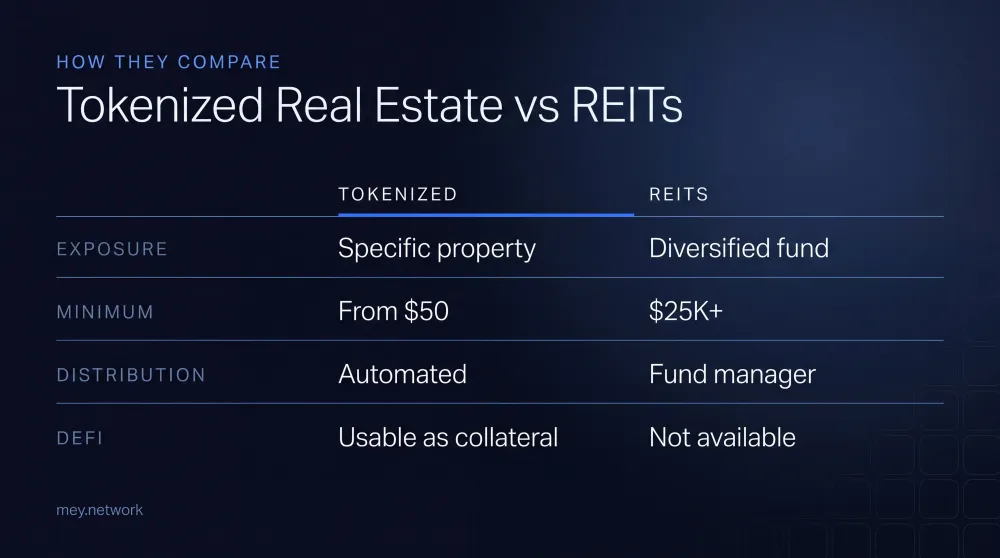
To understand the value of digital property NFTs, you need to compare them honestly against what already exists. REITs are the most common alternative, and they are genuinely good products. But the comparison reveals meaningful differences.
Key advantages of tokenized real estate over REITs:
Direct exposure: you hold a fraction of a specific property, not a diversified fund you cannot inspect.
Lower minimums: entry at $50 to $100 versus $25,000 or more for many private real estate funds.
Programmable distribution: smart contracts distribute flows automatically, with no fund manager taking a cut.
DeFi integration: units can be used as collateral for loans in DeFi protocols, deepening distribution-layer depth without exiting your position.
- Min. entry
- Digital property NFTs: $50-$100
- REITs: $500-$25,000+
- Ownership type
- Digital property NFTs: Direct fractional
- REITs: Pooled fund shares
- Distribution-layer depth
- Digital property NFTs: Limited venue activity
- REITs: High (publicly listed)
- Transaction cost
- Digital property NFTs: 1.5-2.5%
- REITs: 3-5% (traditional)
- Geographic access
- Digital property NFTs: Global
- REITs: Mostly domestic
- Transparency
- Digital property NFTs: On-chain, real-time
- REITs: Quarterly reports
Pro tip: watch regulatory developments in your jurisdiction closely. The SEC's stance on security units and the EU's MiCA framework are both evolving in 2026, and compliance wrappers like ERC-3643 will matter more as enforcement increases.
Future outlook: regulatory changes and ecosystem expansion
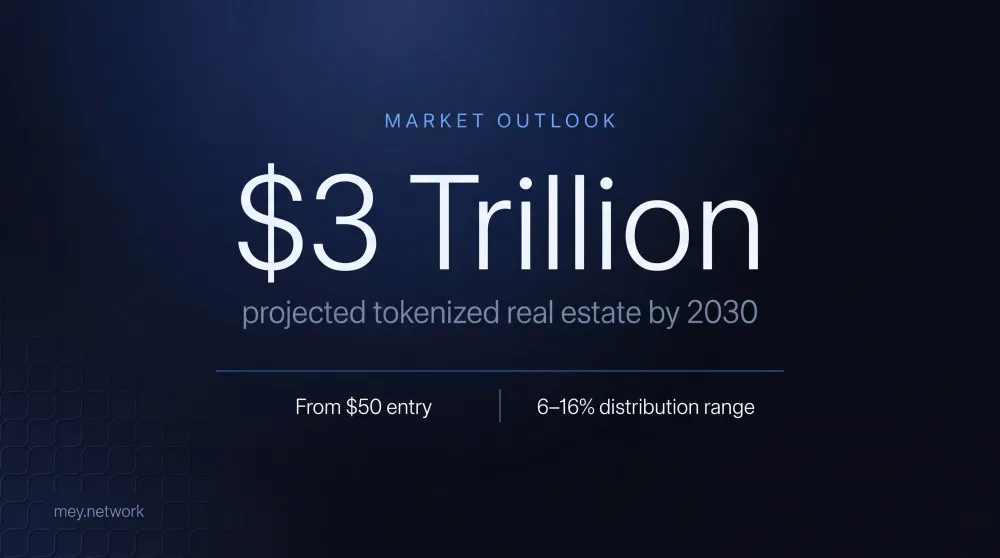
The tokenized real estate ecosystem is not a niche experiment anymore. The space is projected to reach $3 trillion by 2030, driven by institutional adoption and improving regulatory clarity. BlackRock and JPMorgan are both actively exploring tokenized asset frameworks, which signals that the infrastructure is becoming credible enough for institutional capital.
Key trends shaping the next decade:
Institutional entry: major asset managers are building tokenized fund products, which will deepen distribution-layer activity and set compliance standards.
Regulatory maturation: the EU's MiCA framework and evolving SEC guidance in the US are creating clearer rules for security unit offerings.
Cross-chain interoperability: purpose-built blockchains for real-world assets (RWAs) are reducing friction between platforms.
Commercial real estate expansion: offices, warehouses, and data centers are increasingly being tokenized, not just residential properties.
Tokenized real estate offers global access to property ecosystems previously restricted by geography and capital requirements, but participants must weigh regulatory fragmentation and platform-specific risks carefully before committing capital.
The regulatory picture is still fragmented. Different jurisdictions treat tokenized real estate differently, and a unit that is legal in one country may be restricted in another. Platforms that build compliance into the unit layer from day one will have a structural advantage as enforcement tightens.
Our perspective: what most guides miss about digital property NFTs
Most explainers on digital property NFTs spend a good chunk of their time on the technology and almost none on what actually determines participant outcomes. The NFT standard you use matters far less than the depth of the distribution venue and the quality of the legal wrapper around the asset.
We have seen participants get excited about a platform's blockchain infrastructure while ignoring the fact that their units circulate at 5% spreads with almost no daily volume. That is not a fluid position. It is a long-term hold dressed up as a transferable asset.
The real differentiator for participants is preferring fungible security units with built-in compliance over pure NFTs. Regulatory wrappers are not bureaucratic overhead. They are what protect your position when a jurisdiction tightens its rules.
Platform diligence is the skill that separates informed participants from hopeful ones. Check the legal structure of the SPV, the jurisdiction of incorporation, the smart-contract audit history, and the actual distribution-venue volume before you allocate a single dollar.
Explore digital property NFTs with Mey Network
If the mechanics and potential of digital property NFTs resonate with you, the next step is finding a platform built to handle both the technology and the compliance layer properly.
Mey Network is a decentralized platform purpose-built for real-world asset tokenization, with a focus on real estate fractional interests through PTOs (Property Token Offerings).
Whether you are exploring your first fractional property position or looking to integrate tokenized real estate into a broader DeFi strategy, Mey Network offers the infrastructure, transparency, and global accessibility to make it happen securely.
Frequently asked questions
Do digital property NFTs grant physical occupancy rights?
No, most digital property NFTs provide fractional financial interests but not physical access or occupancy rights. You hold economic exposure to the property, not the right to live or operate in it.
What is the minimum entry for fractional digital property NFTs?
Minimum positions typically start as low as $50 to $100, far lower than traditional real estate options that often require $25,000 or more for private funds.
How are rental flows distributed to NFT holders?
Automated smart contracts handle rental distribution directly to NFT holders according to their fractional share, with no manual processing or intermediary required.
What are the main risks with digital property NFTs?
Risks include platform reliability, regulatory fragmentation, illiquid distribution venues, and smart-contract vulnerabilities that could freeze or misdirect assets.
Can I transfer my digital property NFT easily?
Transferring is possible through distribution venues but can be limited, with daily volumes between 0.02 and 0.15% of total supply and bid-ask spreads of 3% to 8%.
