

How industry trends are shaping real estate network Tokenization
Real estate has always been the ultimate illiquid asset, locked behind high minimums, geographic barriers, and mountains of paperwork. That reality is changing fast, driven by the latest real estate tokenization trends. Tokenized real estate assets are projected to reach $4 trillion by 2035, growing at 27% annually from under $300 billion in 2024. Yet most participants, whether retail users curious about blockchain or institutional fund managers weighing allocations, still struggle to connect the dots between big macro forces and what they actually mean for access, distributions, and risk. This guide breaks down the trends driving tokenization and gives you a clear framework for acting on what you learn.
Key Takeaways
Regulation, institutional capital, and technology are the dominant real estate tokenization trends powering scale and adoption.
Retail participants can now access institutional-grade real estate with low minimums; institutions gain automation and partial distribution-layer access.
Distribution-venue depth and compliance remain challenges that participants must consider before entering tokenized ecosystems.
Success depends on selecting mature, regulated platforms, not just following broad sector trends.
What is Tokenization and why is it gaining traction?
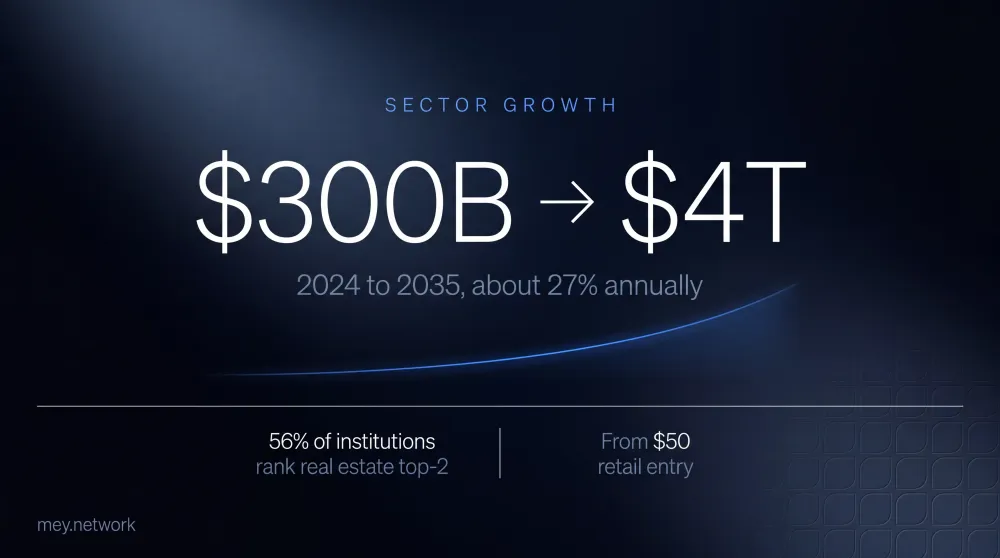
Tokenization is the process of converting ownership rights in a real-world asset, in this case real estate, into digital units recorded on a blockchain. Think of it like slicing a commercial building into millions of digital shares, each one programmable, transferable, and verifiable without an intermediary. Instead of acquiring an entire property, you can acquire a fraction of it for as little as $50 or $100, receive rental flows proportional to your stake, and transfer your position on a digital venue without waiting for a traditional closing process.
The appeal here cuts across participant types. For retail participants, tokenization removes two of the biggest barriers to real estate access: capital requirements and geography. You no longer need a six-figure down payment or a local-ecosystem connection to hold a productive real estate position. For institutional participants, tokenization delivers something different but equally compelling. Smart contracts automate distributions, compliance checks, and cap-table management. This reduces operational overhead dramatically while opening access to a broader pool of distribution providers.
The numbers reflect genuine momentum. That kind of growth does not happen through high-volatility sentiment alone. It happens when real infrastructure meets real demand. Platforms have matured, legal frameworks are clarifying, and institutional players have moved from watching to deploying capital.
Here is why monitoring tokenized real estate growth matters for your portfolio decisions:
Fractional ownership lets you diversify across property types and regions without concentrating risk in one asset.
Programmable distribution means rental flows can be sent automatically to unit holders, reducing administrative delays.
Distribution-venue activity offers a level of exit flexibility that traditional real estate simply cannot provide.
Lower barriers to entry open access to commercial, residential, and industrial properties globally.
Smart-contract automation reduces reliance on intermediaries, lawyers, and escrow agents, cutting transaction costs.
Pro tip: before evaluating any tokenized real estate offering, always verify that the units are backed by legally titled, audited property assets and not just a promise of future backing.
Key real estate tokenization trends
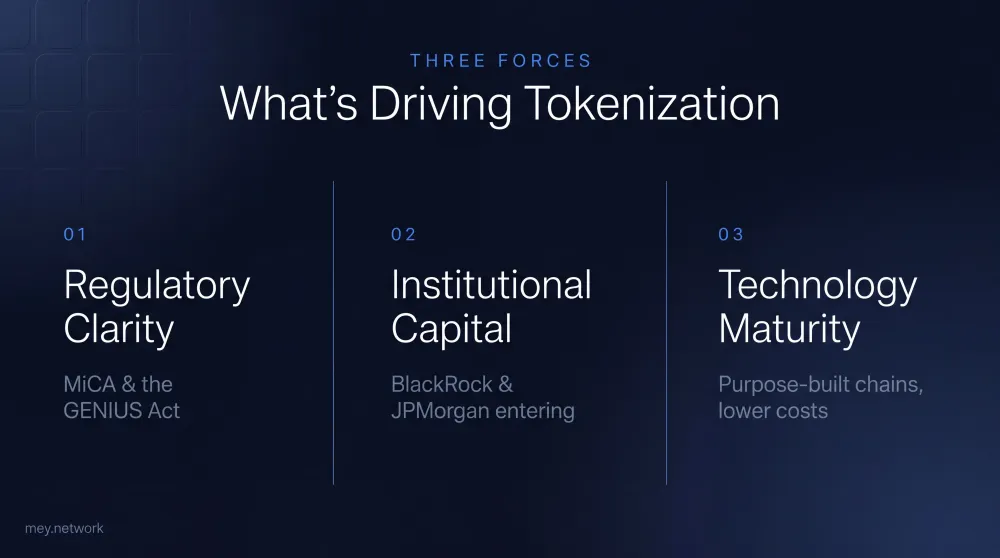
Now that you understand what makes tokenization structurally compelling, it is worth examining the real estate tokenization trends pushing it from a niche experiment toward mainstream adoption. Three major trends stand out: regulatory clarity, institutional capital inflows, and technological maturation.
Regulatory clarity is reducing risk at scale. For years, one of the biggest barriers to tokenization was uncertainty. Participants and platforms alike struggled to operate without knowing whether units would be classified as securities, commodities, or something else entirely. The EU's MiCA framework and the US GENIUS Act have begun changing that calculation. Regulatory clarity and institutional capital are now actively propelling tokenization infrastructure toward large-scale deployment. When legal risk decreases, compliant platforms scale faster, and participant confidence grows in parallel.
Institutional capital is flowing in, and that changes everything about distribution-layer depth. When firms like BlackRock and JPMorgan start building tokenization infrastructure, they bring two things with them: deep pockets and legitimacy. Their presence signals to regulators, auditors, and pension funds that tokenized real estate is a credible asset class, not a fringe experiment. 56% of institutions rank real estate as a top or second-most preferred tokenized alternative, and institutional participants are expected to allocate roughly 5.6% of their portfolios to tokenized assets by 2026. That kind of allocation at the institutional scale creates distribution-venue depth that retail participants can benefit from directly.
Technology has crossed a critical maturity threshold. Early tokenization platforms were clunky, siloed, and vulnerable to smart-contract exploits. The infrastructure available in 2026 looks entirely different. Purpose-built blockchains, cross-chain interoperability protocols, and institutional-grade custody solutions have removed many of the technical barriers that once scared away serious capital.
The convergence of these real estate tokenization trends, regulatory frameworks, institutional participation, and blockchain maturity is not a coincidence. It is the result of years of infrastructure building that is now compressing what would have been a decade of adoption into just a few years.
Here is a snapshot of how these trends stack up:
- Regulatory clarity (MiCA, GENIUS Act)
- What changed: Legal frameworks for unit classification
- Direct participant impact: Lower legal risk, broader platform access
- Institutional inflows
- What changed: Major banks building Tokenization desks
- Direct participant impact: Deeper distribution-venue activity
- Technological maturity
- What changed: Robust platforms, interoperability, security
- Direct participant impact: Faster settlement, lower costs, fewer exploits
- Smart-contract automation
- What changed: Programmable compliance and distributions
- Direct participant impact: Reduced administrative friction
- Cross-border infrastructure
- What changed: Global asset access via blockchain
- Direct participant impact: Geographic diversification without borders
Tracking the size and growth of real estate units tells you where momentum is building, and which regions are accelerating fastest.
Key developments shaping the tokenization landscape right now include:
MiCA's full implementation across EU member states will create a unified regulatory zone for on-chain assets.
The GENIUS Act introduces clearer US guidance on stablecoin and tokenized asset frameworks.
Major custodians like BNY Mellon and State Street are entering the on-chain asset custody space.
Layer 2 and purpose-built blockchains are reducing transaction costs by more than 90% compared to the Ethereum mainnet.
REITs are exploring hybrid tokenization models to attract new participant segments.
How real estate tokenization trends impact participant access
With these real estate tokenization trends mapped out, the practical question becomes: what do these shifts actually mean for you as a participant? The answer differs depending on whether you are approaching this as a retail participant or an institutional allocator.
For retail participants, the transformation is most visible in accessibility. Where real estate once required $50,000 or more to enter any meaningful position, retail gains fractional access at minimums of $50 to $100 on compliant tokenization platforms. That is not just a lower price point. It is a structural change in who gets to participate in one of the world's most consistent wealth-building asset classes. Combine low minimums with global reach, and a retail participant in Southeast Asia can now hold a stake in a commercial property in Germany or a residential development in the US.
For institutional participants, the value proposition centers on efficiency and programmability. Smart-contract automation handles participant onboarding, KYC/AML (Know Your Customer and Anti-Money Laundering) checks, distribution, and compliance reporting automatically. Cap-table management, which can be extraordinarily complex for large property syndicates, becomes transparent and auditable in real time. Regulatory de-risking and institutional entry are enabling new participant access and distribution-layer activity, but true, deep distribution-layer depth still requires maturing distribution venues.
Here is a direct comparison of how these trends translate into different experiences:
- Entry minimum
- Retail participant: $50 to $100
- Institutional participant: $100,000+ (varies by platform)
- Primary benefit
- Retail participant: Fractional access and diversification
- Institutional participant: Compliance automation and distribution-layer access
- Distribution-layer access
- Retail participant: Improving via distribution venues
- Institutional participant: Partial distribution-layer access with cap-table controls
- Main risk
- Retail participant: Platform credibility and exit options
- Institutional participant: Regulatory compliance across jurisdictions
- Relevant trend
- Retail participant: Lower barriers and global platforms
- Institutional participant: Programmable compliance and smart contracts
For retail participants looking to maximize real estate access through tokenization, here is a practical framework to apply right now:
Verify asset backing. Every unit should correspond to a legally titled, independently audited real property. Ask for documentation before allocating.
Assess platform operating record. Look for platforms with verified transaction history, published audits, and transparent governance.
Understand the exit mechanism. How does distribution-venue activity work on that platform? Are there lock-up periods? What is the typical transfer volume?
Diversify across property types. Do not concentrate on one asset category. Spread across residential, commercial, and industrial areas to manage correlation risk.
Monitor regulatory compliance. Ensure the platform operates under a recognized legal framework in the jurisdiction where the property is located.
Pro tip: when evaluating tokenized real estate platforms, prioritize those that publish on-chain proof of reserves and allow you to verify unit-to-asset ratios independently rather than relying on their internal reports alone.
The emerging challenges and what most miss
Even with all the structural progress, meaningful obstacles remain. Ignoring them is one of the fastest ways to turn a sound trend into a costly mistake.
Distribution-layer depth is improving but remains uneven. The narrative around tokenization often implies instant, frictionless transfer activity. The reality in 2026 is more nuanced. Distribution-venue depth varies enormously by platform, region, and asset type. A luxury residential unit in a high-demand European ecosystem may move frequently, while a smaller industrial property unit in a less active ecosystem could sit with thin activity-books for weeks. Institutions must navigate regulatory nuances and distribution gaps across jurisdictions, and retail participants face similar challenges at smaller scale.
Jurisdictional compliance is a persistent friction point. Tokenization is global by nature, but regulation is local. A platform compliant under MiCA in Europe may face a completely different set of requirements to list assets in the US, Singapore, or the UAE. For institutional participants deploying across multiple regions, this creates legal overhead that partially offsets the efficiency gains from automation. Platforms that build compliance into their smart-contract architecture from day one handle this far better than those bolting it on as an afterthought.
Platform quality varies wildly. Not every tokenization project deserves equal consideration. Some are backed by audited, titled assets with credible legal structures. Others amount to marketing wrappers around illiquid or unverified property claims. The distinction matters enormously for both distributions and exit options.
Key warning signs to watch for when evaluating tokenized real estate opportunities:
No independent third-party audit of the underlying property assets.
Vague or absent information about distribution-venue mechanisms.
Promises of fixed guaranteed distributions without disclosure of how those distributions are generated.
Platform teams with no verifiable real estate or blockchain operating record.
Lack of clear jurisdictional licensing or regulatory registration.
Statistic to keep in mind: the tokenized real estate ecosystem is growing at 27% annually, but that aggregate growth masks enormous variation between leading platforms and struggling ones. Macro growth does not guarantee individual participation success.
Pro tip: Use on-chain analytics tools to verify actual transaction volume on any tokenization platform before committing capital. Real platforms have verifiable, consistent activity. Hype-driven platforms often show irregular spikes with no underlying transfer depth.
Why following trends isn't enough: what experienced participants know
Here is the uncomfortable reality most trend-focused content skips over. Knowing that tokenized real estate is growing at 27% annually is useful context. It is not, by itself, a participation strategy. We have seen this dynamic play out repeatedly across emerging asset classes. The participants who outperform are not the ones who identified the trend earliest. They are the ones who paired macro conviction with granular diligence on timing, platform selection, and asset quality.
The growth rates for tokenized real estate are real, and the structural tailwinds are genuine. But sector-wide growth does not flow equally to every participant. The space will likely consolidate around a smaller number of well-capitalized, compliant platforms with proven distribution-venue infrastructure. Participants who choose platforms based on compelling marketing rather than verified fundamentals will bear the cost of that consolidation.
Timing matters in ways that trend narratives underplay. Entering a 27% growth space at the wrong stage of a platform's lifecycle, during regulatory uncertainty, or before distribution-venue depth exists, can deliver disappointing results even as the broader sector thrives. Experienced participants ask: not just "is the trend real?" but "where in the cycle am I entering, and does this platform have the infrastructure to deliver on what it promises?"
The participants who generate real advantage in tokenized real estate combine three things: macro trend awareness, disciplined platform evaluation, and honest assessment of distribution-layer depth at the specific asset level. Trend-chasing without those filters is expensive. Adding them turns a broad thesis into a repeatable process.
Explore tokenization opportunities securely with Mey Network
You now have a clearer picture of the trends reshaping real estate participation and the practical considerations that separate meaningful opportunities from noise.
The Mey Network platform is built specifically to address what this guide has covered: transparent asset backing through PTOs (Property Token Offerings), purpose-built blockchain infrastructure, and a financial ecosystem through MeyFi that supports staking, lending, and DeFi collateralization. Mey Network offers the security, transparency, and interoperability that serious participation in this asset class requires. The next step is not just understanding the trends. It is acting on them with the right tools.
Frequently asked questions
How does regulatory clarity impact real estate Tokenization?
Clear regulations like MiCA and the GENIUS Act lower legal risks and attract both institutional and retail participation by establishing standardized compliance frameworks. Regulatory clarity is actively moving tokenization toward large-scale infrastructure deployment.
What is the projected growth for tokenized real estate assets?
Tokenized real estate is projected to reach $4 trillion by 2035, growing from under $300 billion in 2024 at a 27% annual rate.
How does Tokenization benefit retail and institutional participants differently?
Retail participants gain fractional access starting at $50 to $100, while institutions benefit from programmable compliance automation and partial distribution-layer access, though both must still navigate evolving distribution-venue depth.
What risks remain despite positive sector trends?
Distribution-layer depth in distribution venues and jurisdiction-specific regulatory requirements still create real uncertainty. True distribution-layer depth requires venue maturity and consistent regulatory clarity across regions, neither of which is fully established everywhere yet.
Will Tokenization replace traditional real estate participation?
Tokenization is shaping up as a powerful complement to traditional real estate, expanding access and exit flexibility without eliminating the role of direct property ownership, REITs, and conventional vehicles.
