


Essential Due Diligence Tips For Tokenized Real Estate Participants
Tokenized real estate promises fractional ownership, global access, and instant distribution-layer activity, but the gap between that promise and reality is wider than most marketing decks will admit. The mechanics of blockchain add a technical layer that sits on top of, not instead of, traditional property risk.
Thin venues and wide spreads are common on tokenized real estate distribution venues, and smart-contract vulnerabilities can compound losses in ways that have no equivalent in conventional real estate. This article gives you a step-by-step framework to evaluate tokenized assets rigorously, from legal foundations to exit realities, so you can make decisions with your eyes fully open.
Key Takeaways
Always confirm regulatory compliance and participant rights before moving forward.
Professional audits and transparent unit standards are essential for platform security.
Actual distribution rates and distribution-layer depth may fall short of projections, so demand concrete proof.
Solid off-chain management practices are as important as on-chain security.
Match your due diligence depth to your own participation goals and risk profile.
Establish regulatory and legal foundations
Once you recognize that tokenized real estate carries compounding risks, the smartest starting point is the legal and regulatory layer. A compelling unit offering built on a shaky legal structure is essentially a house of cards.
Before anything else, confirm whether the unit qualifies as a security under applicable law. In the United States, regulators use the Howey Test for securities compliance, which examines whether there is an outlay of money in a common enterprise with an expectation of profit from others' efforts. Most real estate units will meet this definition, which means they must comply with securities regulations. Platforms that ignore or obscure this fact are a red flag.
You also need to understand which jurisdiction's laws govern the unit, the platform, and the underlying property. These three may be in entirely different countries. A property in Portugal, a platform incorporated in the Cayman Islands, and units offered to US participants creates a multi-layered jurisdictional puzzle. Each layer has its own enforcement authority and participant protections, and gaps between them can expose you to situations where no regulator will act on your behalf.
Key items to verify on the legal and regulatory checklist:
Registration or exemption status of the unit under applicable securities laws.
Active KYC (Know Your Customer) and AML (Anti-Money Laundering) procedures that meet current standards.
A clearly drafted Special Purpose Vehicle (SPV) charter that spells out your rights as a unit holder, including voting, revenue sharing, and liquidation priority.
Disclosures about conflicts of interest between the platform, the SPV, and property managers.
Evidence of ongoing compliance, not just initial registration.
Jurisdiction clarity matters as much as the smart-contract code. An ironclad on-chain record is worth little if the off-chain legal entity that holds the property title has ambiguous participant protections.
Pro tip: always request the most recent regulatory filings and legal opinions, not just a summary on the platform's website. If the team hesitates or points you to a terms-of-service page instead, treat that reluctance as a serious warning sign.
Assess smart contracts and unit standards
After legal and regulatory checks, dive into the technical foundation of the units themselves. This is where many participants stop because the material looks intimidating, but you do not need to be a developer to ask the right questions.
A smart contract is simply a self-executing piece of code on a blockchain that handles things like distributing rental flows, recording ownership changes, and enforcing transfer restrictions. The critical issue is that code can have bugs. A flaw in a smart contract can drain participant funds in minutes, with no recourse. That is why independent audits matter enormously.
Professional audit firms like OpenZeppelin examine the contract code for vulnerabilities and publish detailed reports. Smart-contract audits via OpenZeppelin are among the most respected in the sector. Always ask for the full audit report, not just an audit badge on the website. Check the date of the audit too: contracts are sometimes updated after an audit, introducing new bugs.
Beyond audits, look at how the platform verifies that the unit actually represents the real-world property. This is done through proof of reserves, often using oracle networks like Chainlink that pull real-world data onto the blockchain. Without this, you could be holding a unit backed by nothing.
Token standard and infrastructure checklist:
Full, publicly accessible smart-contract audit from a reputable firm.
Proof of reserves verified through a trusted oracle network.
Use of compliance-grade unit standards, such as ERC-3643, which has built-in identity and compliance controls baked into the unit itself.
Transparent mint and burn policy (meaning documented rules about when new units can be created or destroyed, preventing arbitrary dilution of your stake).
Upgradability controls: understand whether the platform can change the contract unilaterally, and what governance exists to prevent abuse.
Token standards comparison:
- ERC-20
- Primary use case: General-purpose units
- Compliance controls: None built-in
- Transfer restrictions: None built-in
- ERC-1400
- Primary use case: Regulated units
- Compliance controls: Partial
- Transfer restrictions: Manual
- ERC-3643
- Primary use case: Regulated units (compliant)
- Compliance controls: Built-in identity
- Transfer restrictions: Automated
- ERC-1155
- Primary use case: Multi-asset units
- Compliance controls: None built-in
- Transfer restrictions: None built-in
Pro tip: look for automatically verifiable audit reports hosted on the audit firm's own website, cross-referenced with the contract address on a public blockchain explorer. A link that only goes to the platform's own site is insufficient verification.
Analyze property management and off-chain operations
Even with strong legal and technical checks, participants can lose out if the underlying property is not competently managed. Blockchain records are only as reliable as the real-world operations they're supposed to represent.
This is where many tokenized real estate offerings have stumbled. Platforms routinely advertise double-digit rental rates and steady distributions, but those projections often rest on optimistic vacancy assumptions, deferred maintenance, and untested property management capacity. When the off-chain reality catches up, the consequences can be severe: vacancy rates that run far higher than advertised, properties falling into disrepair, unpaid property taxes, halted distributions, and, in some cases, lawsuits over whether the tokenization structure ever transferred legal title to participants at all. None of these problems is visible on-chain, which is precisely why participants who lean only on blockchain transparency have been caught off guard.
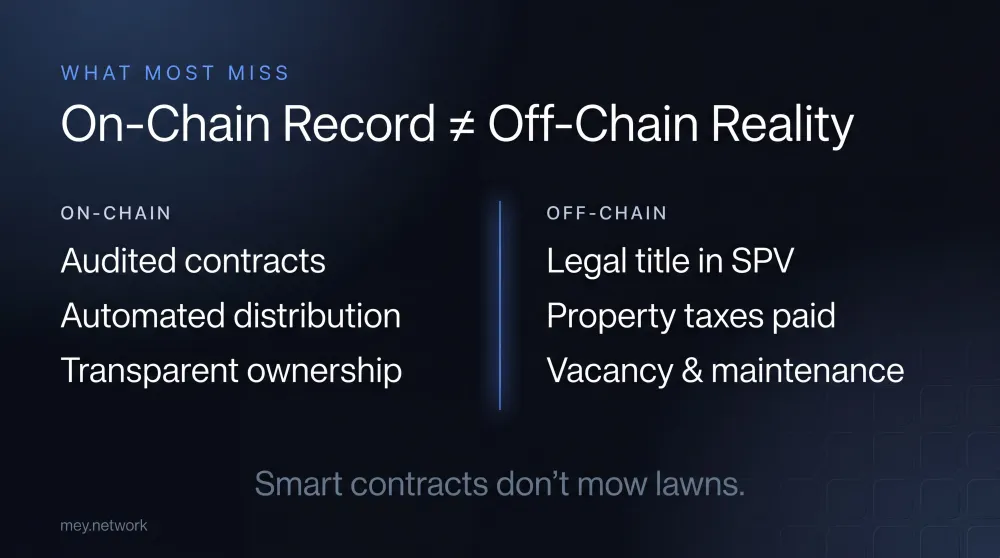
On-chain transparency is not the same as off-chain competence. Perfect records of a badly run property are still records of a badly run property.
Off-chain operations checklist:
Documented property management policies, including maintenance schedules and emergency repair protocols.
Verifiable proof of property title held by the SPV, confirmed by a third-party title company or attorney.
Current property tax payment records, accessible to participants.
Tenant management procedures: who handles lease agreements, evictions, and vacancies?
Operating record of actual versus projected distribution rate, reported at least quarterly.
Vacancy history for the specific property, not just platform-wide averages.
The gap between projected and actual distribution rate is one of the most consistently overlooked metrics in tokenized real estate. Platforms often model rates using optimistic vacancy and maintenance assumptions. Always ask for actual historical performance on the specific property you are evaluating, not portfolio-level averages that mask underperformers. A 1 to 2 percent rate shortfall might sound minor, but compounded over several years, it significantly erodes distributions, especially when you account for the distribution-layer premium you are accepting by holding an illiquid unit.
Evaluate distribution-layer depth and ecosystem realities
Once you have confirmed the asset's quality, focus hard on how and when you could actually exit your position. This is where tokenized real estate marketing diverges most sharply from reality.
The pitch is simple: unlike traditional real estate, which can take months to transfer, tokenized property can be moved 24 hours a day, seven days a week on a distribution venue. The reality is more nuanced. Thin venues and wide bid-ask spreads mean that even when a counterparty exists, you may surrender a significant portion of your position value just to exit. For assets with low transfer volume, those spreads can be even wider, or there may simply be no active counterparties at all during periods of ecosystem stress, which is exactly when you might most want to exit.
There are also edge cases that highlight off-chain misalignment: oracle failures that disconnect on-chain price data from real-world property values, regulatory shifts that freeze distribution-venue activity, and platform insolvencies that halt all activity regardless of the underlying property's performance.
Distribution-layer reality check comparison:
- Activity hours
- tokenized real estate (marketed): 24/7
- tokenized real estate (actual): 24/7 but thin volume
- Traditional real estate: Business hours only
- Time to exit
- tokenized real estate (marketed): Instant
- tokenized real estate (actual): Days to weeks
- Traditional real estate: Months
- Bid-ask spread
- tokenized real estate (marketed): Near zero
- tokenized real estate (actual): Wide and platform-dependent
- Traditional real estate: 5 to 7 percent agent fees
- Lockup periods
- tokenized real estate (marketed): Often none
- tokenized real estate (actual): Platform-dependent
- Traditional real estate: None (legal process)
- Venue depth
- tokenized real estate (marketed): Deep
- tokenized real estate (actual): Shallow for most assets
- Traditional real estate: Local-ecosystem dependent
Questions to ask about the distribution-layer depth specifically:
What is the average daily transfer volume on this specific unit, not the platform overall?
Are there lockup periods during which you cannot transfer?
What happens to your units if the platform shuts down?
Is there a redemption mechanism that lets you convert units back to cash through the platform, as a backstop if distribution-venue depth fails?
Make sound, scenario-based decisions
Now that you have explored all due-diligence angles, the final step is synthesizing your findings into a clear decision that matches your risk profile and participation goals.
Different participants should weight the same findings differently. A conservative participant who finds that a platform's smart contract was audited over a year ago and the property has two months of undisclosed tax arrears should walk away immediately. An aggressive participant with deep expertise in the space might view those same signals as negotiating leverage or an acceptable risk for a dramatically discounted entry price, provided they have the resources to independently verify and remedy the issues.
Edge cases like regulatory shifts and oracle failures are not theoretical. They have materialized in real portfolios. Build these scenarios into your analysis before you allocate, not after.
Final decision-making steps:
Compile all regulatory and legal documents into a single reference file and note any gaps or unanswered questions.
Cross-check the smart-contract audit against the live contract address on a public blockchain explorer to confirm no unauthorized changes.
Calculate the realistic distribution range using actual historical data and conservative vacancy assumptions, not the platform's projections.
Model a stress-test exit: if you needed to transfer in 72 hours, what spread would you accept, and is there enough venue depth to absorb your position?
Identify the specific person or organization responsible for off-chain operations and research their operating record independently.
Decide on a maximum allocation that you can afford to hold illiquid for up to 24 months, in a worst-case scenario.
Document your decision rationale so you can review it objectively if ecosystem conditions change.
This structured approach keeps emotion out of the process and gives you a clear record of the assumptions you made, which is invaluable when the position's performance needs to be reassessed.
Our perspective: go beyond the unit, scrutiny beats hype
Here is the uncomfortable truth that most tokenized real estate platforms will not tell you: blockchain transparency is a feature, but it can also be a distraction. When participants see clean on-chain data, they often relax their scrutiny of the messy, human factors that actually determine whether a property position succeeds or fails.
Legal title held correctly in an SPV, current property taxes, responsive maintenance, and realistic vacancy projections are the real determinants of performance. These are not glamorous, but they are decisive. Overhyped distribution-layer claims and flashy dashboards have consistently led participants to skip the hard questions in favor of the exciting technology story.
The best opportunities in tokenized real estate are found not on the most aggressively marketed platforms, but on the ones that make due diligence easy, that welcome hard questions, provide complete documents without delay, and report actual performance versus projections transparently. Platforms that resist scrutiny are the ones that need it most.
Smart contracts do not mow lawns or pay property taxes. Human reliability still rules.
If you apply this framework consistently, you will likely screen out the majority of tokenized real estate offerings available today. That is not a failure of the technology. It is the filter working correctly.
Explore trusted innovation in tokenized real estate
Applying rigorous due diligence is much easier when the platform you are evaluating is built from the ground up with compliance, transparency, and participant protection as core design principles. If you are looking for a starting point that meets those criteria, Mey Network offers a purpose-built infrastructure for tokenized real-world assets, with emphasis on regulatory alignment and verifiable on-chain operations.
Mey Network's ecosystem includes MeyFi for staking and lending, MeyChain as a purpose-built blockchain for real-world assets, and a framework designed specifically to address the gaps where other platforms have failed participants. For participants who have done their due diligence and want a platform that can withstand that scrutiny, it is worth exploring as part of your research process.
Frequently asked questions
What documents should I request before allocating to tokenized real estate?
Ask for the SPV charter, regulatory filings, smart-contract audit reports, proof of property title, and updated KYC/AML policies. Confirm the unit's securities-compliance status under applicable law before committing any capital.
How can I verify the distribution-layer depth of a tokenized property asset?
Check historical transfer data on the specific unit and compare its current bid-ask spread against your acceptable exit cost. Confirm whether the platform publishes regular transaction volume reports and whether a redemption backstop exists.
What are the most common risks in tokenized real estate?
Top risks are regulatory changes, poor property management, platform failures, and off-chain operational misalignment. The RealT case demonstrates that even technically sound on-chain infrastructure cannot compensate for incompetent real-world property operations.
How do smart-contract audits protect tokenized real estate participants?
Audits check for code vulnerabilities and verify that contracts follow tested standards like ERC-3643, reducing the risk of exploits that could drain participant funds without any recourse through traditional legal channels.
