

Tokenized Real Estate vs REITs: Which Is the Better Approach in 2026?
REITs have been the go-to vehicle for real estate participation since their inception in 1960. They've delivered consistent average annual distributions of 10-12% to millions of participants worldwide. But something's shifting.
Tokenized real estate is reshaping how people access property. You can now hold fractional stakes in individual properties through blockchain platforms. No more trusting a fund manager with your capital. No more opaque fee structures. No more waiting months for distribution-layer activity.
Rather than asking which one replaces the other, the real question in the Tokenized real estate vs REITs debate is what each brings to the table and how they align with your participation strategy.
Key Takeaways
REITs deliver 10-12% average annual distributions with instant distribution-layer access and regulatory clarity. All-equity REITs distribute 4.0% dividends; mortgage REITs distribute 12.2%.
Tokenized real estate offers property-level control, global access, and DeFi distribution stacking that can push distributions to 8-14% when actively managed.
The fee advantage favors Tokenized platforms for active participants, while REITs win on simplicity and distribution-layer depth.
A diversified approach (60% REITs + 40% Tokenized real estate) captures both stability and upside potential without betting on one paradigm.
Deloitte projects Tokenized real estate to reach $4 trillion by 2035, growing at a 27% CAGR. This isn't a niche. It's the future structure of real estate capital.
Understanding REITs: The Traditional Standard
A REIT is a pooled vehicle that owns and operates income-producing real estate. You acquire shares, the REIT collects rent, and distributes flows to shareholders. There are three main types: equity REITs hold properties outright, mortgage REITs lend money to developers, and hybrid REITs do both. The regulatory requirement is solid: REITs must distribute at least 90% of taxable income as dividends.
The numbers tell the story. All-equity REITs posted a 4.07% dividend distribution rate as of December 2025, according to NAREIT data. Mortgage REITs came in at 12.2%. Over the long term, equity REITs have delivered 10-12% total annual distributions, combining dividend rate with property value progression. In 2025, all-equity REITs gained 2.3% year-to-date, while mortgage REITs jumped 14.4%.
REITs are SEC-regulated, offer instant distribution-layer access on public listings, and require minimal capital to start. The downsides? You're trusting the fund manager's property selection and management decisions. Fees eat into distributions. And diversification within a REIT can dilute your distributions if you're bullish on specific property types or ecosystems.
Understanding Tokenized Real Estate
Tokenized real estate fractionalizes individual properties into blockchain units. Each unit represents a piece of one specific building, commercial space, or residential complex. You're acquiring a property, not a fund.
Several platforms operate in this space. RealT runs on Ethereum and Gnosis chains with 970+ Tokenized properties and daily rental flows in stablecoins. Lofty uses Algorand with 150+ properties across 40 ecosystems. Mey Network uses a Property Token Offering (PTO) model paired with MeyChain, a purpose-built Layer 1 blockchain for real-world assets launching Q4 2025.
The transparency difference is significant. You see the exact address, rental flows, tenant details, and property metrics on-chain. Minimums are accessible. A 22-year-old with $500 can hold fractions of multiple properties across different cities.
Head-to-Head Comparison: 8 Critical Dimensions
- Minimum Entry
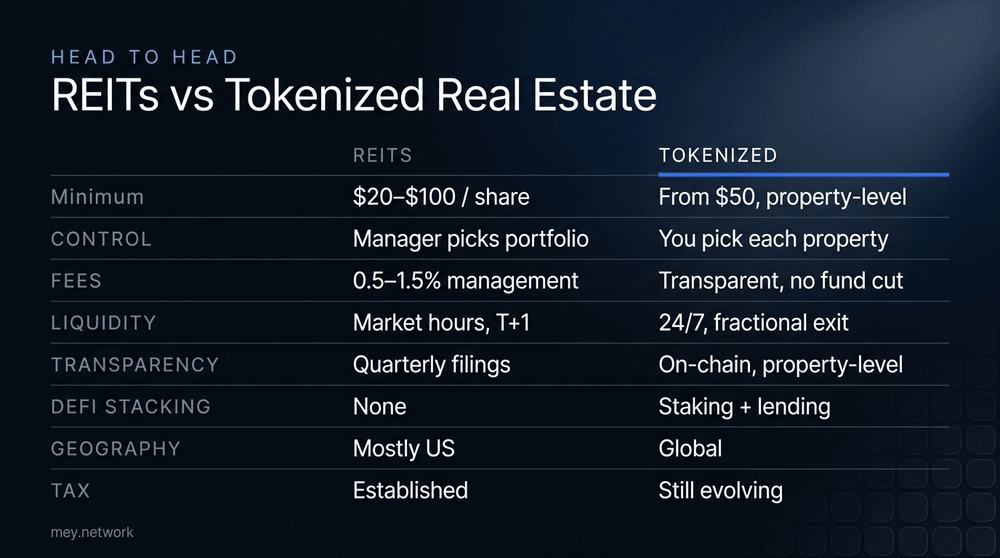
REITs: most start at share price (typically $20-$100 per share for liquid stocks, though ETFs bring it lower). You can access broad REIT exposure through funds for minimal dollars.
Tokenized RE: entry points range from $50 to a few hundred dollars, depending on the property and platform. No fund wrapper means you hold specific assets at smaller ticket sizes.
Winner: tie. Both are accessible, but Tokenized wins for property-specific ownership at low minimums.
- Property Selection and Control
REITs: You acquire the fund. You don't pick individual properties. The manager selects the portfolio based on their strategy. You're making a bet on management quality as much as on real estate fundamentals.
Tokenized RE: You see every property available on each platform. You review the specific address, building type, ecosystem metrics, rent rolls, and expected distributions. Then you cherry-pick which properties to hold.
Winner: Tokenized real estate. This level of transparency and control is what traditional real estate participants expect but rarely receive in pooled vehicles.
- Fee Structure
REITs: management fees typically run 0.5% to 1.5% annually, depending on the fund. Some charge performance fees. These get reflected in your net distributions, which is why $100,000 in a 1% fee REIT distributes 9-11% instead of 10-12% gross.
Tokenized RE: platform fees vary. Mey Network includes staking rewards and DeFi distributions without the fund wrapper taking a cut. The transparency here matters. You can calculate exactly what you're paying and for what.
Winner: Tokenized real estate for active participants. If you're passive and want a single holding, REITs' simplicity is hard to beat.
- Distribution-Layer Depth
REITs: public-listing distribution-layer activity is real, but limited to listing hours (9:30 AM to 4:00 PM EST, weekdays only). T+1 settlement means your cash doesn't actually clear until the next business day, and during volatility, spreads widen, and large positions can move prices against you.
Tokenized RE: distribution venues run 24/7 with no listing hours or banking settlement delays. You can also exit fractionally, transferring only what you need rather than your entire position. As platforms mature and activity-book depth improves, this flexibility advantage grows stronger over time.
Winner: Tokenized RE. REITs offer faster execution within a narrow daily window. Tokenized real estate offers broader access, fractional exit flexibility, and around-the-clock availability.
- Transparency
REITs: quarterly results, annual reports, SEC filings. You receive traditional corporate transparency, which is solid but not granular. You don't know why the manager selected a specific property or what the underlying tenant quality looks like.
Tokenized RE: everything is on-chain or documented at the property level. You see the exact building, neighborhood data, rent roll, tenant history, and capital expenditure plans. Some platforms share daily or weekly performance updates. This level of transparency is standard for blockchain-based participations.
Winner: Tokenized real estate. On-chain transparency changes the trust equation.
- DeFi Integration and Distribution Stacking
REITs: you acquire the dividend. You receive 4% from mortgage REITs or 3-5% from equity REITs. You can't layer additional distributions on top because it's a traditional pooled fund.
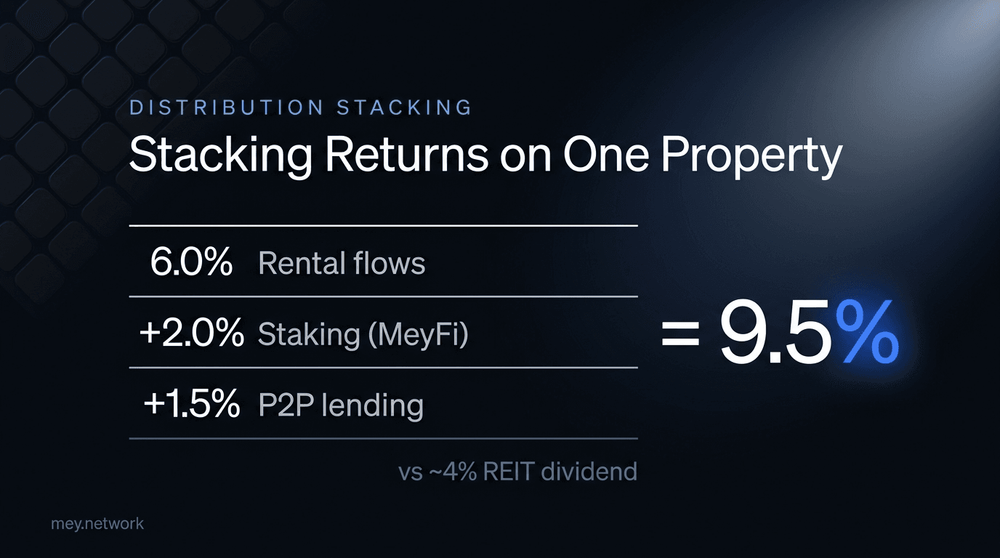
Tokenized RE: this is where the strategy gets interesting. Take Mey Network as an example. You hold a property generating a 6% rental rate. Mey's DeFi platform, MeyFi, offers staking rewards (tiered: Dolphin 10K+, Shark 25K+, Whale 50K+, SVIP 100K+ MEY units). You can also join P2P lending through the platform. Distribution stacking means 6% rental flows plus 2% staking rewards plus 1.5% lending interest equals 9.5% total. RealT units integrate with Aave, allowing additional distributions through DeFi protocols. The math is compelling. A 4% REIT dividend versus a 9.5% distribution stack is a significant difference. But that additional distribution comes with smart-contract and platform risks, which traditional REITs don't have.
Winner: Tokenized real estate. But risk-adjusted, it's closer than the headline numbers suggest.
- Geographic Access
REITs: you're acquiring into a portfolio that's likely concentrated in the US. Some REITs hold international properties, but it's not the norm. You don't control geographic exposure.
Tokenized RE: platforms like Mey Network operate globally, currently with coverage in Vietnam and plans to expand internationally. You can build a geographically diversified portfolio across regions that might be economically uncorrelated.
Winner: Tokenized real estate. Global exposure at property-level precision is a major advantage.
- Tax Treatment
REITs: the tax framework is well established and predictable. Dividends are taxed as ordinary income, which isn't ideal, but at least you know exactly what to expect come tax season. No surprises.
Tokenized RE: tax treatment is still evolving across jurisdictions. The IRS hasn't issued definitive guidance on property unit taxation, and operational value, rental flows, and any distribution components may each be treated differently. For taxable accounts, this uncertainty adds a layer of complexity worth factoring in.
Winner: REITs, but narrowly. Tokenized RE isn't necessarily taxed worse, just less predictably. As regulatory clarity improves, this gap will likely narrow. For now, REITs hold the edge simply by having a known rulebook.
Distribution Comparison: Realistic Expectations
A traditional equity REIT delivers 10-12% total annual distribution: 3-5% in dividend rate plus 5-7% in property value progression. Over decades, that's the historical average according to NAREIT.
Tokenized real estate base rates range from 4% to 11%, depending on property quality and location. Add the DeFi layer, and the equation changes. A property generating 6% rental flow plus 2% staking plus 1.5% lending equals 9.5%. That's competitive with REIT distributions, but it requires active management.
For a passive participant in a REIT index fund, expect distributions of 10-12% over the long term. For someone allocating across Tokenized properties on Mey Network, RealT, and Lofty with DeFi strategies, expect 8-14% depending on property selection and DeFi exposure.
The DeFi Advantage: Why Tokenized Real Estate Offers More Distribution
DeFi distribution stacking is the secret sauce that makes Tokenized real estate compete with REITs on the distribution front.
Here's how it works. You acquire a property unit that generates a 6% rental rate. Mey Network's staking program offers rewards for locking MEY units.
If you're in the Shark tier (25K+ MEY units), you receive approximately 2% annually on your stake. Our platform's P2P lending mechanism lets you receive interest by providing a distribution to other borrowers.
The risk context matters. REITs are regulated by the SEC. Smart contracts on Mey Network's MeyChain or RealT's Ethereum contracts carry execution risk. If there's a bug, your capital could be at risk. That's why distribution-stacking rates should be valued at a discount compared to traditional rates.
But here's the real advantage: you control the stacking decision. You decide which properties to acquire, how much MEY to stake, and how much to lend. With a REIT, you're locked into the manager's dividend policy and capital allocation. With Tokenized real estate, you're making the decisions. That agency is worth something.
When to Choose REITs vs. Tokenized Real Estate
This isn't an either/or question.
Choose REITs if: you want a proven operating record. REITs have 65+ years of history. The 10-12% distributions are real. You want instant distribution-layer access. You need the capital accessible within one settlement day. You want simplicity and zero crypto involvement. You prefer established tax treatment. You're allocating a substantial amount and want minimal fees.
Choose Tokenized real estate if: you want property-level control and transparency. You want global diversification at the property level. You're comfortable with blockchain and DeFi. You want to layer distributions through staking and lending. You're willing to be more active and manage a portfolio across multiple platforms. You have a 5-year or longer time horizon.
Choose both: this is the smart move for most participants. You're not betting on which paradigm wins. You're capturing the advantages of both.
A reasonable allocation might be 60% in traditional REIT index funds or individual REITs for core holdings, plus 40% in Tokenized real estate across multiple platforms and properties. The 60% gives you stability, proven distributions, and distribution-layer access. The 40% gives you upside potential, transparency, and DeFi distributions.
As tokenized real estate matures, that allocation might shift. But diversification across both approaches de-risks your real estate allocation.
Tokenized Real Estate vs. REITs: Are They Converging?
The institutional world is paying attention. Major REIT operators are exploring coordination. Why? It's not because REITs are broken. It's because coordination offers a more efficient structure for capital raising and asset management.
Deloitte projects that tokenized real estate could reach $4 trillion by 2035, growing at a 27% compound annual growth rate from under $300 billion currently. BCG's latest research estimates that tokenized assets will reach $9.4 trillion by 2030. Those numbers suggest this isn't a niche trend.
Regulatory evolution will be the key variable. Right now, tokenized real estate exists in a gray zone in many jurisdictions. The US is still formulating guidance. But as regulations clarify, you'll likely see:
Tokenized REITs that combine REIT scale with blockchain efficiency.
Hybrid platforms where traditional REIT operators Tokenize individual assets.
Greater interoperability between DeFi protocols and real estate units.
REITs aren't going anywhere. They're too entrenched in the financial system. But the line between traditional REIT and tokenized real estate will blur over the next five years.
Conclusion
The Tokenized real estate vs REITs debate is not about competitors fighting for dominance. They're complementary approaches to the same goal: making real estate accessible and generating wealth through property ownership.
REITs offer proven distributions (10-12% historically), immediate distribution-layer access, simplicity, and a century-plus of regulatory clarity. They're ideal for passive participants who want exposure to real estate without thinking about individual properties.
Tokenized real estate offers property-level transparency, global access, property selection control, and DeFi distribution stacking (potentially 8-14% with active management). It's ideal for participants who want to engage more actively and leverage emerging blockchain infrastructure.
For most participants, the answer is both. A 60/40 split between traditional REITs and Tokenized real estate gives you the stability of proven vehicles plus the upside potential of emerging platforms. You're not betting on one paradigm. You're capturing the benefits of both.
If you're exploring Tokenized real estate, platforms like Mey Network, with its Property Token Offering model, offer the transparency and DeFi integration you need. Mey operates across 40+ properties globally, integrates with major partners (AWS, PwC), and offers distribution stacking through our MeyFi platform.
Start small. Hold one or two properties on each platform. Experience the workflow. Compare net distributions after fees and DeFi rates. Then build your allocation based on what works for your strategy.
The future of real estate participation isn't tokenized or traditional. It's diversified across both.
Ready to explore Tokenized real estate? Mey Network brings together 40+ properties globally with transparent on-chain data, staking rewards through MeyFi, and a purpose-built blockchain launching Q4 2025. Join the waitlist on Mey Network and start building your Tokenized real estate portfolio.
FAQs
Is Tokenized real estate better than REITs?
Neither is universally better. REITs excel at proven distributions and simplicity. Tokenized real estate wins on transparency, property-level control, distribution-layer depth, and DeFi distribution potential. The right choice depends on your goals, time horizon, and comfort with blockchain. Most sophisticated participants use both for complementary exposure to real estate.
Can I receive higher distributions with Tokenized real estate?
Potentially, yes. Base property rates (4-11%) plus DeFi distribution stacking (2-5%) can reach 9-14% total. But this requires active management and carries smart-contract risk. REITs offer predictable 10-12% with zero effort. Higher Tokenized rates aren't guaranteed; they depend on property selection and DeFi strategy execution.
Are REITs safer than tokenized real estate?
REITs carry regulatory oversight and SEC transparency. Tokenized platforms carry smart-contract risk. But safety depends on which platform you choose. Mey Network partners with CertiK and AWS. RealT has 970 Tokenized properties and 65,000+ participants. Both are more transparent than many REIT managers. Safety isn't binary.
Should I allocate to both REITs and Tokenized real estate?
Yes, for most participants. A 60/40 split gives you REIT stability plus Tokenized upside. You're not betting the farm on either paradigm. Diversification across both approaches reduces concentration risk and captures the benefits of both models without overexposure to emerging platform risk.
How do fees compare between REITs and Tokenized platforms?
REITs charge 0.5-1.5% annual management fees reflected in net distributions. Tokenized platforms like Mey Network integrate DeFi rewards without traditional fund fees. Tokenized wins on transparency and lower explicit fees. But smart-contract risk is a hidden cost REITs don't carry.
Will REITs become tokenized in the future?
Almost certainly. Deloitte projects $4 trillion in tokenized real estate by 2035. Major REIT operators are exploring coordination. Expect hybrid models where traditional REITs Tokenize assets for capital efficiency. The line between REIT and tokenized real estate will blur. Both will coexist, likely with Tokenized structures becoming standard.
