
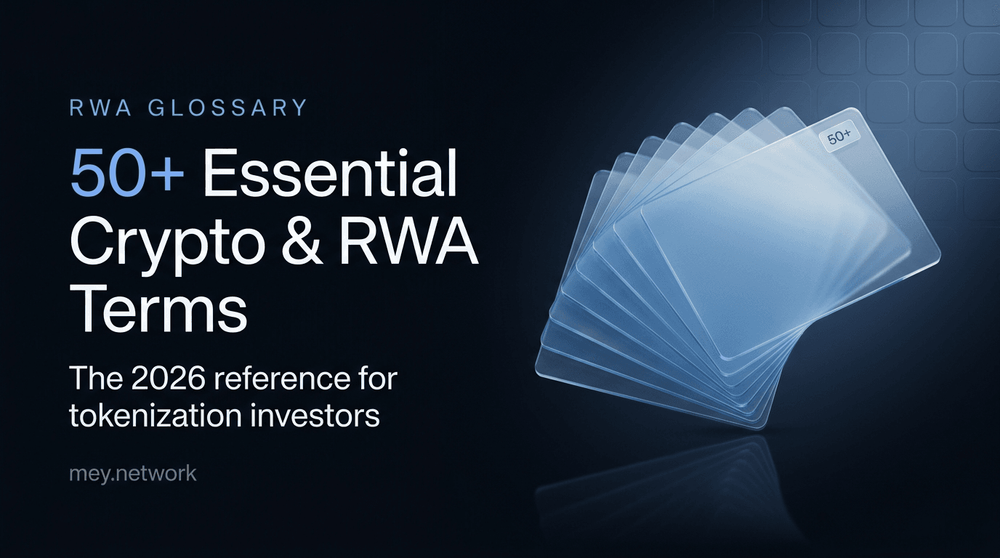
Glossary: 50+ Essential Crypto & RWA Terms Every Investor Should Know
Somewhere between the blockchain whitepaper and the investment dashboard, many investors encounter a disconnect. Concepts such as tokens, smart contracts, and fractional ownership are straightforward in isolation, but when combined within offering documents or investment platforms, the terminology can quickly become complex.
This complexity reflects the convergence of two established domains, blockchain technology and real estate investing, each with its own deeply developed vocabulary. As these worlds intersect, understanding the language becomes essential for effective due diligence and informed decision-making.
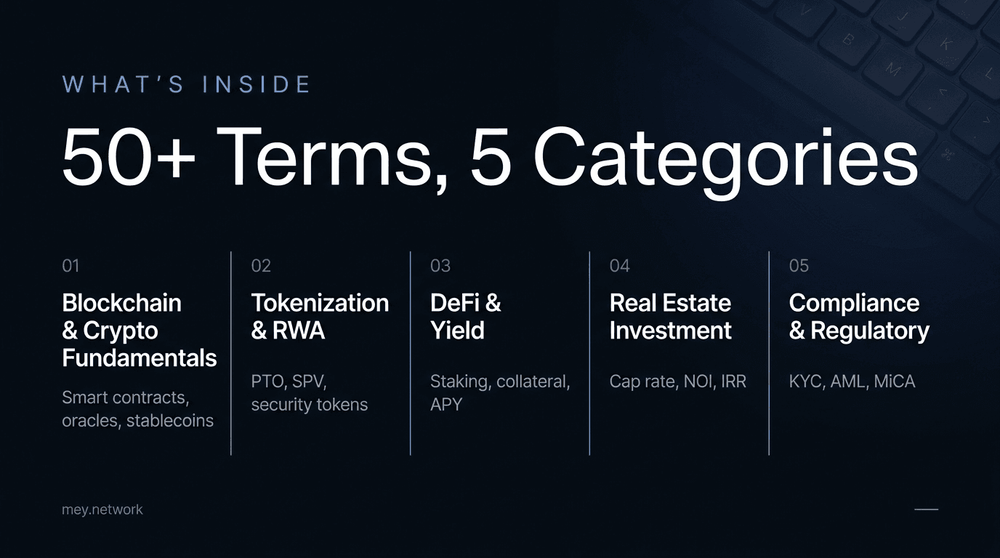
This crypto glossary is designed to provide that clarity. It brings together 50+ essential terms across blockchain fundamentals, tokenization, DeFi, real estate, and compliance, organized for quick reference. Where relevant, each definition highlights its application within real-world asset (RWA) investing, helping bridge the gap between traditional finance and digital assets.
Blockchain & Crypto Fundamentals
These building blocks form the foundation of every tokenized asset platform, including Mey Network. Understanding this section of the crypto glossary means you'll be able to read through any platform's technical documentation without getting lost.
Blockchain: A blockchain is a digital ledger that records transactions across a distributed network of computers in a permanent, transparent sequence. Each data entry, called a block, links cryptographically to the previous one, making the record tamper-resistant by design. Blockchain creates an immutable record of property token ownership and transaction history, with no intermediary required to verify or maintain it.
Smart Contract: A smart contract is a self-executing program stored on a blockchain that automatically carries out defined terms when specific conditions are met, without requiring human intervention or a third party. In RWA context, smart contracts automate rental income distributions to property token holders on a fixed, transparent schedule. No property manager, no bank, no delays contingent on manual processing
Layer 1: Layer 1 is the base blockchain. It is the primary infrastructure on which all applications and transactions run. Ethereum and Bitcoin are the most recognized Layer 1 networks.
Layer 2: Layer 2 is a secondary network built on top of a Layer 1 blockchain. It is designed to improve transaction speed and reduce costs without altering the base protocol.
Wallet: A crypto wallet stores your private and public keys, giving you access to your digital assets. Your tokens live on the blockchain. Your wallet is what you use to access and manage them.
Private Key / Public Key: A private key is a secret code that authorizes transactions from your wallet. A public key is your wallet's shareable address, used for receiving funds. Your private key should never be shared with anyone.
Gas Fees: Gas fees are the costs paid to validate and process transactions on a blockchain network. They compensate the participants who confirm each operation.
High gas fees reduce returns on smaller fractional investments, which is why purpose-built blockchains like MeyChain matter for retail-scale property investing. They are designed to keep these costs low.
Consensus Mechanism: A consensus mechanism is the process by which all computers in a blockchain network agree that a transaction is valid. The two most common types are Proof of Work and Proof of Stake, each with different tradeoffs in speed, energy usage, and security.
Node: A node is any computer in a blockchain network that stores data and validates transactions. More nodes generally mean greater decentralization and a more resilient network.
Oracle: A blockchain oracle is a service that brings real-world data onto the blockchain so smart contracts can act on it. In RWA context, oracles feed property valuations and rental income data into the smart contracts that govern token payouts. They are what make on-chain real estate returns verifiable against actual property performance.
Stablecoin: A stablecoin is a cryptocurrency pegged to a real-world asset, usually the US dollar, to maintain consistent value. USDC and USDT are the most widely used examples.
Cryptocurrency: Cryptocurrency is a digital currency secured by cryptography and operated on a blockchain without a central authority like a bank. Bitcoin and Ether are the most widely recognized examples.
Tokenization & RWA Terms
This is where crypto infrastructure meets real estate investment. These tokenization terms and RWA definitions are the core vocabulary of fractional property investing.
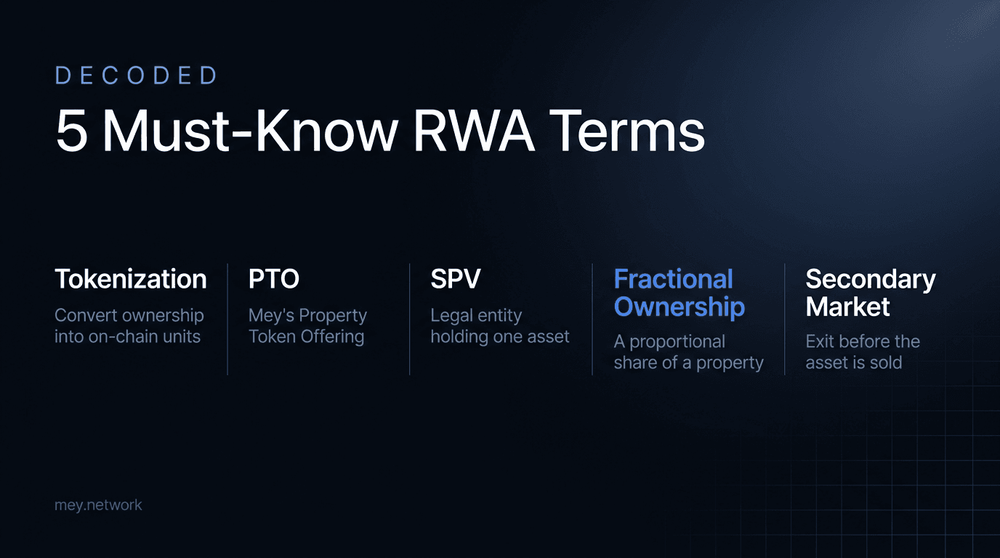
Tokenization: Tokenization is the process of converting ownership rights in a real-world asset into digital tokens that can be held and traded on a blockchain. Explore the complete guide on real estate tokenization to see how this works end-to-end.
Tokenization is the mechanism that makes fractional property ownership financially and technically possible at scale. Without it, fractional ownership stays a concept with no practical delivery system behind it.
Real World Assets (RWA): Real World Assets are physical or traditional financial assets, such as real estate, bonds, or commodities, that have been converted into digital tokens on a blockchain. The RWA tokenization FAQ covers how this process works in practice.
Real estate is one of the fastest-growing categories within the broader RWA market, given its global scale and reliable income characteristics.
Security Token: A security token is a regulated digital asset that represents ownership in an investment, such as equity, real estate, or a fund. It's subject to applicable financial securities legislation in the relevant jurisdiction.
Utility Token: A utility token is a digital asset that grants access to a product or feature within a platform. Unlike a security token, it does not represent ownership or equity in an underlying asset.
Property Token Offering (PTO): A Property Token Offering is the structured process of converting a real estate asset into regulated digital tokens and making them available to investors. It is Mey Network's primary method for fractionalizing property.
In RWA context, a PTO replaces the traditional, closed-door property syndication model with a transparent, blockchain-based investment process that any qualified investor can access and verify independently.
Fractional Ownership: Fractional ownership means holding a percentage share of an asset rather than the whole thing, with proportional rights to income and appreciation. A $500,000 property tokenized into 500,000 units lets a $5,000 investment represent a 1% stake of all income distributions.
For RWA investors, Fractional ownership removes the capital barrier that historically kept direct property investment limited to institutional buyers or high-net-worth investors. It changes who gets access.
SPV (Special Purpose Vehicle): An SPV is a separate legal entity created specifically to hold a single asset. It isolates that asset’s financial risk from the organization that issued the tokens and provides a clean, legally defined ownership layer.
In RWA context, each property on Mey Network is held within an SPV, giving token holders a clear legal claim to the underlying real estate, not just exposure to the platform’s broader balance sheet.
NFT (Non-Fungible Token): An NFT is a unique digital token that represents ownership of a specific, one-of-a-kind item. Unlike fungible tokens, no two NFTs are identical, which makes them well-suited to representing single, indivisible assets.
Fungible Token: A fungible token is a digital asset where each unit is identical and interchangeable with every other unit of the same type. In a property token issuance, one token carries the same rights and proportional value as every other token in that offering.
Secondary Market: A secondary market is a trading venue where investors buy and sell previously issued tokens among themselves, independent of the original issuer. In RWA context, secondary market access lets property token investors exit their positions before the underlying asset is sold. This directly addresses the liquidity problem that makes traditional property investment inflexible.
Mint / Minting: Minting is the process of creating new tokens on a blockchain. When a property is tokenized, its tokens are minted and issued to the market for the first time.
Burn: Burning tokens means permanently removing them from circulation by sending them to an inaccessible wallet address. This reduces total supply and can affect the remaining tokens' value.
Whitepaper: A whitepaper is a formal document published by a blockchain project explaining its technology, economic model, use case, and roadmap. It is the first document a serious investor should read before committing capital to any platform.
Tokenomics: Tokenomics describes the economic design of a token. This includes total supply, distribution structure, incentive mechanisms, and how value is captured overtime. It’s essentially the financial blueprint for how the token is supposed to work.
Ready to apply this knowledge? Mey Network is building regulated, accessible real estate token investing. Join the waitlist for early access to upcoming PTOs.
DeFi & Yield Terms (Terms 27–38)
Understanding the DeFi glossary matters even for real estate investors. Platforms like MeyFi allow property token holders to earn additional yield beyond passive rental income, which makes this section of the crypto glossary directly relevant to know you optimize returns.
DeFi (Decentralized Finance): DeFi is a financial ecosystem built on blockchain that operates without traditional banks or intermediaries, using smart contracts to execute agreements. According to Ethereum.org, DeFi makes financial services accessible to anyone with an internet connection.
DeFi protocols integrated with property tokens let investors earn yield on top of rental income distributions, stacking multiple income streams from a single asset position.
CeFi (Centralized Finance): CeFi refers to financial services delivered through a traditional corporate structure with centralized oversight, such as banks, licensed exchanges, and regulated lenders.
Staking: Staking is the process of locking tokens in a protocol to support its operations or earn rewards. Stakers commit their assets for a defined period and receive yield in return.
On MeyFi, staking property tokens generates additional yield on top of rental income already distributed to token holders. It’s the on-chain equivalent of reinvesting distributions, rather than withdrawing them.
Yield Farming: Yield farming is the active practice of moving tokens across DeFi protocols to maximize returns. It requires ongoing management and carries greater risk than passive staking strategies.
Experienced investors can yield farm across MeyFi products, combining rental income, staking rewards, and liquidity fees for a compounded return from a single property token position.
Liquidity Pool: A liquidity pool is a collection of tokens locked in a smart contract that enables decentralized trading. Investors who deposit tokens into the pool earn a share of the transaction fees generated.
P2P Lending (Peer-to-Peer Lending): P2P lending connects borrowers and lenders directly through a digital platform, removing banks and financial institutions as intermediaries from the transaction.
TVL (Total Value Locked): TVL measures the total value of assets deposited within a DeFi protocol. It is a widely used indicator of platform scale, adoption, and available liquidity.
APY (Annual Percentage Yield): APY is the annualized rate of return on an investment, including the effect of compounding. It gives a more accurate picture of real earnings than a simple interest rate that doesn’t account for compounding.
Composability: Composability is the ability of DeFi protocols to interact with and build on each other. Think of them as modular financial building blocks that can be freely combined into more complex investment strategies.
Collateral: Collateral is an asset pledged as security against a loan. If the borrower defaults, the lender can claim the pledged asset.
Property tokens can serve as on-chain collateral for borrowing stablecoins through DeFi lending protocols on MeyFi. This turns illiquid real estate exposure into working capital without requiring a sale.
Impermanent Loss: Impermanent loss is the temporary reduction in value that liquidity providers experience when the price ratio of their deposited assets shifts, compared to simply holding those assets outside the pool.
Governance Token: A governance token gives holders the right to vote on decisions affecting a protocol or platform, such as fee structures, feature updates, or capital allocation.
Real Estate Investment Terms (Terms 39–46)
These are the core metrics of professional real estate analysis, carried directly into the tokenized context. Investopedia's real estate investing guide provides further depth on each one for investors who want to go deeper.
Cap Rate (Capitalization Rate): The cap rate is a property's annual net operating income divided by its current market value, expressed as a percentage. It estimates income return independent of how the acquisition was financed, making it useful for comparing properties across different capital structures.
NOI (Net Operating Income): NOI is a property's gross income minus operating expenses, calculated before debt service and taxes. It is the foundation metric for most commercial real estate valuations. A property's NOI determines the rental income available for distribution to token holders each period. It is the most important figure to review before any PTO investment.
IRR (Internal Rate of Return): IRR is the annualized return rate that equates all future investment cash flows to the initial capital deployed. It's generally considered the most comprehensive single measure of total investment performance over a defined holding period.
Cash-on-Cash Return: Cash-on-cash return measures annual rental income relative to the total cash invested, excluding property appreciation. It reflects the immediate income yield on a given investment.
Rental Yield: Rental yield is the annual rental income generated by a property, expressed as a percentage of its purchase price. It's a fast, standardized metric for comparing income potential across different assets and markets.
LTV (Loan-to-Value): LTV is the ratio of a loan amount to the appraised value of the asset being financed. A lower LTV indicates less leverage and reduced risk for both the borrower and the lender.
Due Diligence Due diligence is the structured process of investigating an investment before committing capital. It covers financial statements, legal title, physical condition, and market positioning. In tokenized real estate, this should also include reviewing the platform's legal structure, SPV documentation, and smart contract audit reports.
REIT (Real Estate Investment Trust) A REIT is a regulated company that owns income-producing real estate and distributes the majority of its earnings to shareholders. Tokenized real estate offers comparable income exposure but with the lower minimums, direct asset selection, and on-chain performance transparency rather than fund-level aggregation.
Compliance & Regulatory Terms (Terms 47–50)
These terms govern who can participate in tokenized investment offerings and what protections apply. As CoinDesk's crypto glossary notes, compliance is one of the clearest differentiators between credible tokenization platforms and higher-risk alternatives.
KYC (Know Your Customer): KYC is the identity verification process through which a financial platform confirms who its users are before allowing them to transact. It typically requires government-issued identification and proof of address.
AML (Anti-Money Laundering): AAML refers to the legal frameworks, procedures, and internal controls designed to prevent criminal funds from entering or moving through financial systems.
MiCA (Markets in Crypto-Assets Regulation): MiCA is the European Union's comprehensive regulatory framework for crypto assets, fully applicable since December 2024. It establishes licensing requirements for crypto service providers across EU member states. The European Securities and Markets Authority describes MiCA as setting a global benchmark for crypto asset regulation.
MiCA provides European investors and platforms with clear legal certainty for tokenized real estate transactions and defined investor protections, making EU-compliant platforms the safer starting point for new investors.
Accredited Investor: An accredited investor is an individual or institution that meets specific financial criteria, such as minimum net worth or income thresholds, set by regulators to qualify for certain investment opportunities. The exact criteria vary by jurisdiction.
Mey Network-Specific Terms
These three terms are specific to the Mey Network ecosystem and connect directly to the broader concept covered in this crypto glossary.
MeyFi: MeyFi is Mey Network's integrated DeFi platform, enabling investors to stake property tokens, access P2P lending, and trade on secondary markets. It converts passive property holdings into active, multi-stream yield positions.
PTO (Property Token Offering): A PTO is Mey Network's structured process for converting a real estate asset into regulated, fractional digital tokens for investor purchase. It covers due diligence, legal structuring through an SPV, token mining and investor onboarding.
Conclusion
The 50 terms in this crypto glossary form the working vocabulary of tokenized real estate investing. From understanding how a smart contract handles rental distributions to recognizing the difference between a security token and a utility token, each definition gives you a sharper lens for evaluating platforms, assessing investment structures, and managing risk.
The RWA space is scaling fast. According to a 2025 report by Redstone, Gauntlet, and RWA,xyz covered by CoinDesk-,What%20to%20know%3A,-The%20real%2Dworld), the RWA tokenization market reached $24 billion by mid 2025, growing 380% in just three years, with projections pointing toward $30 trillion by 2034. Institutional capital from firms like BlackRock, Goldman Sachs, and Franklin Templeton is now actively deployed in this direction. Fluency in this cryptocurrency terminology is a practical investment advantage, not just background reading.
As you continue exploring this evolving market, bookmark this glossary as a reliable reference point. Clear understanding compounds over time, and having a single source of truth makes navigating new opportunities significantly more efficient.
Now that you speak the language, explore tokenized real estate on Mey Network. Join the waitlist for early access to upcoming PTOs.
FAQs
What is the difference between tokenization and fractionalization?
Tokenization is the technical process of creating digital tokens on a blockchain to represent ownership rights in an asset. Fractionalization is the investment outcome it enables, dividing a single asset into smaller, accessible shares. Tokenization is the mechanism; fractionalization is the result. Together, they make direct property investment accessible to investors at lower capital levels.
What does RWA mean in crypto?
RWA stands for Real World Assets, referring to physical or traditional financial assets such as real estate, bonds, and commodities that have been tokenized on a blockchain. They bring off-chain value into on-chain systems, enabling fractional ownership, faster settlement, and investor access to asset classes previously reserved for institutional or high-net-worth participants.
What is fractional ownership in real estate?
Fractional ownership means holding a percentage share of a property, with proportional rights to rental income and appreciation. Owning 2% of a tokenized building entitles you to 2% of its net rental income each distribution period. Platforms like Mey Network make fractional ownership accessible at significantly lower minimums than traditional direct property investment or syndication structures.
What is a PTO?
A PTO, or Property Token Offering, is Mey Network's process for converting a real estate property into regulated, fractional digital tokens available for investor purchase. It covers due diligence, legal structuring through an SPV, token minting, and investor onboarding, standardizing every stage of the tokenization process in a transparent, blockchain-based format.
What is the difference between DeFi and CeFi?
DeFi, or Decentralized Finance, operates on blockchain using smart contracts, with no banks or intermediaries involved in executing transactions. CeFi, or Centralized Finance, delivers financial services through regulated corporate structures with traditional oversight. DeFi offers greater transparency and programmability. CeFi provides regulatory familiarity and institutional accountability. Most credible tokenized real estate platforms integrate elements of both models effectively.
What is staking in tokenized real estate?
Staking in tokenized real estate means locking property tokens in a DeFi protocol, such as Mey Network's MeyFi platform, to earn yield beyond standard rental income distributions. Rewards are paid in tokens and compound over time. The result is a multi-stream income position from a single property holding that requires minimal ongoing management.
