

What Are Property Token Offerings (PTOs)?
Blockchain can tokenize art, commodities, and private equity. Yet allocating capital to a single rental property still requires six-figure capital, local legal counsel, and months of paperwork. That disconnect is exactly what a Property Token Offering (PTOs) is designed to solve.
ICOs opened up unit-based fundraising but created mostly high-volatility positions. STOs introduced securities compliance but remained generic across asset classes. Neither was engineered around the specific mechanics of real estate: rental cycles, property-level due diligence, SPV legal structures, and exit events tied to physical assets. PTOs address all of these by design.
This guide covers what a Property Token Offering is, the full eight-phase lifecycle from property sourcing to automated distribution, and how the model compares to ICOs, STOs, and REITs.
Key Takeaways
A PTO (Property Token Offering) is Mey Network's model for converting individual properties into fractional digital units backed by real assets.
Each PTO represents one specific property, giving participants control over exactly where their capital goes, unlike pooled funds like REITs.
PTO units grant proportional rental flows, value progression rights, and governance participation, all enforced through smart contracts on blockchain.
Mey Network's smart contracts automate the complex parts of real estate transactions: compliance enforcement, distribution, and ownership transfers.
PTO units can be transferred on MeyFi's distribution venue and staked for additional DeFi distributions on top of rental flows.
What Is a Property Token Offering (PTO)?
A Property Token Offering is Mey Network's model for converting individual real estate assets into fractionalized digital units. Each PTO corresponds to one specific property: a residential building in Lisbon, a commercial space in Dubai, a rental portfolio in Austin. One PTO, one property. That specificity matters.
When you join a PTO, you're acquiring units that represent a proportional share of that property. These units carry economic rights (rental flows and value progression), governance rights (voting on property-level decisions), and transferability (you can move them on the distribution venue).
The technology runs on blockchain. Smart contracts handle everything from unit issuance to automated distribution. There's no middleman collecting rent checks and manually wiring funds. The smart contract executes distributions based on predefined rules.
The key distinction from other tokenization models: PTOs are property-specific by design. You know exactly what you're allocating to, you can verify the property data on-chain, and your distributions are tied directly to that asset's performance.
According to a joint report by Boston Consulting Group and ADDX, asset tokenization is projected to grow into a US$16.1 trillion opportunity by 2030, with real estate representing the largest segment at an estimated $5 trillion. PTOs are positioned squarely within that growth trajectory.
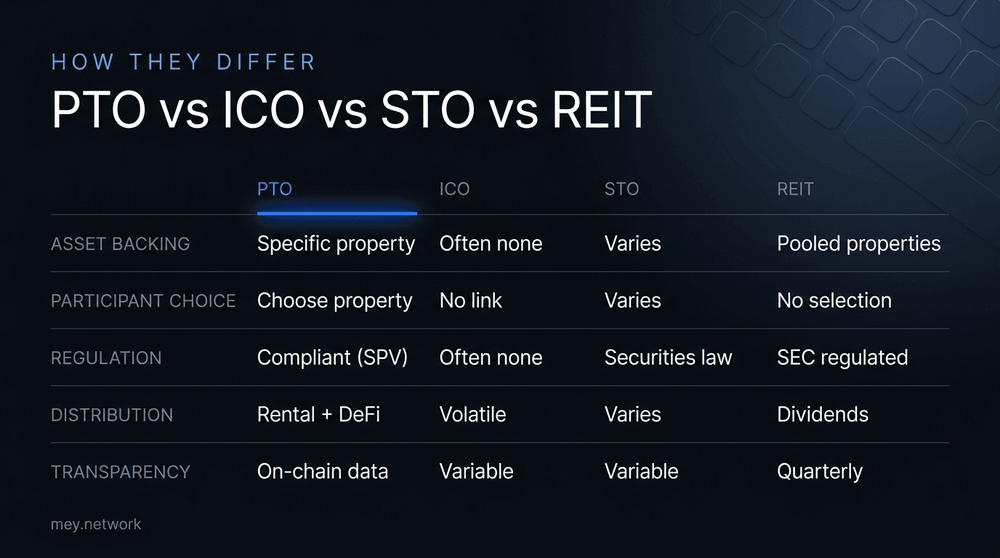
PTO vs. ICO vs. STO vs. REIT: Key Differences
Participants who've spent time in crypto or traditional finance will immediately ask: how does this compare to what already exists? Fair question. Here's where the models diverge.
ICOs (Initial Coin Offerings) exploded in 2017, mostly in unregulated territory. Many had no assets backing whatsoever. You were acquiring a unit and hoping the project behind it would create value. PTOs are the opposite: every unit is backed by a verified, appraised real estate asset inside a legal SPV structure.
STOs improved on ICOs by bringing securities compliance into the equation. That's a step forward. But STOs are generic. They can represent anything from equity to debt to revenue shares. PTOs are specifically engineered for individual properties, with smart contracts designed around rental cycles, property management decisions, and real estate exit events.
REITs are probably the closest traditional comparison. But REITs pool participant capital across a portfolio of properties. You don't get to choose which buildings your money goes into. PTOs flip that model: you pick the exact property, review the data, and allocate at the asset level.
Here's how they compare across six key criteria:
- Asset Backing
- PTO: Specific property
- ICO: Often none
- STO: Varies
- REIT: Pooled properties
- Participant Choice
- PTO: Choose property
- ICO: No property link
- STO: Varies
- REIT: No selection
- Regulation
- PTO: Compliant (SPV)
- ICO: Often unregulated
- STO: Securities law
- REIT: SEC regulated
- Distribution
- PTO: Rental rate + DeFi
- ICO: High-volatility
- STO: Varies
- REIT: Dividends
- Distribution-layer depth
- PTO: Distribution venue
- ICO: Listing-based
- STO: Limited
- REIT: Public ecosystem
- Transparency
- PTO: On-chain data
- ICO: Variable
- STO: Variable
- REIT: Quarterly reports
The comparison isn't about which model is best in every scenario. REITs offer public-ecosystem activity that PTOs don't yet match. STOs have broader applicability beyond real estate. The point is that PTOs are specifically optimized for one thing: individual property participation through blockchain infrastructure.
How Does a PTO Work?
At its core, a PTO works by coordinating a real estate property into fractional units on Mey’s blockchain infrastructure, then making those units available to verified participants through the MeyFi platform. The process is designed to handle the complexity of real estate transactions (legal compliance, distribution, ownership transfers) through smart contracts rather than manual processes.
Mey Network's smart-contract layer is specifically optimized for RWA tokenization and management. These contracts are designed to handle complex real estate transactions, enforce legal agreements, and automate asset management tasks such as rental payments and ownership transfers. Developers can customize contracts for fractional ownership, property transfers, and automated distribution tailored to specific property requirements.
Compliance is built into every stage. Mey Network's compliance framework integrates KYC and AML requirements at the platform level, with smart contracts designed to enforce regulatory rules across jurisdictions. This approach covers every stage of the transaction process, from asset tokenization to distribution-layer activity and ownership transfers. Mey Network also works with local legal counsel in each jurisdiction to address cross-border tokenization requirements.
Once a property is tokenized and the PTO is live, participants acquire fractional units that represent their share of the asset. From there, the smart contracts handle what traditionally required layers of intermediaries: revenue collection, proportional distribution, compliance enforcement, and record-keeping. Everything is automated and verifiable on-chain.
After the initial offering, PTO units can be transferred on the MeyFi venue, where participants can acquire, transfer, and move tokenized real estate assets. This distribution-layer functionality gives participants a pathway to circulation that traditional real estate participation typically lacks.
Explore how fractional real estate access works for a deeper look at the participant experience.
What Do You Get as a PTO Participant?
PTO units grant fractional ownership of a specific tokenized property. That means proportional rights to rental flows, potential value progression when the property is transferred, and participation in property-level decisions through governance mechanisms.
Distribution is handled automatically through smart contracts. Revenue flows proportionally to unit holders without manual processing or intermediary delays. Because everything runs on-chain, distribution is transparent and verifiable.
Beyond holding, PTO units unlock additional functionality on MeyFi. Participants can collateralize their tokenized property holdings to borrow funds through P2P lending or transfer their units on the venue. The units are designed for transferability, so your position has a pathway to circulation that traditional real estate rarely offers.
Benefits of the PTO Model
The PTO structure carries several advantages worth spelling out, especially for participants comparing options.
Property-level selection. You're choosing specific assets, not joining a blind pool. If you want exposure to European commercial real estate but not residential in Southeast Asia, you can build that portfolio property by property.
On-chain transparency. Property data, financial performance, fee structures, and distributions are all verifiable on Mey Network's blockchain. There's no waiting for quarterly reports to understand how your position is performing.
Low minimums. Traditional real estate participation often requires six or seven figures to access institutional-quality properties. PTOs are designed to bring those minimums way down, opening the door to retail participants who've been priced out of direct ownership.
Automated distribution. Smart contracts handle rental distribution without manual intervention. It arrives proportionally, on schedule, into your wallet.
DeFi integration through MeyFi. This is where PTOs go beyond traditional tokenization. You can stake your PTO units on MeyFi for additional distributions, join peer-to-peer lending, or transfer on the distribution venue. Rental flows are the floor, not the ceiling.
Global access. Geography isn't a barrier. A participant in Singapore can hold fractional ownership of a property in Miami, with full on-chain visibility and automated distribution, all without navigating foreign real estate bureaucracy directly.
Ready to explore the model? Browse the Mey Network platform to see how PTOs work in practice.
Risks and Considerations
Any honest assessment of a participation model needs to cover the risks. PTOs carry several that participants should weigh carefully.
Property-specific risk. Because each PTO is tied to a single property, your exposure is concentrated. If that specific building underperforms (vacancy spikes, maintenance costs exceed projections, local ecosystem softens), it directly impacts your distributions. Diversification across multiple PTOs can mitigate this, but it requires capital allocation across several offerings.
Regulatory variance. Real estate regulation differs dramatically across jurisdictions. A PTO structured for a property in Germany faces different compliance requirements than one in the UAE. Mey Network handles the legal structuring, but regulatory shifts in any operating jurisdiction could affect specific PTOs.
Smart-contract risk. The automation that makes PTOs efficient also introduces technical risk. Smart-contract bugs or vulnerabilities could theoretically affect unit operations. Mey Network mitigates this through third-party audits and security protocols, but the risk isn't zero. It never is in blockchain-based systems.
Distribution-venue depth. While MeyFi provides a venue for PTO unit transfers, depth depends on counterparty demand. Early-stage venues may have limited transfer volume, which could affect your ability to exit a position quickly at your desired price.
Platform dependency. PTOs run on Mey Network's infrastructure and MeyFi. The platform's operational continuity matters. Participants are, to a degree, dependent on Mey Network's technology and team execution. The backing of Meey Group (500 staff, ISO-certified, PwC-audited) adds organizational depth, but the dependency is worth acknowledging.
The Technology Behind PTOs
MeyFi is the integrated DeFi layer that sits on top of Mey Network's blockchain. It's where distribution-layer activity happens, but it goes further than that. MeyFi enables staking of PTO units for additional distributions, peer-to-peer lending using tokenized real estate as collateral, and venue features for browsing and acquiring fractional property positions.
The combination creates what you might call a distribution stack: rental flows from the property itself, staking rewards from MeyFi, and potential lending distributions, all flowing to the same unit. That composability between real estate cash flow and DeFi mechanics is a significant differentiator.
Looking ahead, Mey Network's blockchain architecture is designed for cross-chain interoperability, which would allow PTO units to interact with the broader DeFi ecosystem beyond Mey Network's own platform.
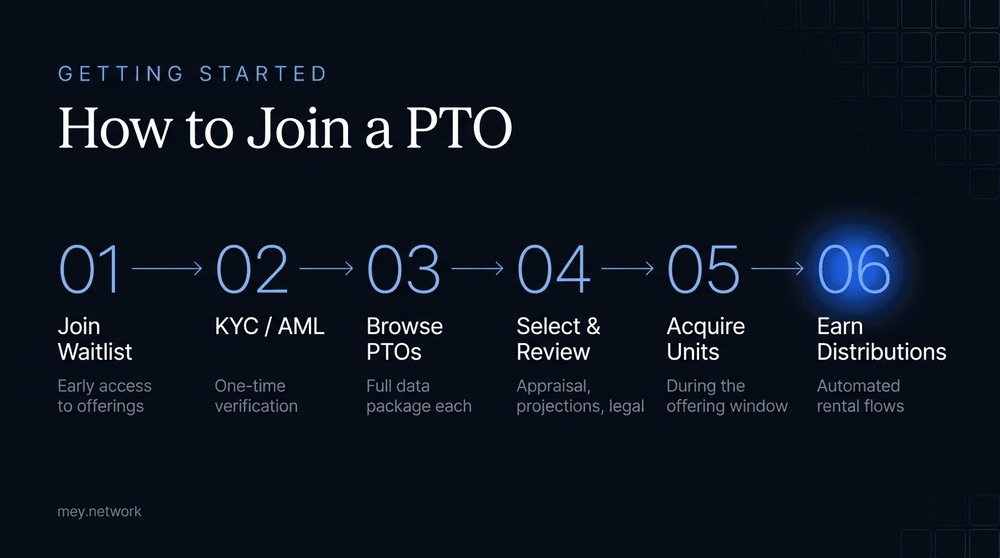
How to Join a PTO
If you've read this far and want to actually get involved, here's the step-by-step process.
Join a waitlist. Early access is currently available through the waitlists. This gets you in line for upcoming PTO offerings before they open to the general public.
Complete KYC/AML verification. Compliance is mandatory. You'll verify your identity through an integrated process. This is a one-time setup that unlocks access to all future PTOs.
Browse available PTOs. Once verified, you can explore the offerings. Each PTO comes with a full data package, including property appraisal, financial projections, legal structure, and location details.
Select a PTO and review the details. Take the time to evaluate the property fundamentals, projected distribution rate, and risk profile. The data is all on-chain and verifiable.
Acquire units during the offering window. Commit your allocation during the PTO's open period. Unit pricing and minimum thresholds are set for each offering.
Receive automated distribution and monitor performance. Once the PTO closes and the property is operational, rental flows reach your wallet automatically.
Conclusion
Property Token Offerings represent the most purpose-built model for bringing real estate onto the blockchain. They solve specific problems that ICOs, STOs, and REITs weren't designed to address: property-level selection, automated distribution, on-chain transparency, and DeFi composability, all with compliance enforcement built directly into the smart-contract layer.
Presently, distribution-layer depth is still developing, regulatory landscapes are evolving, and platform dependency is real. But for participants who want direct, verifiable exposure to specific real estate assets with the automation benefits of blockchain technology, PTOs offer something that stands apart.
Explore upcoming PTOs on Mey Network and join the waitlist to get early access to tokenized property positions.
Frequently Asked Questions
What is a Property Token Offering?
A PTO is Mey Network's model for converting individual real estate properties into fractional digital units. Each PTO represents one specific property, giving participants proportional distribution rights, value progression exposure, and governance participation, all enforced through smart contracts.
How is a PTO different from a REIT?
A PTO lets you allocate to a specific property you choose, with on-chain transparency and automated distribution. REITs pool capital across many properties with no participant control over which assets are selected. You're joining a managed fund, not a specific building.
What do I legally own?
PTO units represent fractional ownership of a tokenized property, granting proportional rights to rental flows, potential value progression, and governance participation. Smart contracts enforce compliance and automate ownership transfers.
How do I receive distributions from PTO units?
Proportional rental distribution is handled automatically by smart contracts. Beyond rental rate, you can stake your PTO units on MeyFi for additional rewards and join peer-to-peer lending for extra distribution streams.
What is the minimum entry for a PTO?
Minimums vary by property offering, as each PTO has its own unit pricing and threshold structure. Mey Network designs PTOs to be accessible to retail participants. The whole point is lowering the barrier to institutional-grade real estate.
Can I transfer my PTO units after acquiring them?
Yes. PTO units can be transferred on MeyFi's distribution venue after the initial offering period. Transactions are subject to compliance requirements, but the units are designed for transferability and circulation.
