

Holding a slice of a Tokyo skyscraper or a London office building from your laptop sounds like a fantasy. For most participants, traditional real estate has been locked behind geographic borders, massive capital requirements, and layers of paperwork that slow deals to a crawl. Blockchain technology is changing that equation fast. By enabling fractional interests, automating agreements, and creating tamper-proof records, blockchain opens real estate ecosystems that were previously out of reach for all but the wealthiest players. This article walks through four concrete use cases that matter most for participants and real estate professionals building global portfolios in 2026.
Key Takeaways
- Asset tokenization expands access — Participants can acquire fractional shares of properties, lowering entry barriers and enabling international diversification.
- Smart contracts streamline deals — Automated agreements cut delays and reduce intermediary costs, making transactions smoother.
- Decentralized registries offer security — Blockchain-based ledgers help prevent fraud and build trust for cross-border participants.
- Crowdfunding opens development — Blockchain lets global participants fund projects transparently, opening new participation avenues.
- Matching solutions to goals — Choosing the right blockchain use case involves weighing distribution-layer depth, access, and risk tolerance.
What makes blockchain revolutionary in real estate?
Blockchain is a distributed digital ledger that records transactions across many computers simultaneously, making records nearly impossible to alter without detection. In real estate, this matters because property deals have historically relied on trust between strangers, mountains of paperwork, and slow intermediaries like title companies and escrow agents. Blockchain cuts through that friction.
Tokenization is the process of converting ownership rights in a physical asset into digital units on a blockchain. Think of it like splitting a $10 million building into 10 million digital shares, each worth $1, that anyone can acquire, transfer, or move. Blockchain enables secure, transparent transactions in real estate by creating an auditable trail that every party can verify in real time.
When evaluating any blockchain real estate solution, focus on three criteria:
Asset access: Can you take a position in properties across borders without prohibitive minimums?
Distribution-layer depth: Can you exit your position quickly without waiting months for a counterparty?
Participant protection: Are there regulatory safeguards and transparent governance structures?
Pro tip: before committing capital to any blockchain real estate platform, verify that it operates under a recognized regulatory framework. Compliance is not optional. It is your first line of defense against fraud.
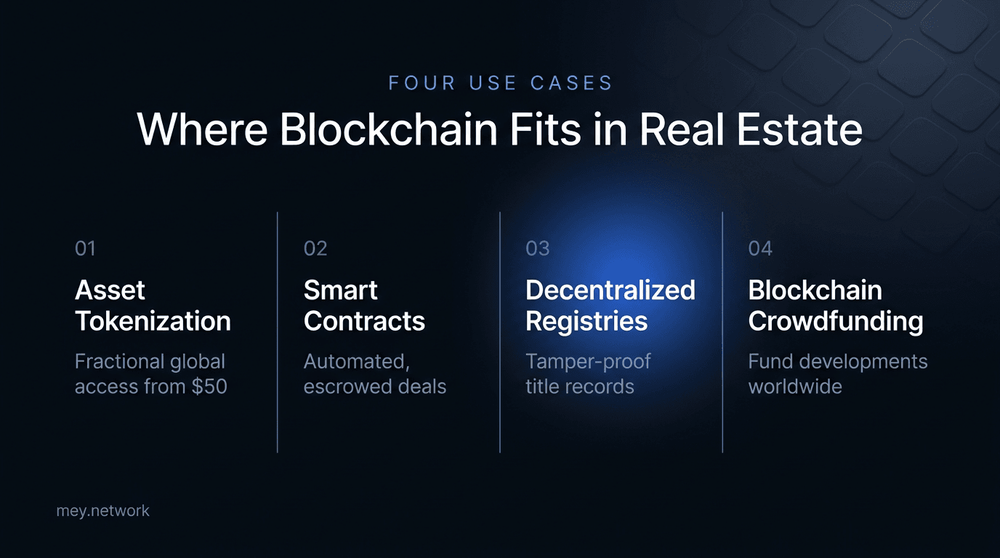
Asset tokenization: opening doors to global property access
Tokenization is the most practical application blockchain brings to real estate right now. Instead of wiring $500,000 to acquire a foreign property you have never visited, you can acquire fractional units representing a share of that asset for a few hundred dollars. The ownership is recorded on-chain, meaning it is verifiable, transferable, and not dependent on any single institution.
Here is how the process works in practice. A property owner or fund manager places a real estate asset into a legal structure, often a special purpose vehicle (SPV). The SPV issues digital units that represent ownership stakes. Participants acquire those units through a compliant platform, and the blockchain records every transaction. Rental flows and value progression reach unit holders proportionally.
The benefits for cross-border participants are significant:
Lower minimums: entry points can drop from hundreds of thousands of dollars to as little as $50 or $100.
Faster settlement: unit transfers settle in minutes rather than the weeks typical of traditional closings.
Geographic freedom: a US-based participant can hold fractional stakes in a London office, a Dubai apartment, and a Tokyo retail space simultaneously.
Transparent flows: smart-contract distributions mean rental income arrives automatically, without relying on a property manager to cut a check.
Tokenization can lower minimums and deepen the distribution layer, making real estate accessible to a far broader pool of global participants. That shift is already attracting institutional attention from firms like BlackRock and JPMorgan, which signals that blockchain-coordinated real estate is moving from experiment to mainstream asset class.
Smart contracts: automating deals and reducing friction
Smart contracts are self-executing programs stored on a blockchain that carry out predefined actions when specific conditions are met. In real estate, they replace the manual tokenization between counterparties, lawyers, and escrow agents with automated logic that runs exactly as written.
A typical smart-contract-powered property transaction follows these steps:
Deposit: the acquirer sends funds to a smart-contract address, which holds them in escrow automatically.
Verification: the contract checks that all conditions are satisfied, such as title clearance, inspection approval, and identity verification.
Transfer: once every condition is confirmed, the contract simultaneously releases funds to the previous holder and transfers the digital title unit to the new holder.
Recording: the completed transaction is written to the blockchain, creating a permanent, auditable record.
Smart contracts can execute property transactions automatically when predefined conditions are met, removing the need for manual oversight at every stage.
The efficiency gains are real, but so are the risks. A bug in the contract code can cause unintended outcomes, and legal enforceability varies by jurisdiction. Mitigation means working with platforms that conduct third-party code audits and operate in jurisdictions where digital contracts carry legal weight. Smart contracts reduce friction dramatically, but they work best when paired with sound legal counsel.
Decentralized property registries: enhancing transparency and security
For cross-border participants, verifying that a previous holder actually owns the property they are transferring is one of the hardest problems in international real estate. Traditional registries are often paper-based, siloed within national systems, and vulnerable to fraud or clerical errors. Blockchain-based registries solve this by creating a shared, immutable record of ownership that any authorized party can query from anywhere in the world.
Decentralized ledgers improve reliability and reduce risk of forged documents, which is especially critical when acquirers cannot physically inspect records in a foreign country.
The practical impact is significant. A participant in Singapore evaluating a property in Portugal can verify ownership history, check for liens, and confirm title status without hiring a local attorney just to read a registry. That kind of remote due diligence was nearly impossible a decade ago.
- Accessibility
- Traditional registry: Local offices, business hours
- Blockchain registry: 24/7, global access
- Fraud risk
- Traditional registry: High, paper records can be altered
- Blockchain registry: Very low, immutable ledger
- Update speed
- Traditional registry: Days to weeks
- Blockchain registry: Near real-time
- Cost
- Traditional registry: High administrative fees
- Blockchain registry: Lower, automated processing
- Transparency
- Traditional registry: Limited, often opaque
- Blockchain registry: Full audit trail
Blockchain-powered crowdfunding: opening real estate development
Blockchain crowdfunding takes tokenization one step further by allowing global participants to fund entire development projects, not just existing properties. A developer building a mixed-use complex in Miami can raise capital from participants in Seoul, Berlin, and São Paulo simultaneously, all through a compliant unit offering.
Blockchain crowdfunding allows participants worldwide to join with greater security and transparency than traditional syndication models, where deal flow is often restricted to accredited participants with existing relationships.
For portfolio diversification, this model is powerful. Instead of concentrating capital in one or two large deals, you can spread exposure across multiple projects, asset types, and geographies with relatively small individual commitments.
Pro tip: when evaluating blockchain crowdfunding platforms, look for those that publish smart-contract audits, maintain clear participant rights documentation, and operate under securities regulations in their home jurisdiction. Transparency at the platform level reflects the transparency you should expect at the deal level.
- Participant eligibility
- Blockchain crowdfunding: Broader, often global
- Traditional syndication: Often accredited only
- Minimum entry
- Blockchain crowdfunding: Low, sometimes under $100
- Traditional syndication: Typically $25,000 or more
- Transparency
- Blockchain crowdfunding: On-chain, real-time reporting
- Traditional syndication: Periodic, manual reports
- Distribution-layer depth
- Blockchain crowdfunding: Distribution-venue activity possible
- Traditional syndication: Illiquid until exit event
- Geographic reach
- Blockchain crowdfunding: Global
- Traditional syndication: Mostly domestic
Comparing blockchain use cases: which solution suits your goals?
Each blockchain application in real estate solves a different problem. Choosing the right one depends on your participation profile, distribution-layer needs, and cross-border objectives. A side-by-side view helps clarify the compromises.
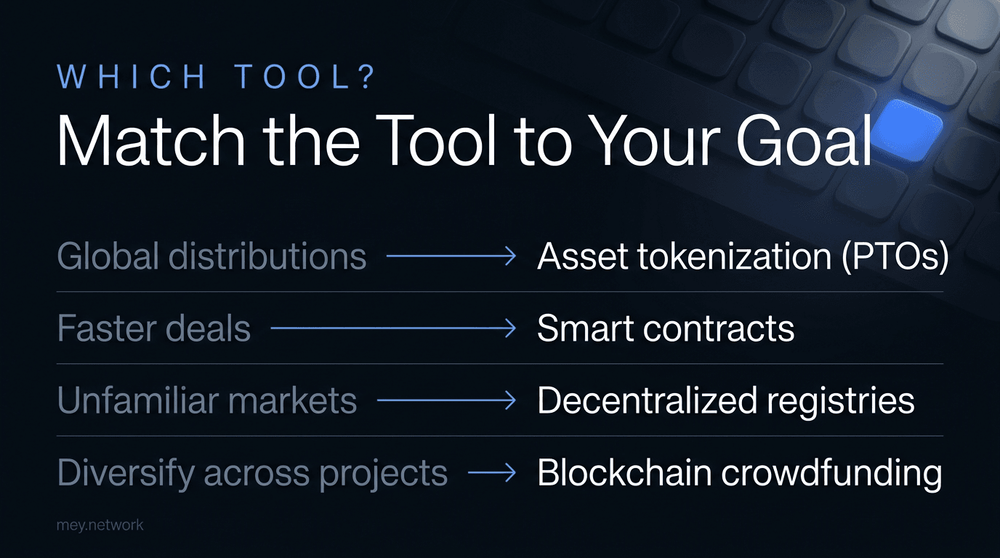
Here is how to match each tool to your goals:
You want distribution flows from global properties: asset tokenization is your primary tool. Look for platforms offering PTOs (property token offerings) with built-in distribution.
You are closing deals frequently and want speed: smart contracts reduce your transaction timeline and eliminate manual tokenization.
You are acquiring in unfamiliar ecosystems: decentralized registries give you the verification layer you need before committing capital.
You want diversification across projects: blockchain crowdfunding lets you spread risk across multiple developments with small individual stakes.
Most sophisticated participants will use a combination of these tools rather than relying on any single approach. The key is understanding what each one does well and where its limitations lie.
- Asset tokenization
- Best for: Fractional interests, distribution flows
- Distribution-layer depth: High
- Complexity: Low to medium
- Cross-border fit: Excellent
- Smart contracts
- Best for: Transaction automation, speed
- Distribution-layer depth: N/A
- Complexity: Medium
- Cross-border fit: Good
- Decentralized registries
- Best for: Due diligence, fraud prevention
- Distribution-layer depth: N/A
- Complexity: Low
- Cross-border fit: Excellent
- Blockchain crowdfunding
- Best for: Project-level diversification
- Distribution-layer depth: Medium
- Complexity: Medium
- Cross-border fit: Excellent
Unlock blockchain-powered real estate opportunities with Mey Network
Understanding blockchain use cases is one thing. Having a platform that puts all of them to work for your portfolio is another.
Mey Network is built specifically for participants who want to access blockchain-coordinated real estate globally without the friction of traditional ecosystems. The platform issues PTOs (property token offerings) that represent a fractional interest in real-world assets, with flows distributed automatically through smart contracts. MeyFi, the platform's operational engine, adds staking and lending capabilities so your holdings can generate distributions beyond rental flows. Whether you are looking to diversify across borders, deepen distribution-layer access in an illiquid asset class, or join the growing RWA super cycle, Mey Network provides the infrastructure to do it securely and transparently. Explore the platform and see which coordinated properties align with your goals.
Frequently asked questions
How does blockchain make real estate participation more global?
Tokenization and crowdfunding expand global property access by removing capital minimums and geographic restrictions, while blockchain crowdfunding allows global participation with on-chain transparency that traditional models cannot match.
Are blockchain-based property registries safer than traditional ones?
Decentralized ledgers improve reliability and reduce the risk of forged documents, making them significantly more secure for remote and cross-border transactions where physical verification is not practical.
Can smart contracts replace lawyers and intermediaries in real estate?
Smart contracts can execute property transactions automatically, but legal professionals remain essential for ensuring contracts are enforceable under local law and that all regulatory requirements are met.
What should participants look for in a blockchain real estate platform?
Prioritize regulatory compliance, published smart-contract audits, transparent fee structures, and a clear operating record of completed transactions before committing capital to any platform.
