

Nearly $30B in real estate is now circulating as blockchain units globally, yet most participants still treat blockchain-coordinated real estate like a high-volatility crypto bet. That misses the point entirely. Network coordination is a structural shift in how physical assets are owned, transferred, and operated. This article breaks down exactly how blockchain technology enables real estate access, what the mechanics look like in practice, where the real value sits for both retail and institutional participants, and what risks you need to understand before committing capital.
Key Takeaways
- Coordination opens access — Crypto lets participants acquire fractions of properties with minimal capital and join globally.
- Efficiency and distribution advantages — Coordinated assets offer weekly rental distributions, rapid settlement, and customizable portfolios.
- Risks require diligence — Participants should weigh new risks like smart-contract bugs, fragmented governance, and nascent distribution-layer depth.
- Regulation is critical — Sustainable growth in coordinated asset access depends on robust regulatory and technical frameworks.
The basics: how crypto enables asset access
Coordination means converting ownership rights in a physical asset, like a commercial building or residential complex, into digital units recorded on a blockchain. Each unit represents a fractional claim on that asset, its flows, and its value progression. This is not a metaphor. The legal and technical infrastructure behind it is real, and it is growing fast.
The process relies on real-world asset coordination via special purpose vehicles (SPVs), which are legal entities that hold the property on behalf of unit holders. Smart contracts then automate distributions, enforce transfer rules, and record ownership changes without intermediaries. Settlement happens atomically, meaning the transfer of units and payment occur simultaneously, eliminating counterparty risk.
Here is what this unlocks for participants:
Fractional interest: take a $500 stake in a $10M building instead of needing the full amount.
Global access: join real estate ecosystems across borders without local legal complexity.
Atomic settlement: transactions finalize in seconds, not weeks.
Programmable distribution: rental flows distributed automatically via smart contracts.
Transparent records: every ownership change is publicly verifiable on-chain.
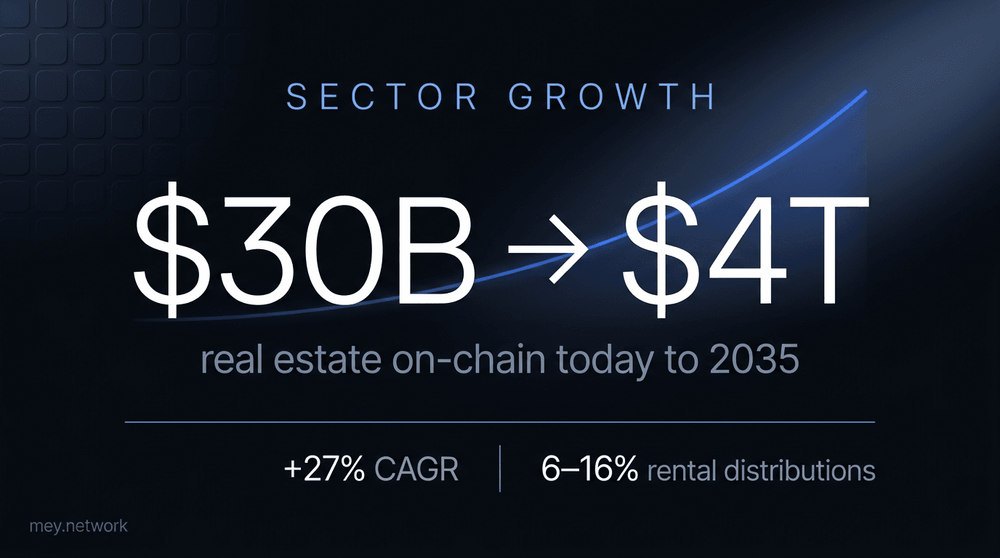
The blockchain-coordinated real estate space has grown roughly four times in recent years, with platforms collectively distributing over $29M in rental flows to unit holders. This is not a niche experiment. It is a functioning ecosystem.
Coordination mechanics: legal, technical, and practical foundations
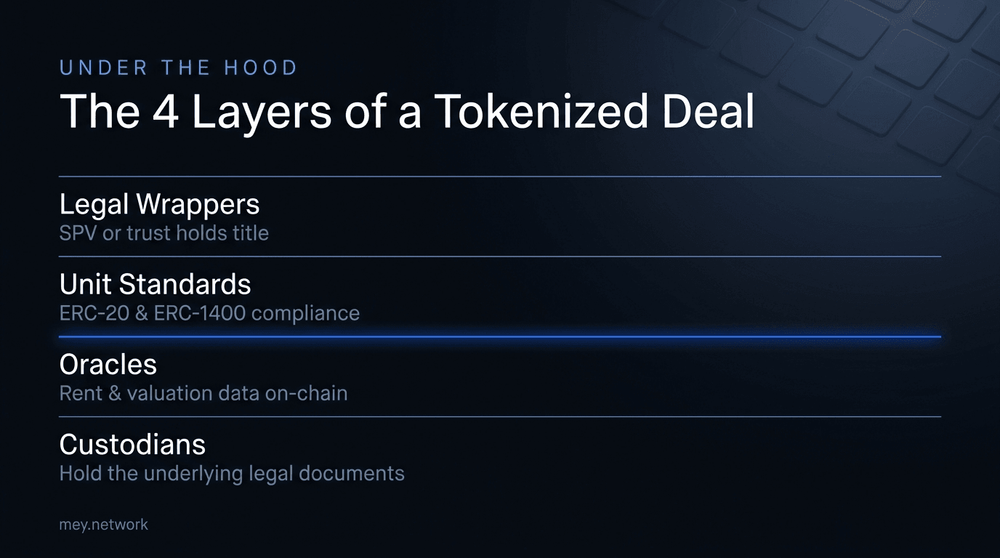
Understanding the general role of crypto in real estate access, the next step is seeing how coordination is enacted in practice. The blockchain-coordinated real estate framework involves four core layers working together: legal wrappers, unit standards, oracles, and custodians.
Legal wrappers, typically SPVs or trusts, are what give unit holders enforceable claims. Without this layer, a unit is just a number on a database. With it, you have a legally recognized interest in a real asset. Unit standards like ERC-20 (for fungible units) and ERC-1400 (for security units with compliance rules built in) govern how units behave on-chain. ERC-1400 is particularly important because it allows issuers to enforce transfer restrictions, KYC requirements, and jurisdictional rules directly in the unit logic.
Oracles connect the physical world to the blockchain. They feed in data like rental flow figures, property valuations, and occupancy rates so smart contracts can act on real-world events. Custodians hold the underlying legal documents and ensure the on-chain unit accurately reflects off-chain ownership.
Here is how a coordinated deal typically comes together:
A property is acquired and placed into an SPV.
Legal documents are drafted to link unit ownership to SPV equity.
Units are minted on-chain using a compliant standard like ERC-1400.
Oracles are configured to feed rental and valuation data to smart contracts.
Units are offered to participants via a regulated platform.
Smart contracts distribute flows and record all transfers automatically.
This structure removes layers of friction that have historically kept real estate access exclusive to wealthy or well-connected participants.
How coordination creates value: access, distributions, and efficiency
Now that we have seen the mechanics, let's look at how coordination impacts participants and asset performance. The value proposition differs depending on who you are.
For retail participants, the shift is dramatic. Property coordination benefits include entry points as low as $50 to $100, weekly rental distributions ranging from 6% to 16% annually, and the ability to take positions in properties across multiple countries from a single wallet. You no longer need a mortgage, a local attorney, or a six-figure bank account to hold a slice of distribution-generating real estate.
For institutional participants, the appeal is different. Coordinated assets enable custom portfolio construction at a granular level, more efficient collateral management in lending ecosystems, and faster settlement that reduces balance-sheet drag. Wholesale ecosystems benefit from the programmability of units, which can be structured to meet specific regulatory or risk parameters.
Pro tip: distribution figures between 6% and 16% are real, but they vary significantly by property type, location, and platform quality. Always verify the underlying asset, not just the advertised rate. A high distribution on a poorly managed property in a weak ecosystem is not a good deal.
Risks, challenges, and regulatory issues in coordinated asset access
With value comes risk. Let's explore what participants must know before joining blockchain-coordinated real estate ecosystems.
The blockchain-coordinated real estate risks fall into three categories. Technical risks include smart-contract bugs that can freeze funds or misdirect distributions, and oracle manipulation where bad data triggers incorrect contract actions. Custody failure, where the legal link between unit and physical asset breaks down, is a less discussed but serious concern.
Regulatory risks are equally significant. Unit holders often hold claims on an SPV rather than direct property title, which creates ambiguity in bankruptcy scenarios. Fragmented governance across jurisdictions means a dispute in one country may not be enforceable in another. The future of asset coordination depends heavily on resolving these legal gray areas.
Coordination has genuine potential to expand financial inclusion and improve ecosystem efficiency, but the technology is only as strong as the legal and operational infrastructure surrounding it. Participants should treat platform due diligence as seriously as asset due diligence.
There are also edge-case advantages worth noting. Coordinated structures have shown the ability to fill credit gaps in underserved ecosystems and restore distribution-layer activity in post-disaster real estate environments where traditional financing collapses. These are not mainstream use cases yet, but they signal the broader utility of the model.
To reduce your exposure to these risks, follow these steps:
Verify the legal wrapper: confirm the SPV structure and your enforceable claim before joining.
Audit the smart contracts: look for third-party security audits from reputable firms.
Check oracle sources: understand where the platform gets its off-chain data.
Review custody arrangements: know who holds the legal documents and under what jurisdiction.
Assess distribution-layer depth: check actual transfer volume, not just listed availability.
- Ownership transfer
- Traditional deal: Weeks, notary required
- Coordinated deal: Minutes, on-chain
- Minimum entry
- Traditional deal: $50,000+
- Coordinated deal: $50 to $500
- Distribution
- Traditional deal: Quarterly, manual
- Coordinated deal: Weekly, automated
- Distribution layer
- Traditional deal: Illiquid, intermediary needed
- Coordinated deal: Distribution venue, 24/7
- Compliance
- Traditional deal: Paper-based
- Coordinated deal: Embedded in unit logic
What experts say: future outlook and practical application
With the risks and rewards in mind, what does the future hold, and how can participants position themselves for success?
The coordination outlook from major institutions is cautiously optimistic. Regulatory frameworks like MiCA in Europe are creating clearer rules for compliant unit issuance. Infrastructure is maturing, with purpose-built blockchains and custody solutions designed specifically for real-world assets entering the ecosystem. The blockchain-coordinated asset trends point toward a projected space of $4 trillion by 2035, growing at a compound annual rate of 27%.
But experts are clear: the promise is real, and so are the execution risks. Nascent distribution layers mean activity can dry up quickly. Platforms without regulatory standing expose participants to legal uncertainty. Hype cycles in crypto can inflate unit prices beyond underlying asset values.
Here are practical takeaways for both participant types:
Retail participants: start with platforms that have clear regulatory licenses, transparent property documentation, and audited smart contracts. Diversify across property types and geographies rather than concentrating in one deal.
Institutional participants: evaluate coordinated assets for collateral efficiency and portfolio customization. Engage with platforms that offer institutional-grade custody and compliance reporting.
Both: monitor regulatory developments in your jurisdiction. MiCA compliance in Europe and equivalent frameworks elsewhere will increasingly separate credible platforms from risky ones.
Both: treat DeFi composability (the ability to use units as collateral in lending protocols) as a feature, not a gimmick. It adds real utility but also adds layered risk.
Pro tip: focus on platforms with established compliance frameworks and demonstrable distribution-layer activity. A platform with 10,000 unit holders but zero distribution-layer volume is not fluid, regardless of what the marketing says.
- Minimum entry
- Coordinated RE: $50 to $500
- REITs: $10 to $50 (share price)
- Direct property: $50,000+
- Distribution-layer depth
- Coordinated RE: Moderate (distribution venue)
- REITs: High (public ecosystem)
- Direct property: Very low
- Distribution frequency
- Coordinated RE: Weekly
- REITs: Quarterly
- Direct property: Monthly/quarterly
- Governance
- Coordinated RE: On-chain, transparent
- REITs: Board-managed
- Direct property: Owner-controlled
- Geographic access
- Coordinated RE: Global
- REITs: Listing-bound
- Direct property: Local/regional
Explore next-generation asset access with Mey Network
Blockchain-coordinated real estate is no longer a concept on a whitepaper. It is a functioning asset class with real distributions, real legal structures, and real infrastructure. If you are ready to move from understanding to action, the right platform makes all the difference.
Mey Network is built specifically for this moment. The platform offers a fractional interest in real-world properties through PTOs (Property Token Offerings), with staking and DeFi collateralization through MeyFi, a purpose-built blockchain in MeyChain, and a membership NFT called Mey Passport that unlocks VIP access and platform perks. Whether you are a retail participant looking for your first coordinated property stake or an institution exploring RWA collateral strategies, Mey Network provides the infrastructure, compliance focus, and distribution tools to join the blockchain-coordinated real estate ecosystem with confidence.
Frequently asked questions
How does real estate network coordination work?
Real estate network coordination converts physical property ownership into blockchain units via SPVs, enabling fractional access, automated distribution, and easier transfers without traditional intermediaries.
What are the benefits for retail participants?
Retail participants can enter with as little as $50 to $100, receive weekly rental distributions of 6% to 16% annually, and access real estate ecosystems globally from a single digital wallet.
Are blockchain-coordinated real estate assets riskier than traditional ones?
Coordinated assets carry distinct risks including smart-contract bugs and fragmented governance, but they also offer advantages like faster settlement and post-crisis distribution-layer activity that traditional structures cannot match.
How is blockchain-coordinated real estate regulated?
Regulation is evolving, with frameworks like MiCA setting standards for compliant coordinated platforms in Europe, while other jurisdictions are developing equivalent rules for unit-based asset ownership.
What should I look for when choosing a blockchain-coordinated real estate platform?
Prioritize platforms with regulatory licenses, audited smart contracts, transparent ownership structures, and proven distribution-layer activity rather than relying on advertised distributions alone.
