

Real estate has long been the domain of the wealthy, with direct property ownership requiring hundreds of thousands of dollars in capital, legal expertise, and geographic proximity. NFTs are changing that equation fast. By representing fractional shares of physical properties on a blockchain, these units let participants worldwide acquire real estate exposure for as little as $100. This article breaks down exactly how NFT-based real estate works, which platforms are leading the charge, what genuine benefits exist, and where the real risks hide so you can make informed decisions before committing capital.
Key Takeaways
- Opened access — NFTs lower the bar for real estate participation, offering fractional shares to a global audience.
- Automated and efficient — Smart contracts automate rent distribution and simplify the management of positions.
- Legal and platform risks — Most NFTs do not give legal property title and risks include regulatory and platform failures.
- Distribution-layer potential — NFTs can enable easier, smaller re-transfers, though depth is often limited and volatile.
- Participant due diligence — Check every platform's legal structure, operating record, and regulatory status before joining.
How NFTs Work In Real Estate
An NFT, or non-fungible token, is a unique digital record stored on a blockchain. In real estate, coordination means converting ownership rights in a property into digital units that can be acquired, transferred, or held. The blockchain acts as a transparent, tamper-resistant ledger that records every transaction without needing a bank or title company to verify it.
Here is how the structure typically works in practice:
A property is placed inside a Special Purpose Vehicle (SPV) or LLC, a legal entity created solely to hold that asset.
The SPV issues units, often NFTs, that represent fractional membership interests in the company.
Smart contracts, which are self-executing code on the blockchain, automate rent distribution, voting rights, and re-transfer rules.
Participants hold units in digital wallets and can transfer them on distribution venues without going through a traditional title transfer.
This structure means fractional real estate mechanics rely on blockchain for transparent ledgers and programmable agreements, not on replacing the legal deed itself.
Pro tip: most platforms do not make the NFT the legal property deed. You are acquiring a share in an LLC or SPV that owns the property, not the property itself. This distinction matters enormously for your legal rights.
Smart contracts eliminate the need for manual rent collection or distribution. When a tenant pays rent, the contract automatically splits and sends proportional payments to every unit holder within minutes. That level of automation simply does not exist in traditional real estate.
How fractional real estate NFT positions work
With the technical foundation set, let's see how real-world platforms put these mechanics into action for participants.
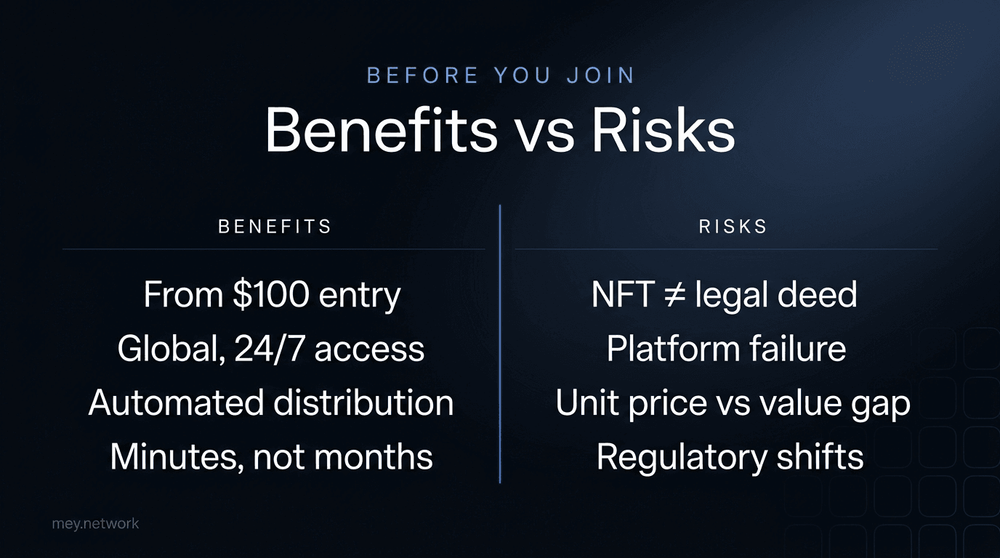
The retail participation process is more straightforward than most people expect. Here is a typical flow:
Sign up and complete KYC. Platforms require identity verification and, in many cases, accredited-participant status for US residents.
Browse available properties. Listings show projected rental rates, property details, and unit price.
Acquire units. Minimum positions can be as low as $100. Platforms like Homebase use NFTs on Solana for fractional single-family rental interest with distribution-layer activity enabled.
Receive automated payouts. Rent flows are distributed via smart contract on a regular schedule.
Transfer or hold. Units can be listed on distribution venues, though depth varies significantly by platform.
On the institutional side, the scale is dramatically larger. Cardone Capital plans a $5B portfolio coordination, while other operators like Patel have launched $100M coordinated funds. These moves signal that coordination is not just a retail experiment. It is attracting serious capital.
NFT-based platforms offer 24/7 distribution-layer access and automation, but depth remains thin on most distribution venues. Participants should not assume they can exit a position quickly.
Some platforms impose yearly lockup periods, meaning you cannot transfer your units for a set time after acquisition. This protects the underlying property position but limits your flexibility. Always read the smart-contract terms before acquiring.
Key benefits: accessibility, efficiency, and global reach
Understanding how positions are managed, let's look closer at what NFTs actually add compared to legacy models.
The advantages are real and measurable. Real estate coordination data shows that NFTs and coordination open access for retail and institutional participants and enable global 24/7 distribution-layer activity, though depth remains thin and regulations are strict in many jurisdictions.
Here are the core benefits worth knowing:
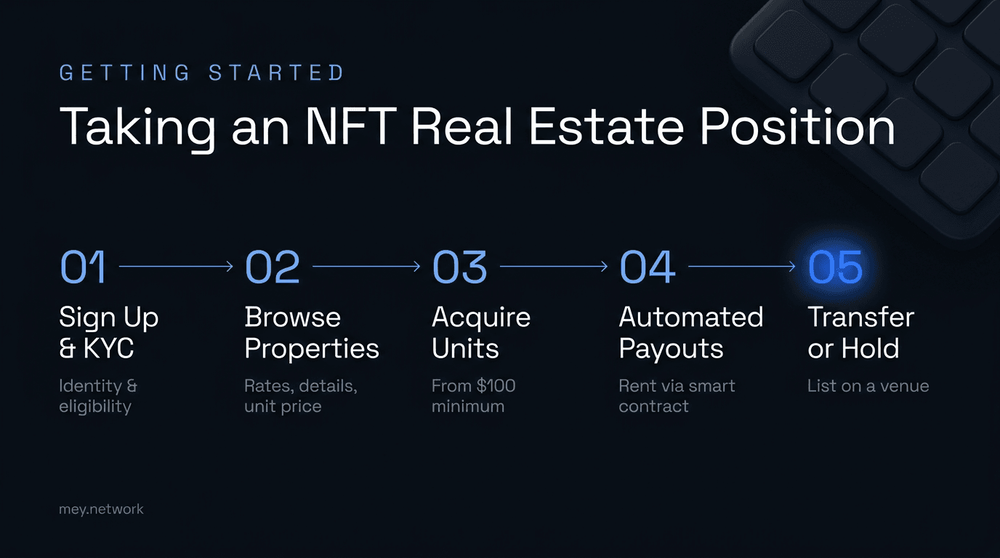
Low entry point. Fractional access starts from $50 to $100, compared to tens of thousands for a traditional down payment.
Global participation. Any participant with internet access and a compliant wallet can join, regardless of where the property is located.
Automated distribution. Smart contracts distribute rental flows without delays, manual processing, or intermediaries.
Faster re-transfers. Transferring a unit takes minutes versus months for a traditional property transfer.
Pro tip: retail access is opening up, but regulatory and tax treatment still depend heavily on your jurisdiction. Check local requirements before joining, especially if you are outside the US.
The efficiency gains are not just theoretical. When rent is distributed automatically to thousands of unit holders simultaneously, the operational cost per participant drops dramatically compared to managing individual landlord relationships.
- Minimum entry
- Traditional real estate: $50,000+
- NFT-based fractional interests: $50 to $100
- Distribution-layer depth
- Traditional real estate: Very low (months to transfer)
- NFT-based fractional interests: Moderate (distribution venue)
- Fees
- Traditional real estate: High (agents, title, legal)
- NFT-based fractional interests: Lower (smart-contract automation)
- Automation
- Traditional real estate: None
- NFT-based fractional interests: Full (rent, payouts, voting)
- Global accessibility
- Traditional real estate: Limited by geography
- NFT-based fractional interests: Open to global participants
Risks, legal barriers, and real-world challenges
Every innovation carries risks. Here is what participants need to watch out for in NFT real estate.
The legal landscape is the biggest source of uncertainty. The SEC views many real estate units as securities under Regulation D or Regulation A, which means platforms must register offerings or qualify for exemptions. Legal critiques of NFT real estate point out that direct NFT-as-deed is not legally recognized, and risks include property mismanagement that unit holders have little power to address.
Key risks to understand before joining:
Legal status. Your NFT represents a company interest, not a deed. If the platform or SPV faces legal trouble, your recourse is limited.
Platform failure. If the company operating the platform shuts down, unit holders may struggle to recover their position.
Unit price vs. property value. Distribution-venue prices can diverge significantly from the underlying property's actual value.
Regulatory changes. New SEC guidance or international regulations could restrict transfers or require platform restructuring.
Empirical unit-circulation data shows that units are competitive with REITs in distributions, but distribution-layer transfers often occur at a premium with low depth, and property-level risks create clustering effects that can hit multiple unit holders at once.
Coordination offers efficiency, but property mismanagement and unclear legal status remain the two most significant risks for unit holders today.
Real-world examples make this concrete. RealT, one of the earliest NFT real estate platforms, faced lawsuits in Detroit related to property conditions. Unit holders had no direct mechanism to force repairs or management changes. That gap between digital ownership and physical control is a structural challenge the industry has not fully solved.
Who should consider NFT real estate participation?
After examining the spectrum of risks, let's highlight who stands to benefit and how to approach the opportunity wisely.
NFT real estate participation is not for everyone, but it fits certain participant profiles well. Real estate unit-distribution data shows that mechanics via SPV plus NFT or smart unit enable global access through blockchain, though KYC and regulatory requirements apply, and benchmarks show RE unit distributions rival REITs but with clustering risk.
Who benefits most:
New participants with limited capital who want real estate exposure without a large down payment.
Global participants who cannot easily acquire property in foreign ecosystems due to legal or financial barriers.
Institutions piloting modern solutions that want to test coordination at scale before full commitment.
Before you join, ask these questions:
What is the legal structure? Is the NFT backed by an SPV or LLC, and what are your rights as a member?
What is the platform's operating record? How long has it operated, and has it paid out consistently?
How fluid is the distribution venue? Can you realistically transfer your units if you need to exit?
What distributions are projected, and how are they calculated? Are they based on actual rental flows or speculative value progression?
What KYC and AML requirements apply? Are you eligible to join based on your residency and accreditation status?
To get started, follow these steps:
Research platforms that operate in your jurisdiction and have a verifiable operating record.
Complete jurisdiction due diligence. Understand local tax treatment and whether the units qualify as securities where you live.
Pick a platform with transparent smart-contract terms, audited code, and clear property management disclosures.
Read the smart-contract terms before acquiring. Understand lockup periods, fee structures, and exit conditions.
Start small. Use the low minimum threshold to test the platform before committing significant capital.
- Average distribution rate
- NFT real estate units: 6 to 10%
- Traditional REITs: 4 to 8%
- Distribution-layer depth
- NFT real estate units: Low
- Traditional REITs: High
- Minimum entry
- NFT real estate units: $50 to $100
- Traditional REITs: $1 (ETF shares)
- Legal clarity
- NFT real estate units: Evolving
- Traditional REITs: Well established
- Property control
- NFT real estate units: None
- Traditional REITs: Indirect via management
Explore NFT-powered real estate opportunities with Mey Network
If you are ready to move from understanding to action, the right platform makes all the difference. Mey Network is built specifically for participants who want real, asset-backed exposure to global real estate through blockchain technology.
Mey Network offers fractional property interests through PTOs (Property Token Offerings), a purpose-built blockchain called MeyChain, and MeyFi tools for staking and lending against your real estate units. Whether you are a retail participant starting with a small amount or an institution exploring coordinated portfolios, Mey Network provides the infrastructure, transparency, and distribution tools to join the growing RWA ecosystem. Visit Mey Network to explore current listings, educational resources, and how to get started with blockchain-coordinated real estate today.
Frequently asked questions
Do NFTs give me legal title to a property?
No. NFTs in real estate represent a membership interest in an LLC or SPV that holds the property, not a legally recognized deed transfer. Your rights are defined by the company's operating agreement, not property law.
Can I take a position in real estate NFTs if I'm not an accredited US participant?
Most US-facing platforms require accredited-participant status, but coordination regulations vary globally, and some platforms operating under Regulation S allow broader international participation outside the US.
How does transferring my NFT work compared to transferring a rental property?
You list your unit on a distribution venue and a counterparty acquires it directly, often within days. However, distribution-venue depth is still limited on most platforms, so finding a counterparty at your target price is not guaranteed.
What are the biggest risks with NFT real estate participation?
Legal uncertainty, platform failures, and lack of direct property control are the primary risks. Cases like RealT Detroit lawsuits show that unit holders have limited recourse when physical property management breaks down.
