

For most of history, acquiring real estate meant having serious capital, a lawyer, an intermediary, and months of patience. Blockchain and DeFi are changing that fast. Fractional ownership via tokenization now lets you hold a slice of a commercial building for less than the cost of a dinner out, and transfer it in minutes rather than months. This guide breaks down the mechanics, the real opportunities, the genuine risks, and where the ecosystem is heading so you can make informed decisions as either a retail or institutional participant.
Key Takeaways
- Access for all — DeFi and tokenization let anyone access global real estate for as little as $50.
- 24/7 distribution-layer activity — Property units can be transferred at any time, making real estate access far more fluid.
- Balanced opportunities — Participants gain new ways to access distributions but face risks in regulation, technology, and governance.
- Evolving landscape — Future trends involve more automation, global reach, and community-led property management.
What is DeFi and why does it matter for real estate?
Decentralized finance, or DeFi, refers to financial services and ecosystems built on blockchain networks using smart contracts, with no banks or intermediaries required. Instead of trusting a middleman to execute a deal, you trust code. That shift sounds subtle, but for real estate, it is enormous.
Traditional property participation involves banks approving mortgages, title companies verifying ownership, intermediaries negotiating deals, and lawyers drafting contracts. Every step adds cost, time, and friction. DeFi automates trust and value transfer through programmable, permissionless tokenization, removing intermediaries entirely.
Smart contracts enforce the rules automatically. Unit standards like ERC-20 handle fungible property shares, while ERC-1400 adds compliance layers such as transfer restrictions and participant whitelisting, which are critical for regulated tokenized real estate ecosystems. These standards enable the programming of ownership rights, distributions, and governance rules directly into the unit itself.
Here is what DeFi brings to real estate that traditional finance simply cannot match:
Global access: any participant with a crypto wallet can join, regardless of geography.
Speed: transactions settle in seconds, not weeks.
Transparency: every ownership record and distribution payment lives on a public ledger.
Programmability: rent distributions, voting rights, and compliance rules are automated.
Lower minimums: entry points drop from hundreds of thousands of dollars to under $100.
DeFi removes the gatekeepers that have historically kept real estate participation exclusive. The result is an ecosystem that is faster, more transparent, and open to anyone with an internet connection.
How does tokenization enable fractional ownership?
Tokenization is the process of converting ownership rights in a real asset into digital units on a blockchain. For real estate, this typically works through a special-purpose vehicle, or SPV. The SPV is a legal entity, usually an LLC, that holds the actual property. Properties held by SPVs are then issued as units representing equity or debt shares in that entity, giving unit holders legal exposure to the underlying asset.
This structure solves a fundamental problem: you cannot put a building on a blockchain, but you can put a legal claim to that building on one.
To understand the math, consider a concrete example:
- $2,000,000
- Unit price: $10,000
- Total units: 200 units
- Minimum entry: $10,000
- $2,000,000
- Unit price: $1,000
- Total units: 2,000 units
- Minimum entry: $1,000
- $2,000,000
- Unit price: $50
- Total units: 40,000 units
- Minimum entry: $50
Units can represent as little as $50 to $100 of a property, which means a diversified real estate portfolio is now within reach for almost any participant. You can spread $500 across 10 properties in 5 countries.
Here is how the acquisition process typically works:
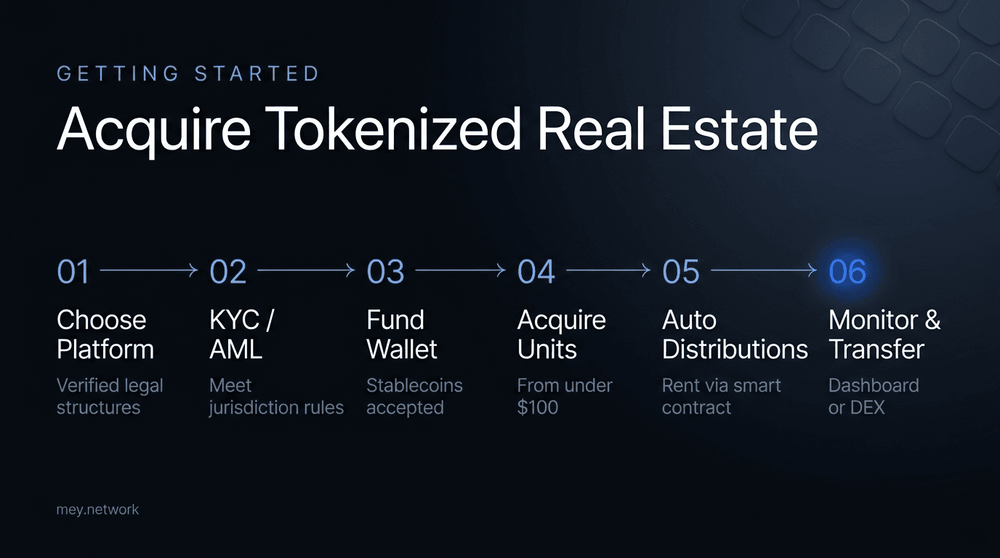
Choose a platform that lists tokenized properties with verified legal structures.
Complete KYC/AML verification to meet regulatory requirements for your jurisdiction.
Fund your wallet with stablecoins or accepted cryptocurrencies.
Acquire units directly from the platform or on a distribution venue.
Receive distributions automatically via smart-contract payments to your wallet.
Monitor and transfer your holdings through the platform dashboard or connected DEX.
You can explore the full mechanics of fractional ownership mechanics to understand how different platforms structure their legal and technical layers.
Pro tip: always verify the KYC/AML requirements before joining. Many platforms restrict participation for US persons under securities law, while others are US-only. Knowing your regulatory status upfront saves time and avoids compliance issues later.
DeFi's role in deepening the distribution layer: transfers and lending with real estate units
Distribution-layer depth is where DeFi truly separates itself from every prior model of real estate participation. Traditional property is notoriously illiquid. Transferring a building takes months. Even REITs, which list public ecosystems, have limited hours and settlement delays. DeFi changes the equation entirely.
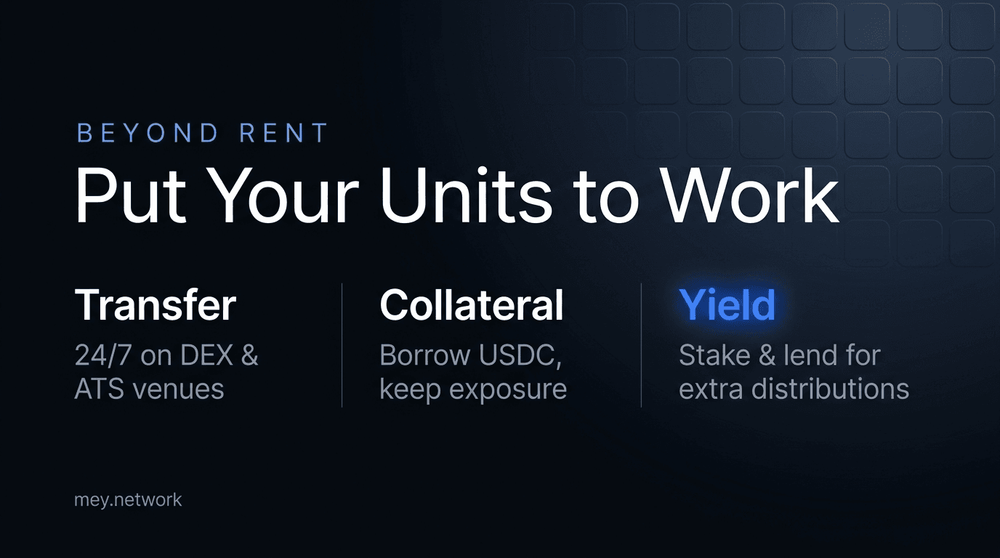
Distribution venues on DEXs like Uniswap, compliant ATS platforms, and platform-native buyback programs enable instant settlement around the clock. You are not waiting for a counterparty to get a mortgage approved.
Beyond transferring, units used as collateral for lending and DeFi distributions open up a completely new dimension. You can borrow USDC against your real estate unit holdings without exiting your position, similar to how margin lending works in traditional finance, but without the bank. Platforms and protocols currently leading in this space include Uniswap for unit swaps, RealT's Real World ecosystem for peer-to-peer transfers, and Landshare Pools for distribution farming with real estate-backed assets.
For institutional participants, this collateralization feature is particularly powerful. It allows real estate exposure to serve as productive capital rather than a locked, passive holding.
- Activity hours
- Traditional real estate: Business hours only
- REITs: Listing hours
- DeFi real estate units: 24/7
- Settlement time
- Traditional real estate: 30 to 90 days
- REITs: 2 days
- DeFi real estate units: Seconds
- Minimum entry
- Traditional real estate: $50,000 or more
- REITs: $10 to $100
- DeFi real estate units: $50 to $1,000
- Geographic access
- Traditional real estate: Local/national
- REITs: Listing-bound
- DeFi real estate units: Global
- Collateral use
- Traditional real estate: Limited
- REITs: Limited
- DeFi real estate units: DeFi lending protocols
Opportunities and challenges for participants: distributions, risks, and real-world impact
The numbers behind tokenized real estate are compelling. The tokenized real estate ecosystem sits at $486 million in total value locked in 2026, with projections reaching $4 trillion by 2035. Typical distribution rates run from 6% to 16% annually, depending on property type and location. That compares favorably to most fixed-income alternatives.
Tokenization can automate compliance and administration, but it does not erase the underlying property risks. Vacancy, maintenance, and local ecosystem conditions still apply.
But the risks are real and worth understanding clearly. Key risks in tokenized real estate include thin distribution layers, smart contract vulnerabilities, legal uncertainty across jurisdictions, and operational risks related to property management.
Here is a practical breakdown of what to watch:
Distribution-layer gaps: some unit ecosystems trade at a discount to underlying property value, particularly in lower-demand areas like Detroit, where risk and location reduce participation.
Regulatory uncertainty: securities laws vary widely by country, and platforms may be forced to restrict access or shut down distribution channels.
Smart-contract risk: bugs in code can lead to fund losses, and audits are not always thorough or public.
Platform dependency: if the issuing platform fails, unit holders may face complex legal recovery processes.
Valuation opacity: Property appraisals may not be updated frequently, creating gaps between unit prices and real asset values.
You can review a deeper academic analysis of fractionalization risks to understand how researchers are modeling these challenges.
Pro tip: prioritize platforms that publish regular distribution records, third-party property audits, and transparent fee structures. Consistent reporting is the clearest signal of operational integrity.
The future of DeFi and real estate: trends, governance, and what to watch
The next phase of DeFi-powered real estate is moving beyond simple tokenization toward more sophisticated ownership and governance structures. Several trends are worth tracking closely.
Governance transitions to DAOs and SPVs, with compliance enforced through unit standards like ERC-1400 and ERC-3643, are becoming the norm for serious platforms. This means unit holders can vote on property decisions, approve renovations, or even trigger asset transfers through on-chain governance mechanisms.
Here is what is shaping the next cycle:
Hybrid units: new unit models combine equity, debt, and cashflow rights in a single instrument, giving participants more flexible exposure profiles.
Automated compliance: blockchain-based audit trails and programmable transfer restrictions reduce the cost of regulatory reporting dramatically.
Cross-border access: platforms are building geoblocking tools to manage jurisdiction-specific rules while still serving global participants.
Institutional adoption: firms like BlackRock and JPMorgan are actively exploring RWA tokenization, which will bring deeper distribution-layer activity and credibility to the ecosystem.
DAO governance: community-controlled property funds are emerging, where unit holders collectively manage assets without a centralized manager.
Platforms like RealT are already demonstrating what this looks like in practice, with on-chain rent distributions and distribution-venue activity that operates without traditional intermediaries. The regulatory environment will be the key variable. Jurisdictions that develop clear frameworks for tokenized securities will attract the most capital and innovation.
Explore DeFi-powered real estate solutions with Mey Network
The shift from traditional property participation to blockchain-based fractional ownership is not a distant future scenario. It is happening now, and the infrastructure is maturing fast. If you are ready to move from understanding to action, the right platform makes all the difference.
Mey Network is built specifically for this moment. The platform offers tokenized real estate through PTOs (property token offerings), a DeFi operational engine called MeyFi for staking and lending, and a purpose-built blockchain for real-world assets. Whether you are a retail participant looking to start with a small position or an institutional player seeking distributions and collateral options, Mey Network provides the tools, transparency, and distribution-layer infrastructure to join the global tokenized real estate ecosystem. Explore live projects, review distribution records, and connect with a community of participants who are already building diversified property portfolios on-chain.
Frequently asked questions
How can small participants join tokenized real estate?
Anyone can acquire property units, sometimes for under $100, via compliant DeFi platforms that require standard KYC identity verification before purchase.
Can you transfer real estate units at any time?
Many units circulate on distribution venues and DEXs around the clock with instant settlement, though distribution-layer depth and pricing vary significantly by platform and property.
What risks should I consider with DeFi real estate?
Key risks include regulatory changes, smart-contract vulnerabilities, platform insolvency, and ongoing property management challenges that technology cannot eliminate.
How does governance work for tokenized real estate?
Governance is typically handled by DAOs or SPVs, enabling unit holders to vote on key property decisions or join fund management through on-chain mechanisms.
