

Institutional participants often assume that tokenized real estate automatically creates liquidity and direct ownership access. In practice, the structure is far more nuanced. Reality is far more nuanced. Many institutions pursue this approach primarily to improve liquidity access within traditionally illiquid property markets and access global real estate opportunities without establishing complex local operating structures. This guide clarifies how blockchain coordination actually works for institutions, what performance data reveals, and which strategic applications make sense for your portfolio.
Table of Contents
Key takeaways
Understanding why institutions pursue real estate blockchain coordination
Evaluating blockchain-coordinated real estate performance and risks
Expert perspectives and practical applications for institutions
Explore blockchain-coordinated opportunities with Mey Network
Frequently asked questions
Key Takeaways
- Continuous activity enabled — Blockchain coordination creates transferable fractional units that can be moved outside traditional fund cycles, enabling near-continuous distribution-layer activity.
- Lower entry thresholds — Fractional interests allow minimum commitments as low as $100, expanding access beyond typical institutional REIT minimums.
- Global access via platforms — Coordination platforms remove local-entity requirements and manage cross-border regulatory and currency considerations, enabling participation in properties worldwide.
- Performance vs. distribution-layer compromises — Blockchain-coordinated real estate posted 10–18% annual distribution rates in 2024, but daily distribution-layer activity remains low, and bid-ask spreads are wide relative to traditional REITs.
Understanding why institutions pursue real estate blockchain coordination
Traditional real estate allocations lock capital for extended periods. Commercial properties typically require holding periods of 7 to 10 years before participants can exit without significant discounts. This illiquidity creates portfolio-management challenges for institutions seeking flexibility.
Blockchain coordination provides access to global real estate ecosystems by enabling borderless participation without physical presence. Institutions can now participate in London commercial properties, Dubai residential developments, or Tokyo office buildings without establishing local entities or navigating complex cross-border regulations. The fractional interest model transforms accessibility.
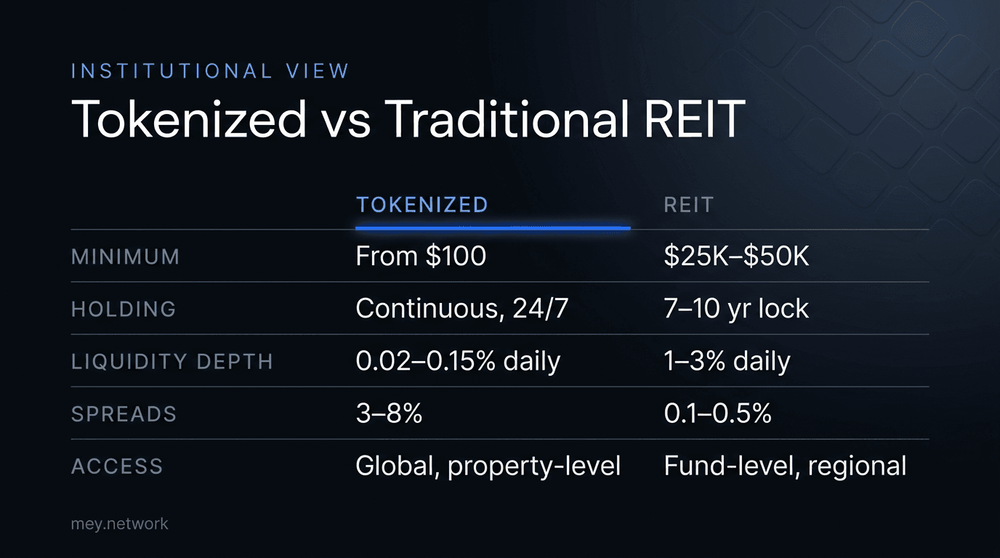
Consider the threshold difference. Traditional REITs typically require minimum allocations of $25,000 to $50,000 for institutional-grade exposure. Blockchain-coordinated platforms reduce this barrier dramatically:
Fractional interests enable minimum positions as low as $100 for institutional participants testing new ecosystems.
Distribution-layer transfers allow position adjustments without waiting for fund redemption windows.
24/7 infrastructure supports global time zones and rapid portfolio rebalancing.
Smart-contract automation reduces administrative overhead and settlement times from weeks to minutes.
The distribution improvement stems from fractional divisibility. A $50 million office building coordinated into 500,000 units at $100 each creates a transferable layer where traditional whole-asset transfers would require months of negotiation. Institutions can scale positions incrementally rather than committing large capital blocks upfront.
Blockchain coordination fundamentally changes the distribution profile of real estate by enabling continuous transfer activity rather than episodic transactions tied to fund lifecycles or property sales.
Global ecosystem access delivers strategic value beyond distribution. Institutions building diversified portfolios across geographies previously faced operational complexity in establishing local partnerships, understanding regional regulations, and managing currency exposures. Coordination platforms handle these operational layers, allowing institutions to focus on asset selection and portfolio construction.
Pro tip: evaluate platforms based on their legal framework transparency and regulatory-compliance track record before committing capital, as these factors directly impact your ability to exit positions when needed.
Evaluating blockchain-coordinated real estate performance and risks
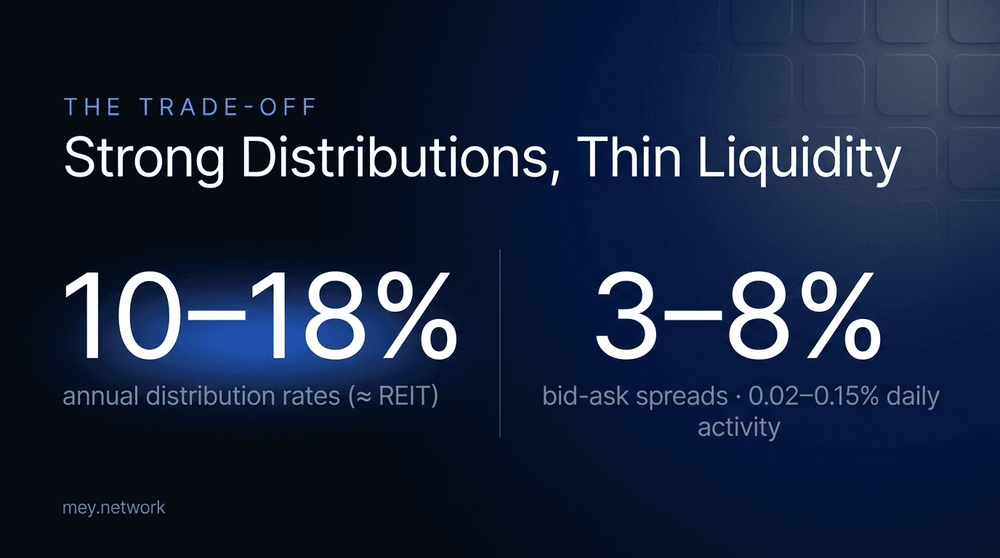
Blockchain-coordinated real estate delivers competitive distribution rates compared to traditional REITs, with empirical data showing 10% to 18% annual distribution rates across major platforms in 2024. Performance varies by asset class, with residential units averaging 12% and commercial properties reaching 16% in high-demand ecosystems. These figures align closely with traditional REIT benchmarks.
- Annual distribution (2024)
- Blockchain-Coordinated Real Estate: 10–18%
- Traditional REITs: 9–17%
- Daily distribution-layer activity
- Blockchain-Coordinated Real Estate: 0.02–0.15%
- Traditional REITs: 1–3%
- Bid-ask spread
- Blockchain-Coordinated Real Estate: 3–8%
- Traditional REITs: 0.1–0.5%
- Minimum participation
- Blockchain-Coordinated Real Estate: $100–$1,000
- Traditional REITs: $25,000–$50,000
- Settlement time
- Blockchain-Coordinated Real Estate: Minutes to hours
- Traditional REITs: 2–3 days
- Activity hours
- Blockchain-Coordinated Real Estate: 24/7
- Traditional REITs: Regulated venue hours only
Distribution-layer metrics tell a different story. Daily distribution-layer activity for blockchain-coordinated real estate ranges from 0.02% to 0.15% of total network capitalization. Compare this to traditional REITs maintaining 1% to 3% daily activity. The gap reveals ecosystem immaturity.
Bid-ask spreads present practical challenges. Coordinated assets show spreads of 3% to 8%, significantly wider than the 0.1% to 0.5% typical for liquid REIT shares. This spread represents real transaction costs that erode net distributions when institutions need to adjust positions quickly. The depth of the distribution layer remains thin across most platforms.
Ownership structure requires careful examination. Network units typically represent claims through special-purpose vehicles rather than direct property titles. You hold a share of an SPV that owns the real estate, not a fractional deed to the property itself. This legal wrapper introduces intermediary risk and potential disputes over asset control.
Regulatory uncertainty and smart-contract risks remain primary concerns for institutional adoption:
Smart-contract vulnerabilities could enable unauthorized transfers or lock funds permanently.
Regulatory frameworks vary dramatically across jurisdictions, creating compliance complexity.
Asset fragmentation through coordination may trigger litigation over property rights and governance.
Platform bankruptcy or operational failure could strand units without clear redemption paths.
Tax treatment remains unclear in many jurisdictions, complicating institutional accounting.
The performance data shows blockchain coordination delivers on distribution-rate potential but falls short on the distribution-layer promise that drives institutional interest. The transfer layer lacks the depth and efficiency of established securities venues. Institutions must weigh competitive distribution rates against execution challenges and structural risks.
Pro tip: always verify the legal structure underlying any blockchain-coordinated allocation, including SPV documentation, property title records, and bankruptcy-remoteness provisions, before committing institutional capital.
Expert perspectives and practical applications for institutions
Smaller real estate assets under $50 million represent optimal candidates for blockchain coordination by institutions. Cost structures favor these properties because coordination expenses, including legal setup, smart-contract development, and regulatory compliance, typically range from $100,000 to $500,000. These fixed costs consume 0.2% to 1% of a $50 million asset but balloon to 2% to 5% for a $10 million property.
Institutions deploy blockchain coordination tactically rather than strategically. Portfolio managers use network units to gain targeted exposure to specific ecosystems, property types, or development stages without committing to large-scale allocations. A pension fund might allocate 2% to 5% of real estate holdings in coordinated assets for geographic diversification while maintaining core positions in traditional vehicles.
Legal frameworks determine viability across jurisdictions. Europe's MiCA framework provides standardized rules for unit issuance and transfer, reducing compliance uncertainty. The UAE's Virtual Asset Regulatory Authority offers clear licensing pathways for coordination platforms. These regulatory advances enable institutional participation by establishing participant protections and operational standards.
Token holders typically gain exposure through SPV structures rather than direct ownership rights, a distinction that confuses many participants. Understanding this structure prevents misconceptions about rights and remedies. When you acquire a blockchain-coordinated real estate position, you receive:
A beneficial interest in an SPV that holds legal title to the property.
Rights to distribution flows as defined in the unit's smart contract and offering documents.
Governance rights that may be limited compared to direct ownership.
Exposure to both property performance and SPV operational risks.
Claims subordinate to any debt secured by the underlying property.
Follow this framework when evaluating blockchain-coordinated real estate opportunities:
Assess asset suitability by reviewing property size, ecosystem activity, and coordination cost ratios.
Ensure legal clarity by examining SPV structure, title documentation, and bankruptcy-remoteness provisions.
Evaluate distribution-layer activity by analyzing historical transfer volumes, bid-ask spreads, and depth.
Monitor the regulatory landscape across relevant jurisdictions for compliance requirements and participant protections.
Leverage fractional-interest benefits by building diversified exposure across geographies and property types.
Institutional adoption accelerates when platforms demonstrate operational track records. Established coordination providers with multi-year histories, audited financials, and regulatory licenses reduce adoption friction. New entrants face skepticism regardless of technological capabilities.
The tactical application model suits institutional risk management. Rather than replacing traditional real estate allocations, blockchain coordination supplements existing strategies with incremental positions that offer specific benefits. A university endowment might use network units to access emerging-ecosystem properties that would be operationally complex through direct allocation, while maintaining core domestic holdings in traditional funds.
Pro tip: prioritize positions with comprehensive legal documentation from reputable law firms and platform providers with regulatory licenses, as these factors significantly reduce operational and legal risks.
Explore blockchain-coordinated opportunities with Mey Network
Institutions seeking practical applications for blockchain coordination find comprehensive solutions through Mey Network, a platform specifically designed to connect institutional participants with blockchain-coordinated real estate opportunities worldwide. The platform addresses the distribution-layer and access challenges discussed throughout this guide by providing transparent legal frameworks, regulatory-compliance infrastructure, and diverse asset classes suited to institutional strategies.
Mey Network's Property Token Offerings enable fractional positions with clear ownership structures through audited SPVs and documented title records. The platform supports strategic portfolio construction across geographies while handling operational complexity, local regulations, currency management, and compliance reporting. Institutions gain the targeted exposure benefits of blockchain coordination without building internal infrastructure or navigating fragmented regional platforms.
Frequently asked questions
What distinguishes blockchain-coordinated real estate from traditional REIT allocations?
Blockchain-coordinated real estate offers a fractional interest in specific properties with 24/7 transfer capability and minimum positions starting at $100, while REITs provide diversified portfolios of properties with higher minimums but superior distribution-layer activity and regulatory oversight. Network units represent claims through SPVs rather than direct equity shares in operating companies. Both deliver comparable distribution rates, but blockchain coordination enables targeted property exposure, whereas REITs offer professional management and established ecosystem infrastructure.
How does fractional interest work in blockchain-coordinated real estate?
Fractional interest divides property value into digital network units representing beneficial interests in an SPV that holds legal title. Each unit conveys rights to proportional distribution flows and potential value progression, defined in smart contracts and legal documentation. You acquire units representing your desired ownership percentage, typically in increments as small as $100, enabling precise position sizing. The SPV structure provides bankruptcy remoteness while units enable distribution-layer transfers without moving underlying property titles.
What are the major risks involved with blockchain-coordinated real estate?
Regulatory uncertainty across jurisdictions creates compliance complexity and potential legal challenges to unit validity. Smart-contract vulnerabilities could enable unauthorized transactions or permanently lock funds. Low distribution-layer activity with 3% to 8% bid-ask spreads increases transaction costs significantly. SPV operational failures or platform bankruptcies may strand units without clear redemption mechanisms. Asset fragmentation through coordination can trigger governance disputes and litigation over property control rights.
Can institutions transfer blockchain-coordinated assets 24/7 through the distribution layer?
Most coordination platforms offer 24/7 infrastructure, but actual distribution-layer activity remains limited, with daily transfer volumes representing only 0.02% to 0.15% of network capitalization. Continuous access does not guarantee execution at desired prices, especially for larger institutional positions. Bid-ask spreads widen significantly during off-peak hours when depth thins further. Institutions should view 24/7 access as operational flexibility rather than true distribution enhancement compared to traditional securities ecosystems.
What legal protections should institutions verify before allocating to network units?
Verify SPV documentation establishing bankruptcy remoteness and clear title to underlying properties through independent legal review. Confirm regulatory licenses for the coordination platform in relevant jurisdictions and review compliance with securities laws. Examine smart-contract audits from reputable blockchain-security firms to identify technical vulnerabilities. Review offering documents detailing governance rights, distribution mechanisms, and redemption provisions. Ensure title insurance covers the underlying property and assess whether unit holder claims are subordinate to property-level debt.
