

Every crypto passive income method pays you from one of three places. New tokens the network issues. Interest from someone borrowing your capital. Or cash that a real-world asset earns.
That distinction matters more than any rate. Two platforms, both advertising 6%, can be nothing alike, because the reason one stops paying has nothing to do with the reason the other does.
Eight methods are covered below, sorted by where the money comes from, each with a current rate, its lock-up terms, and how it fails. Seven are crypto-native and well established. The eighth is participation backed by real-world assets, still absent from most passive income crypto roundups: the tokenized real-world asset market reached roughly $38 billion in August 2026 (RWA.xyz), and is projected to reach $9.4 trillion by 2030 (Boston Consulting Group x Ripple, 2025).
If you're working out how to make passive income with crypto, you need four things per method: how it works, what it pays, whether your money gets locked up, and how it can go wrong. All four are below, plus one red-flag rule covering every method.
This guide is educational and compares multiple ways to put crypto to work. It is not financial advice, and no method described here guarantees a fixed benefit or is risk-free.
Key Takeaways
- There are at least 8 legitimate ways to generate crypto passive income in 2026: staking, lending, liquidity provision, running a node, RWA-backed staking, yield aggregators, rebasing tokens, and CeFi savings accounts.
- Sustained advertised rates above roughly 20% on any method, not just RWA-backed ones, deserve close scrutiny.
- RWA-backed staking (like MeyFi's) ties participation benefits to real-world cash flows rather than token emissions, which changes its risk and volatility profile compared with most crypto-native methods.
- Every method carries real risk, whether smart-contract, platform, liquidity or regulatory, and none of them is passive in the sense of being risk-free.
What Counts as Crypto Passive Income?
Crypto passive income is any method where an asset you already hold earns something without you trading it. None of them is risk-free, and several aren't especially passive. What matters most is where the money comes from:
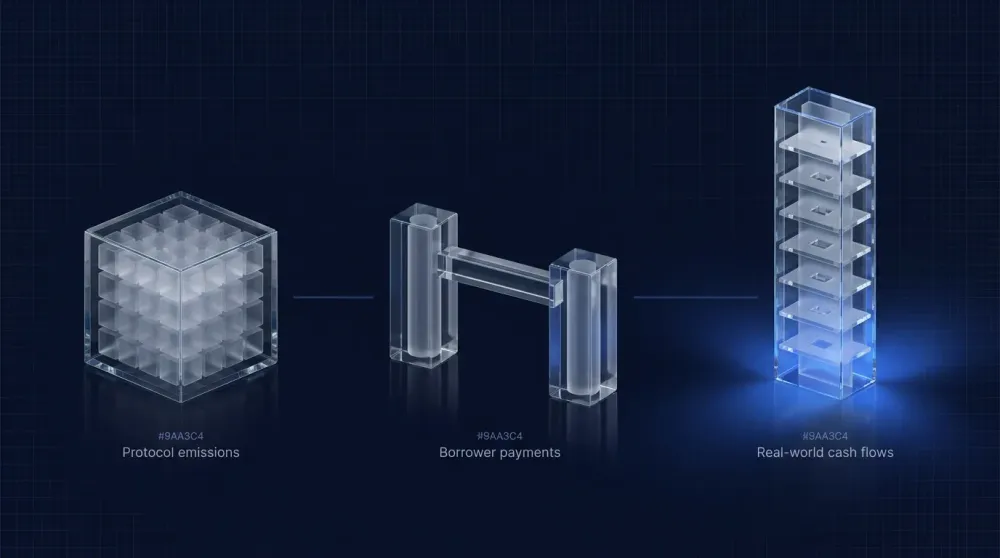
- Protocol emissions. New tokens the network mints and pays to people securing it. That's staking and running a node.
- Borrower or trader payments. Someone pays to use your capital. That's lending and liquidity provision.
- Real-world cash flows. Money an off-chain asset earns, such as a property, passed to holders of a token tied to it.
Emissions dilute existing holders to pay new ones. Payment-based methods need someone on the other side to pay. Asset-backed methods need a physical thing to perform. Comparing headline rates across all three without asking what funds them tells you little.
The 8 Proven Ways to Generate Crypto Passive Income in 2026
1. Staking
Staking locks tokens to help secure a proof-of-stake network, and the network pays you for it. It's the most established crypto staking passive income method and the easiest place to start.
Solo staking on Ethereum needs 32 ETH per validator (ethereum.org). Network reward rates sat at about 2.6 to 2.7% in early August 2026 (validatorqueue.com). Pools and liquid staking providers take a fee and let you start with far less.
Rates vary a lot by chain. In early August 2026, Staking Rewards showed Solana at about 5.47%, Cardano at 2.17% and Cosmos at 19.28% (Staking Rewards). That Cosmos figure is gross, before the chain's 5% minimum validator commission, and reflects its 10% maximum inflation setting (Cosmos Hub mint params). A high rate on a fast-issuing token is not the same as a high rate on fixed supply.
Lock-ups matter more than the headline rate. The Cosmos Hub's on-chain unbonding parameter is 1,814,400 seconds, or exactly 21 days (Cosmos Hub staking params). Solana uses epoch-based warmup and cooldown (Anza).
One thing to note is that Polkadot is no longer 28 days. Referendum 1910, enacted 6 July 2026, cut nominator unbonding to about 2 days (2 eras), and nominators can no longer be slashed (Polkadot Forum). Requests made before that referendum still run on the old schedule.
Risk: slashing on some networks, token price swings, and no access to your tokens during unbonding.
2. Crypto Lending
You supply assets to a lending market and borrowers pay you interest. Crypto lending passive income comes in two forms with very different risk profiles.
DeFi lending is non-custodial and the rates are public. On August 2, 2026, DefiLlama showed Aave v3 paying about 3.26% on USDC and 2.70% on USDT, with Compound v3 USDC near 3.30% (DefiLlama). Rates move with how much is being borrowed.
CeFi lending hands your assets to a company, which is method 8. Notice how modest the DeFi numbers are. About 3% on a dollar-denominated asset is defensible crypto lending passive income. Anything advertising 15% on stablecoins is either subsidised by emissions that will stop, or taking a risk it isn't telling you about.
Risk: smart-contract failure, collateral shortfalls during sharp price moves, and stablecoin depeg.
3. Liquidity Provision (LPing)
You put two assets into an automated market maker and collect a share of the trading fees. The fees can be good. So can the loss you didn't sign up for.
Impermanent loss is the gap between holding a pair in a pool and just holding both assets. Uniswap's documentation publishes the table: a 1.25x price change costs 0.6% against holding, 1.5x costs 2.0%, 2x costs 5.7%, 3x costs 13.4%, and 5x costs 25.5% (Uniswap Docs). It works both ways, so a 2x rise and a 50% fall hurt the same.
That table is for the 50/50 model in Uniswap v2. Concentrated liquidity in v3 and v4 can cost more for the same move, in exchange for higher fees, while the price stays in range. Pairing correlated assets, such as two stablecoins or an asset and its liquid staking token, cuts the problem a lot. Pairing a volatile token against ETH does not.
Risk: impermanent loss, contract exploits, and pools that quietly stop trading.
4. Running a Node or Validator
Running your own validator means you keep the full reward with no fee to anyone. It also turns a passive position into a job.
The requirements are real: 32 ETH for Ethereum, dedicated hardware, reliable power and internet, and near-constant uptime. There's a queue too. On August 2, 2026, about 2.45 million ETH sat in Ethereum's entry queue with a wait of roughly 42 days (validatorqueue.com). This suits people who already run infrastructure. If not, use a pool and pay the fee.
Risk: slashing for downtime or misbehavior, hardware failure, and locked-up capital.
5. RWA-Backed Staking (Tokenized Real Estate)
This one works differently from the seven around it. Instead of a benefit funded by new tokens or by someone else's borrowing, participation benefits are tied to the cash a real, identified property generates.
Mey Network is an RWA tokenization ecosystem that converts verified real estate into onchain Property Token Offerings (PTOs), giving participants borderless, transparent access to real estate through MeyFi's staking, lending, and marketplace tools.
A verified property is tokenized into participation units, participants hold and can stake those units through MeyFi, and distributions trace back to how the property performs rather than to an emissions schedule.
What changes is that the benefit doesn't dilute other holders and doesn't depend on borrowing demand. What doesn't is that distributions vary with the property, can pause, and carry platform and regulatory risk like everything else. No fixed benefit is promised, and any platform promising one fails the red-flag test below.
Risk: property performance, platform and custody risk, rules that vary by country, and thinner secondary markets than crypto-native assets.
6. Yield Aggregators & Vaults
Aggregators pick strategies and compound for you across several protocols. You deposit once and the vault rebalances, harvests and reinvests.
The cost is exposure to the vault contract plus every protocol it touches, so one bug anywhere in the stack reaches your deposit. Aggregator rates are also quoted as APY with compounding built in, which flatters them next to simple APR figures. The sensible use is managing a stablecoin position across lending markets without rebalancing by hand.
Risk: stacked smart-contract exposure, strategy risk, and performance fees eating the advertised rate.
7. Dividend-Paying / Rebasing Tokens
Rebasing tokens increase your balance automatically, so your wallet shows more tokens each day without you doing anything.
The question is what pays for it. Out of real protocol revenue, a rebase is a genuine distribution. Out of new issuance, your token count rises while each token's claim falls, so the balance grows and the position doesn't. Several rebasing projects advertised four-figure APYs in the 2021 cycle and collapsed once new money stopped covering emissions. If the protocol mints it, that's dilution dressed up as income.
Risk: emissions that can't last, a falling token price cancelling out balance growth, and messy tax from constant accrual.
8. Crypto Savings / CeFi Interest Accounts
A company holds your crypto and pays you a rate. It's the simplest method to use, and the one with the most instructive failures.
Celsius Network paused withdrawals on June 12, 2022 and filed Chapter 11 a month later. On January 4, 2023 the bankruptcy court ruled that assets in Celsius "Earn" accounts belonged to the estate, roughly $4.2 billion or about 77% of platform assets, because the terms of use gave Celsius rights and title to deposited crypto (Morrison Foerster). That left Earn account holders as unsecured creditors (Arnold & Porter). BlockFi filed in November 2022 with more than 100,000 creditors and $275 million owed to FTX US (CNBC).
The lesson isn't to avoid CeFi. It's that the terms of use decide whether you're a depositor or an unsecured creditor, and you find out which at the worst possible time.
Risk: platform insolvency, rehypothecation, and your claim ending up behind everyone else's.
Realistic Ranges by Method
These figures are from early August 2026 and move constantly, so treat them as a guide rather than a quote.
- Method, Staking. Typical rate, ~2–7% (higher on high-inflation chains). Source of return, Protocol emissions. Risk, Medium. Liquidity, Locked during unbonding (2–21 days by chain). Complexity, Low.
- Method, Crypto lending (DeFi). Typical rate, ~2.7–3.5% on major stablecoins. Source of return, Borrower interest. Risk, Medium. Liquidity, Usually instant, depends on utilisation. Complexity, Low–medium.
- Method, Liquidity provision. Typical rate, Highly variable. Source of return, Trading fees. Risk, High. Liquidity, Generally instant. Complexity, Medium.
- Method, Running a node. Typical rate, Full rate, no fee deducted. Source of return, Protocol emissions. Risk, Medium–high. Liquidity, Locked; depends on queue. Complexity, High.
- Method, RWA-backed staking. Typical rate, Varies with property performance. Source of return, Real-world cash flows. Risk, Medium. Liquidity, Lower; thinner secondary markets. Complexity, Low–medium.
- Method, Yield aggregators. Typical rate, Underlying rate minus fees. Source of return, Stacked strategies. Risk, High. Liquidity, Usually instant. Complexity, Medium.
- Method, Rebasing tokens. Typical rate, Advertised rates often extreme. Source of return, Emissions, sometimes revenue. Risk, High–very high. Liquidity, Varies. Complexity, Low.
- Method, CeFi savings. Typical rate, ~2–6%. Source of return, Platform lending activity. Risk, High (custodial). Liquidity, Platform decides. Complexity, Very low.
Two things stand out. Legitimate passive income crypto rates cluster between 2% and 7%, an order of magnitude below what the loudest content promises. And the riskiest methods aren't the highest-paying ones.
The Red-Flag Rule: When "Passive Income" Is Actually a Risk Signal
One rule covers all eight: sustained advertised rates above roughly 20% deserve close scrutiny, whatever the mechanism.
That's not an automatic no. Short incentive programmes really do pay high rates for a few weeks, and high-inflation networks pay double digits by design. The word doing the work is sustained: a rate presented as durable, above 20%, funded by something the platform can't explain in one sentence, is the pattern that keeps showing up in enforcement actions.
SEC guidance is blunt: "'Guaranteed' high investment returns. Promises of high investment returns with little or no risk are a classic warning sign of fraud," with BitConnect, a roughly $2 billion scheme, as the worked example (SEC Investor Alert).
Three questions to ask about any offer:
- Who pays this? If the answer isn't a specific party, whether borrowers, traders, the protocol or a tenant, there may be nobody paying.
- What ends it? A platform that can't tell you when its rate drops hasn't worked it out.
- Is it fixed? Variable is honest. Guaranteed is the strongest fraud signal on the list.
Risks Across All 8 Methods
Four risks come up again and again.
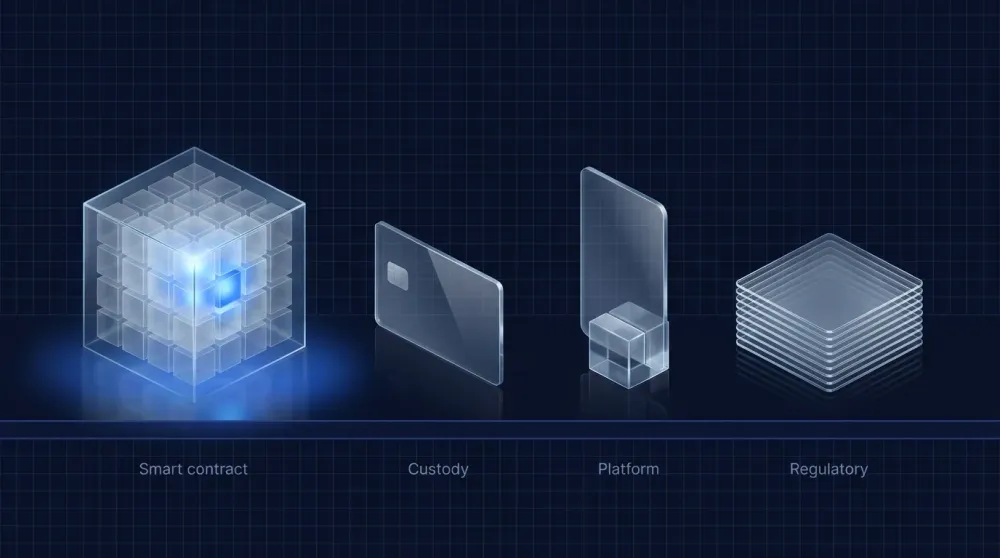
Smart-contract risk applies to methods 1 to 3 and 5 to 7. Chainalysis recorded over $3.4 billion stolen across crypto in 2025 (Chainalysis), and DefiLlama's running total stood at roughly $16.79 billion across 607 incidents as of August 2, 2026 (DefiLlama). Audits reduce this without removing it, and Consensys Diligence states that its reports carry no "warranty or representation to any third party in any respect, including regarding the bug-free nature of code" (Diligence).
Custody risk dominates method 8 and applies anywhere a company holds your assets, as Celsius settled in favour of the estate. Platform and operator risk covers what an audit can't: the company stops operating, mismanages keys, or changes its terms.
Regulatory risk varies by country. In the US, the crypto staking passive income position is settled. Revenue Ruling 2023-14 holds that staking rewards count as income at fair market value "in the taxable year in which the taxpayer gains dominion and control" (IRS), and that's still current in 2026.
Impermanent loss belongs to method 3 alone and is the most underestimated risk here, because it doesn't look like a loss. It looks like an opportunity cost you only notice when you compare against doing nothing.
Crypto Passive Income vs. Real-World-Asset-Backed Participation
The structural difference is who pays. Emissions-driven methods are funded by the protocol issuing new tokens. RWA-backed participation is funded by an off-chain asset earning cash.
Three things follow. Dilution: emissions expand supply to pay participants, while a property's cash flow dilutes nobody. Correlation: most crypto-native methods pay in an asset whose price moves with the market, so the rate and your principal fall together. Failure modes: emissions stop when the schedule ends; asset-backed distributions stop when the asset stops performing.
None of this makes RWA-backed participation safer, just exposed to different things, which is why it deserves its own category rather than another row in a staking table. Terms are defined in our crypto and RWA glossary.
Which Method Is Right for You?
Match the method to your actual constraints rather than the biggest number. Finding the best crypto passive income route starts here.
- New to this: staking through an established pool, or DeFi stablecoin lending.
- Comfortable with DeFi: liquidity provision on correlated pairs, or a vault whose strategy you've actually read.
- Technically capable with capital to spare: run your own validator.
- Want exposure outside crypto price cycles: RWA-backed participation.
- Want nothing technical at all: CeFi accounts, with the Celsius lesson in mind.
Two filters settle most of the decision: how long you can lock the money up, and how much technical failure you can absorb. Answer both honestly, and most of the eight rule themselves out. That gets you to the best crypto passive income method faster than any ranking of passive income with crypto written by someone selling one of them.
How to Get Started
Pick one method and learn it properly before adding a second. Spreading money across eight things you half-understand works out worse than doing one well.
Start with the method that matches your technical comfort. Commit an amount you could lose in full without it mattering. Run the three red-flag questions before you deposit: who pays this, what ends it, and is it fixed.
Anyone asking how to make passive income with crypto is really asking two things at once: what pays, and what lasts. The first has easy answers, and the second doesn't, which is why chasing the highest rate goes badly so consistently.
Explore MeyFi, one way to put real-world asset-backed tokens to work, and one option among eight worth judging on its own terms.
FAQs
Q: What is the best way to earn crypto passive income in 2026?
No single method is best for everyone. Staking suits beginners, with modest rates and simple mechanics. DeFi stablecoin lending suits people who want dollar-denominated exposure. RWA-backed participation suits people who want value tied to real assets rather than emissions. Match the method to your lock-up tolerance and technical comfort.
Q: Is crypto passive income actually passive?
Only partly. Staking through a pool and CeFi accounts come close to hands-off. Liquidity provision needs monitoring for impermanent loss, running a node is ongoing work, and every method needs you to reassess the platform now and then. None is passive in the sense of being risk-free or needing no attention after setup.
Q: How much can you realistically earn from crypto passive income?
Legitimate rates in 2026 sit between 2% and 7%. Ethereum staking was near 2.6 to 2.7%, and major stablecoin lending on Aave and Compound between 2.7 and 3.5%. Some high-inflation networks pay much more, but a high rate on a fast-issuing token partly compensates you for dilution rather than being pure gain.
Q: Is crypto passive income safe?
No method here is risk-free. Smart-contract exploits, platform insolvency, impermanent loss and regulatory change all cause real losses, and Chainalysis recorded over $3.4 billion stolen across crypto in 2025. You lower the risk by using audited protocols, reading custodial terms carefully, and treating sustained rates above 20% with scepticism.
Q: What's the difference between crypto staking and RWA-backed staking?
Standard staking pays rewards funded by protocol emissions, since the network issues new tokens to secure itself. RWA-backed staking ties participation benefits to cash flows from a real-world asset such as a tokenized property. The first dilutes supply and moves with crypto markets. The second depends on the asset performing.
Q: What are the biggest risks of crypto passive income?
Four dominate. Smart-contract risk affects most on-chain methods. Custody risk applies wherever a company holds your assets, and Celsius Earn account holders became unsecured creditors in bankruptcy. Platform and operator risk covers company failure. Regulatory risk varies by country. Liquidity provision adds impermanent loss on top.
Q: Do you pay tax on crypto passive income?
In the US, yes. IRS Revenue Ruling 2023-14 holds that staking rewards count as gross income at fair market value in the year you gain dominion and control over them, and that's still current guidance in 2026. Other methods and countries vary, so speak to a qualified tax professional about your situation.
