

Ask whether is tokenized real estate safe has a simple answer, and you usually get one of two replies. One treats the category as the future of property investing and skips past the risks. The other writes off the whole sector. Neither helps if you're about to commit money, because the real answer depends on the platform: is tokenized real estate safe is a question you answer about one operator, one property, and one legal structure, not about the category.
That difference matters more every quarter. The tokenized real-world asset market reached roughly $38 billion in August 2026 (RWA.xyz), and is projected to reach $9.4 trillion by 2030 (Boston Consulting Group x Ripple, 2025). Growth like that draws in serious operators and opportunists alike.
This guide covers the tokenized real estate protections a good platform gives you, the tokenized real estate risks that rarely appear in marketing, the red flags to watch for, and a checklist you can use on any platform, including Mey Network.
This guide is educational, not financial or legal advice. Always check a platform's audits, licensing, and legal structure yourself before participating.
Key Takeaways
- Tokenized real estate safety depends heavily on the platform. There is no yes-or-no answer for the whole category, and the sections below show exactly what to check.
- Good platforms offer real protections: verified property and title, smart-contract audits, a clear legal structure such as an SPV, and on-chain records of distributions.
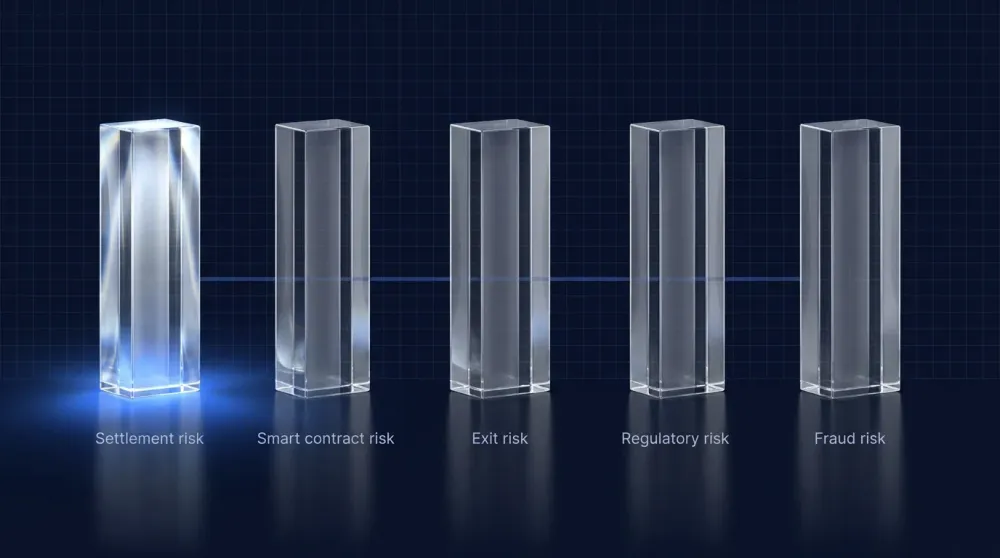
- The main tokenized real estate risks are settlement and counterparty risk, smart-contract and platform risk, liquidity risk, regulatory risk, and fraud risk.
- A short list of property token red flags separates good platforms from bad ones: guaranteed fixed returns, no audits, no disclosed legal structure, and sustained advertised rates above roughly 20%.
Is Tokenized Real Estate Safe? The Short Answer
It depends on the platform, and an honest answer is a list rather than a reassurance. Five real estate tokenization risks apply no matter how good the technology is: settlement and counterparty risk, smart-contract and platform risk, liquidity risk, regulatory risk, and fraud risk. A good platform reduces every one. None can be removed, and anyone who says otherwise is selling something.
What tokenization really changes is the shape of the risk. Owning property directly ties up your money, costs a lot to transact and takes work to manage. Tokenized access moves part of that onto the operator, the code and the legal wrapper. The real estate tokenization risks you get in return are younger and less tested.
What Legitimate Tokenized Real Estate Actually Protects You With
Tokenized real estate protections are the main evidence you have for telling a good platform from a bad one.
Verified property and title
Every legitimate structure starts with a property that provably exists and a title that provably transfers. The Consumer Financial Protection Bureau describes owner's title insurance as protection "if someone sues and says they have a claim against the home from before the homeowner purchased it," covering things like a previous owner's unpaid taxes (CFPB). The American Land Title Association lists the usual covered defects: liens, easements, recorded use restrictions and claims arising out of bankruptcy (ALTA).
Tokenization doesn't replace that work. If a platform can't show you the title chain, the valuation and the jurisdiction, it has skipped the first step.
Smart-contract audits
An audit is a hard look at the code that issues tokens and moves money. OpenZeppelin describes reviewing every line with at least two security researchers, combining static analysis, manual inspection, automated tooling, fuzzing, and invariant testing (OpenZeppelin).
Here is the part that rarely gets quoted. Audits are not guarantees, and audit firms say so themselves. Consensys Diligence attaches this to its reports: "No Report provides any warranty or representation to any third party in any respect, including regarding the bug-free nature of code… it is not a guarantee as to the absolute security of the project" (Consensys Diligence).
So an audit is proof that someone checked the code. It is not proof that the code is safe. No audit at all should rule a platform out, and an audit means you keep looking.
Regulatory and legal structure (e.g., SPV)
The legal wrapper decides what you actually hold. Most structures put the property inside a special purpose vehicle, a separate company with its own assets, liabilities and legal standing. It's often set up to be bankruptcy-remote, so that "if the parent company goes bankrupt, the special purpose vehicle can carry on" (Corporate Finance Institute).
Regulators have been clear about what tokenization doesn't change. SEC staff said in January 2026 that "the format in which a security is issued or the methods by which holders are recorded does not affect application of the federal securities laws," and warned that holders "may be exposed to risks with respect to the third party, such as bankruptcy" (SEC). Commissioner Hester Peirce put it more simply: "Tokenized securities are still securities" (SEC, July 2025).
If a platform won't name the company that holds the deed and tell you what your token entitles you to, there is no legal structure. There is a promise.
On-chain transparency and auditability of distributions
This is the protection tokenization really adds. When distributions run through a public contract, anyone can check what was paid, when, and to how many holders, without asking the operator for a report. Traditional property deals run on quarterly statements and trust. One caveat: on-chain records show what happened on-chain, not what happened at the building.
The Real Risks of Tokenized Real Estate
Settlement / counterparty risk
Rent is collected off-chain, in a bank account, by a person. Tokens live on-chain. Something has to connect the two, and that connection is a legal promise, not a cryptographic guarantee.
So the contract can work perfectly and still pay out nothing, because the operator never funded it. A vacancy, a tenant who doesn't pay, and an operator who stops doing its job all look the same on-chain. The settlement gap in detail covers how good platforms structure and disclose this.
Smart-contract & platform risk
Code fails, and the losses are large. Chainalysis recorded over $3.4 billion stolen across crypto in 2025 (Chainalysis), and DefiLlama's running total stood at roughly $16.79 billion across 607 incidents as of August 2, 2026 (DefiLlama). Platform risk is broader than bugs. It also covers key management, admin privileges, upgradeable contracts, oracle dependencies and whether the operator stays solvent.
Liquidity risk
Tokenized real estate is often sold on liquidity, and the data only partly backs that up. As of August 6, 2026, RWA.xyz tracked roughly $202.8 million of value across 105 tokenized real estate assets, held by about 18,670 holders (RWA.xyz). Set against roughly $38 billion of total tokenized RWA value on the same tracker, real estate is under one percent of the category.
Few holders means thin secondary markets. A 2026 preprint looking at nine Ethereum RWA tokens found that a large tokenized market "can remain illiquid if activity is concentrated in minting and redemption flows" (Mafrur, arXiv). That study covered Treasuries, gold and private credit rather than real estate, but the same mechanism applies. Tokenized property sells faster than a building and slower than a listed REIT.
Regulatory risk
Rules differ by country and keep changing. Dubai's Land Department launched what it calls the region's first tokenized real estate project in May 2025 through the Prypco Mint platform, with VARA and the Central Bank of the UAE, at a minimum of AED 2,000 (Dubai Land Department). Singapore's Monetary Authority runs Project Guardian to "test the feasibility of applications in asset tokenisation and DeFi while managing risks to financial stability and integrity" (MAS). Both are good signs, and both cover one jurisdiction only. That's the actual risk.
Market / property-specific risk
Tokenization does not protect you from the building. A property in a weakening area loses value whether ownership sits on a blockchain or in a county registry. Vacancy, deferred maintenance, currency swings and local policy all pass straight through to the token. This gets little attention, and it is still one of the most likely ways to lose money.
Fraud / bad-actor risk
Competitors rarely name this one. Some platforms are frauds, and "backed by real estate" has been a specific fraud pitch.
In May 2025, the SEC charged Unicoin and three executives with fraud, alleging about $110 million raised from more than 5,000 investors on "fictitious promises that its tokens, when issued, would be backed by real-world assets including an international portfolio of valuable real estate holdings" (SEC). Earlier, REcoin was marketed as "The First Ever Cryptocurrency Backed by Real Estate." Its founder was sentenced to 18 months in prison, and prosecutors said he "bought neither real estate nor diamonds" (DOJ).
Both cases share a pattern worth remembering. In each tokenized real estate scam, the asset backing was the pitch, and the asset backing was not there.
Red Flags: How to Spot an Illegitimate Platform
You can check these property token red flags in an afternoon. Any single one is a reason to stop.
- Guaranteed or fixed returns. Why it matters, SEC guidance says to be "highly suspicious of any 'guaranteed' investment opportunity" (Investor.gov). Property income varies by nature.
- No published smart-contract audit. Why it matters, or an audit with no firm name, no scope, no commit hash and no findings list.
- No disclosed legal structure. Why it matters, if you can't name the company holding title, there is nothing enforceable behind the token.
- Unverifiable property. Why it matters, no address, no valuation, no title documents, no third-party confirmation.
- Sustained rates above ~20%. Why it matters, property income does not support that. Treat it as a question about solvency.
- Pressure tactics and urgency. Why it matters, good offerings survive due diligence. Bad ones need you to skip it.
- Anonymous team. Why it matters, normal in crypto. Not normal for an operator holding real-world title.
The SEC's fraud guidance also lists overly consistent returns, unregistered offerings, unlicensed sellers, secretive strategies and trouble getting paid. That list applies neatly to any tokenized real estate scam.
How to Verify a Platform Before You Participate
Work through these in order. They apply to any platform, including this one.
- Confirm the property exists. Get the address, the valuation and the valuation date, then cross-check a public land registry if there is one.
- Find out who holds title. Which company holds the deed, where is it registered, and is it ring-fenced from the operator's other debts?
- Read the audit, not the badge. Check the firm, date, scope, commit hash, number of findings and whether they were fixed.
- Map your rights. What does the token entitle you to, against which company, enforceable where? Get it in writing.
- Check the regulator. Which authority oversees this, if any, and is the platform licensed, sandboxed, exempt or silent?
- Trace a payment on-chain. Pull up the contract on a block explorer and confirm distributions actually reached real holders on time.
- Test the exit first. Is there a working secondary market or a redemption window, or neither?
- Stress the numbers. Ask what happens at 20% vacancy, or if the property sells below valuation.
Is Tokenized Real Estate Safer or Riskier Than Traditional Real Estate?
Neither, as a category. The risks trade places rather than shrink.
- Legal recourse. Direct ownership, Strong, mature, lots of case law. Tokenized real estate, Newer, depends on structure, uneven by country.
- Counterparty exposure. Direct ownership, Low; you hold the deed. Tokenized real estate, Real; platform, SPV and operator sit in between.
- Technology risk. Direct ownership, Effectively none. Tokenized real estate, Real; smart-contract and platform risk.
- Liquidity. Direct ownership, Poor; weeks to months to sell. Tokenized real estate, Better than direct, worse than listed REITs.
- Concentration. Direct ownership, High; one property, one market. Tokenized real estate, Lower; small positions across assets.
- Transparency. Direct ownership, Limited; your records and manager reports. Tokenized real estate, High on-chain; the off-chain side still needs trust.
- Barriers to entry. Direct ownership, Large capital, financing, closing costs. Tokenized real estate, Low per-unit minimums.
Direct ownership wins on legal maturity and control. Tokenized access wins on concentration, entry cost and verifiable payments. Anyone claiming one is simply safer is making a sales pitch.
How Mey Network Approaches These Risks
Mey Network is an RWA tokenization ecosystem that converts verified real estate into onchain Property Token Offerings (PTOs), giving participants borderless, transparent access to real estate through MeyFi's staking, lending, and marketplace tools.
Against the risks above, that structure does three things. Property verification happens before a PTO is issued, so the asset behind each participation unit is identified, not just described. Distributions are recorded onchain, so the payment history can be checked independently rather than taken on trust. And participation units are tied to one specific tokenized property rather than a pooled promise.
Note: These measures don't erase settlement, platform, or market risk.
Run the checklist above on us before you run it on anyone else. [See the live Property Token Offerings on Mey Real](https://meyreal.io).
Due Diligence Checklist (Summary)
Before you participate on any tokenized real estate platform, confirm all nine:
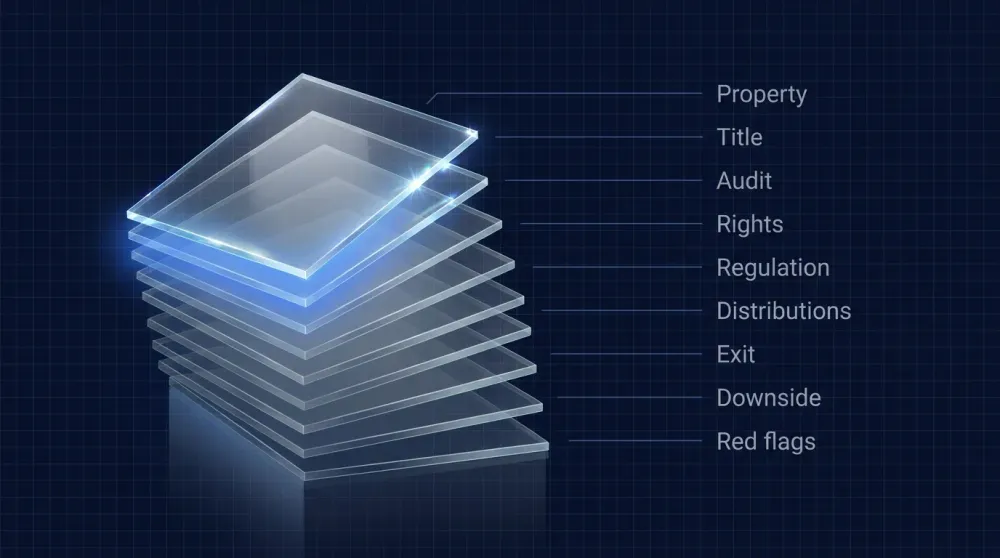
- Property: address, valuation, valuation date, and independent confirmation the asset exists.
- Title: the exact company holding the deed, its jurisdiction, and whether it is ring-fenced.
- Audit: named firm, date, scope, commit hash, findings count, fixes made, with the full report linked.
- Rights: what the token entitles you to, against which company, enforceable where, in writing.
- Regulation: the supervising authority, licence, exemption or sandbox status.
- Distributions: at least one traced on-chain to real holders.
- Exit: the actual way out, and evidence someone has used it.
- Downside: what the platform models at high vacancy or a below-valuation sale.
- Red flags absent: no guaranteed returns, no unnamed audits, no hidden structure, no sustained rates above ~20%, no artificial urgency.
Anything you can't confirm is a question to ask, and a question that never gets answered is itself an answer.
FAQs
Q: Is tokenized real estate safe?
It depends on the platform, not the category. Good operators lower the risk with verified title, audited contracts, a clear legal structure, and on-chain payment records. None of that removes settlement, liquidity, regulatory or fraud risk. Check those four protections yourself before you participate, rather than trusting marketing claims.
Q: What are the biggest risks of tokenized real estate?
Five stand out: settlement and counterparty risk when off-chain rent never reaches the contract, smart-contract and platform risk, liquidity risk from thin secondary markets, regulatory risk that varies by country, and fraud risk from operators whose claimed property backing does not exist. Ordinary property market risk applies on top.
Q: How can I tell if a tokenized real estate platform is legitimate?
Check four things yourself. Confirm the property exists, with an address and a valuation. Find the company that holds title. Read the actual audit report, including firm, scope and findings. Trace a real payment on a block explorer. A platform that can't give you all four hasn't earned your money.
Q: What protections do tokenized real estate platforms offer?
Good platforms give you verified property and title documents, third-party smart-contract audits, a clear legal structure such as a special purpose vehicle holding the deed, and on-chain records that let anyone check distributions independently. That last one is genuinely new, since traditional property deals rely on periodic reports from the operator.
Q: Is tokenized real estate regulated?
Yes, though it varies a lot by country. SEC staff said in January 2026 that tokenization format "does not affect application of the federal securities laws." Dubai's Land Department runs a tokenization project with VARA, and Singapore's MAS runs Project Guardian. Rules differ widely, so check the framework covering your specific offering.
Q: What red flags should I watch for before buying property tokens?
Guaranteed or fixed returns come first, since the SEC advises being "highly suspicious of any 'guaranteed' investment opportunity." Also watch for missing audit reports, no disclosed legal structure, property details you can't verify, sustained advertised rates above roughly 20%, artificial urgency, and a team you can't identify.
Q: Is tokenized real estate safer than traditional real estate investing?
Neither is safer as a category, because the risks trade places rather than disappear. Direct ownership gives you stronger legal recourse and full control, but ties up your money in one asset that sells slowly. Tokenized access lowers the entry cost and improves transparency, while adding platform, smart-contract and counterparty risk.
