

Both routes are after the same thing: exposure to property that produces cash, with very different amounts of money, control, and hassle. Weighing tokenized real estate vs. buying a rental property means weighing a six-figure commitment with full ownership and responsibility against a low-minimum position with neither. That only gets useful once you put real numbers against both sides, which is what this guide does.
Tokenized access is the newer of the two by about a century. The tokenized real-world asset market reached roughly $38 billion in August 2026 (RWA.xyz), and is projected to reach $9.4 trillion by 2030 (Boston Consulting Group x Ripple, 2025), though tokenized real estate is still a small slice of that.
Below: what each route actually costs, what you hold, where each one genuinely wins, the risks on both sides, and a blended option most comparisons skip.
This comparison is educational, not financial or investment advice. Actual costs, distributions, and property performance vary and are not guaranteed.
Key Takeaways
- Buying a rental property takes significant capital, financing, and ongoing management. Tokenized real estate takes none of those, starting at the platform's verified per-token minimum.
- Owning a rental property gives you full control and mortgage leverage that tokenized real estate does not.
- Tokenized real estate offers liquidity and geographic reach that owning a rental property directly generally can't match.
- The two aren't mutually exclusive, and this guide covers a blended approach for readers who want both.
Tokenized Real Estate vs. Buying a Rental Property: The Core Difference
In the tokenized real estate vs. buying a rental property debate, one route gives you control and asks for capital. The other gives you access and asks you to give up control.
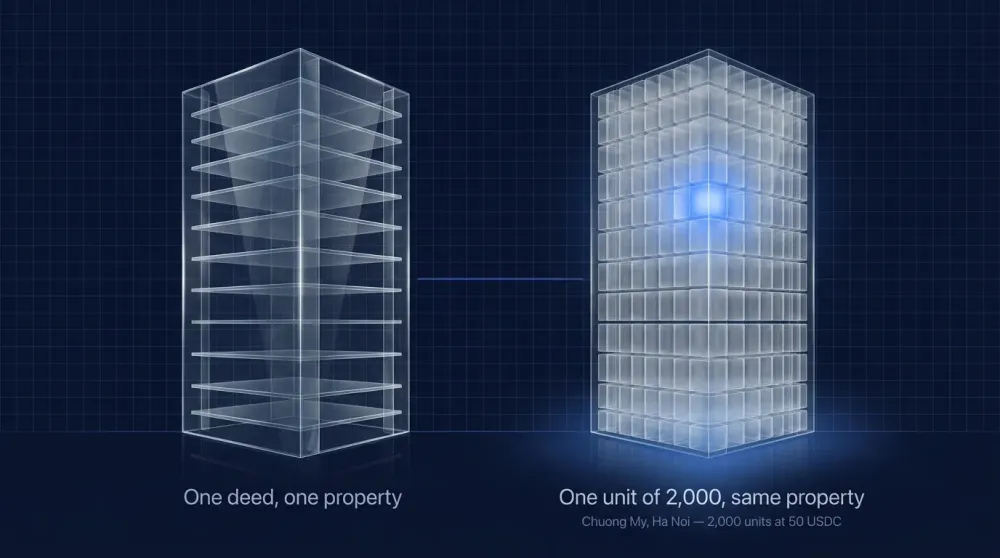
Buy a rental property, and you hold the deed. You pick the tenant, set the rent, decide when to renovate, refinance on your own timing and sell when you want. You also take the maintenance calls, carry the vacancies and pay for the roof.
Hold property tokens and you hold a defined share of a property someone else runs. Entry is cheap, the work is close to zero and the geographic reach is wide. You don't pick the tenant, you can't improve the building, and you can't borrow against your position the way a mortgage lets you borrow against a house. Everything below expands on that trade.
What It Takes to Buy a Rental Property the Traditional Way
Capital & financing
Capital is the first hurdle, and a big one. The median existing-home sale price was $440,600 in June 2026 (NAR). Investment properties usually need larger down payments than owner-occupied ones, where NAR's 2025 Profile put the median at 10% for first-time buyers and 23% for repeat buyers (NAR).
Then closing costs, which Freddie Mac puts at 2% to 5% of the price (Freddie Mac), or roughly $8,800 to $22,000 here. Add a reserve and the realistic total to get through the door sits comfortably in six figures.
Ongoing management (tenants, maintenance, vacancy)
Three costs get underestimated more than any others.
Vacancy. The US rental vacancy rate was 7.3% in Q2 2026 (U.S. Census Bureau, CB26-116). One unit isn't a portfolio, so you're either fully occupied or fully empty, and the mortgage doesn't pause for the gap.
Maintenance. Angi's 2025 State of Home Spending found US households spending an average of $2,041 on maintenance and $1,143 on emergency repairs (Angi). Rentals take harder wear than owner-occupied homes.
Management. Industry sources usually quote 8 to 12% of collected rent, plus a leasing fee (AllPropertyManagement). Do it yourself and you save the fee by doing the work: screening tenants, chasing rent, arranging repairs and handling the legal side of any eviction.
On the popular rules of thumb: the "1% rule" and "50% rule" get repeated everywhere and have no authoritative source behind them. Use them for a first-pass sniff test, not for underwriting.
Control & leverage
Direct ownership wins three things outright, and they're worth stating plainly.
Leverage. A mortgage lets you control a $440,000 asset with a fraction of that in cash, and any appreciation goes to your equity, not the lender's. No tokenized structure currently offers individuals anything comparable. This is the strongest argument for buying a rental property.
Forced appreciation. You can add value on purpose by renovating, converting, or repositioning the tenancy, so the building responds to your decisions. A passive position gives you no such lever.
Full control. Tenant selection, rent, hold period, refinancing, and sale timing are all yours. That's worth a lot to some people and exactly what others want to escape.
What It Takes to Access Tokenized Real Estate
Capital required
The minimum is set per offering, and it's small. The verified Chuong My listing in Ha Noi, Vietnam, shows the scale: 2,000 tokens issued at 50 USDC per token, so a single unit is a defined proportional share of that property. Against a six-figure entry for a median-priced rental, that's about three orders of magnitude, with no financing to arrange, no closing costs, no escrow, and no reserve requirement.
What you're actually holding
This is where most of the confusion sits, so it's worth being precise: you hold a participation unit, not a deed.
Mey Network is an RWA tokenization ecosystem that converts verified real estate into onchain Property Token Offerings (PTOs), giving participants borderless, transparent access to real estate through MeyFi's staking, lending, and marketplace tools. A PTO unit is a defined claim tied to one specific verified property, recorded onchain.
That gives you a proportional share of how the property performs, on-chain records of every distribution, and the ability to hold, stake, or transfer the position. It doesn't give you a title, a say on the tenant, the right to improve the building, or the ability to mortgage the position.
Regulators have been clear that the wrapper doesn't change the substance. SEC staff noted in January 2026 that "the format in which a security is issued or the methods by which holders are recorded does not affect application of the federal securities laws," and that holders "may be exposed to risks with respect to the third party, such as bankruptcy" (SEC).
Management effort
Close to zero, by design. The platform and its operating partners handle tenants, maintenance, compliance, and the distribution mechanics. You get distributions when the property performs, and less or none when it doesn't. That's an accurate picture of passive real estate access vs active rental property ownership: you've outsourced the work, and the control went with it.
Side-by-Side Comparison
The fractional real estate vs direct ownership trade-off, cut down to the nine factors that decide it.
- Capital required. Buying a rental property, Six figures typical on a median US property (down payment plus 2–5% closing costs). Tokenized real estate, Per-token minimum; 50 USDC in the verified Chuong My example.
- Liquidity. Buying a rental property, Weeks to months, plus agent fees and closing costs on exit. Tokenized real estate, Faster in principle, though secondary markets stay thin.
- Control. Buying a rental property, Full; tenant, rent, renovation, sale timing. Tokenized real estate, None; the platform and operator decide.
- Management effort. Buying a rental property, High, or 8–12% of rent to hand off. Tokenized real estate, Near zero.
- Leverage / financing. Buying a rental property, Mortgages widely available. Tokenized real estate, Not available to individual holders.
- Geographic reach. Buying a rental property, Limited to markets you can reach and finance. Tokenized real estate, Cross-border by design.
- Tax treatment. Buying a rental property, Established rules with deductions and depreciation (see IRS Publication 527). Tokenized real estate, Newer and varies by country; get professional advice.
- Diversification. Buying a rental property, One property, one market, one tenant. Tokenized real estate, Small positions across several assets.
- Transparency. Buying a rental property, Your own records plus manager reports. Tokenized real estate, Distributions recorded on-chain and checkable by anyone.
Compare the numbers yourself. [Browse live Property Token Offerings on Mey Real](https://meyreal.io).
Where Buying a Rental Property Wins
Put as property token vs landlord, the landlord takes four categories outright, and none of them is close.
Leverage. Mortgage financing is what makes direct ownership powerful. Controlling a large asset with a fraction of its value in cash magnifies gains in a way no tokenized structure currently matches for individuals. If you can get financing and you're comfortable with the downside, this alone can settle the decision.
Forced appreciation. Renovation, repositioning and better management raise a building's value through your own effort. A passive position gives you exposure to performance with no way to improve it.
Tax treatment. Rental ownership sits inside mature rules, where owners deduct qualifying expenses and depreciate the building, as the IRS sets out in Publication 527, Residential Rental Property (IRS). Tokenized participation is newer and less settled, which is a real disadvantage rather than a technicality.
Absolute control. Some people want the deed in their name and the decisions in their hands. No amount of convenience replaces that.
Where Tokenized Real Estate Wins
Capital barrier. 50 USDC against six figures isn't a small improvement. It's a different level of access, and it lets in people that down payment requirements shut out entirely.
Geographic reach. Buying a rental abroad means dealing with foreign ownership rules, financing, currency and remote management. Tokenized participation crosses borders by design.
No landlord duties. No tenant screening, no maintenance calls, no evictions, no property manager to manage. If you're looking at rental property investing alternatives specifically to get out of that work, this is the whole point, and the property token vs landlord question answers itself.
Diversification at small size. A six-figure budget buys one property in one market. The same money spread across tokenized positions covers several properties and countries.
Transparency. Anyone with a block explorer can check the distribution records, with no waiting for a quarterly statement.
Risks on Both Sides
Weighing tokenized real estate vs. buying a rental property means comparing two different sets of risk, not one safe option against one risky one.
Buying a rental property:
- Vacancy. No tenant, no rent, and the mortgage still due. The 7.3% national rate is an average across a whole market; your single unit is all or nothing.
- Concentration. One property, one local economy, one tenant. A regional downturn hits the whole position.
- Liability. Injury claims, habitability disputes and local compliance land on you.
- Illiquidity. Selling takes months and costs a real percentage of the sale price.
- Leverage cuts both ways. A mortgage magnifies losses just as efficiently as gains.
- Cost shocks. The roof, the HVAC, the special assessment. One major failure costs several times Angi's $1,143 average annual emergency-repair figure.
Tokenized real estate:
- Platform and custody risk. The operator, not you, holds the relationship with the asset. Business failure is a live risk on its own, separate from fraud.
- Smart-contract risk. Code can fail. Audits help, and Consensys Diligence states its reports offer no "warranty or representation to any third party in any respect, including regarding the bug-free nature of code" (Consensys Diligence).
- Regulatory risk. Treatment varies by country and keeps changing.
- Property risk. Vacancy and market declines pass through to distributions exactly as they would to a direct owner. Tokenization changes the wrapper, not the building.
Both lists are real. The question is which set you'd rather deal with.
Which Is Right for You? Decision Framework
Four questions settle tokenized real estate vs. buying a rental property for most people.
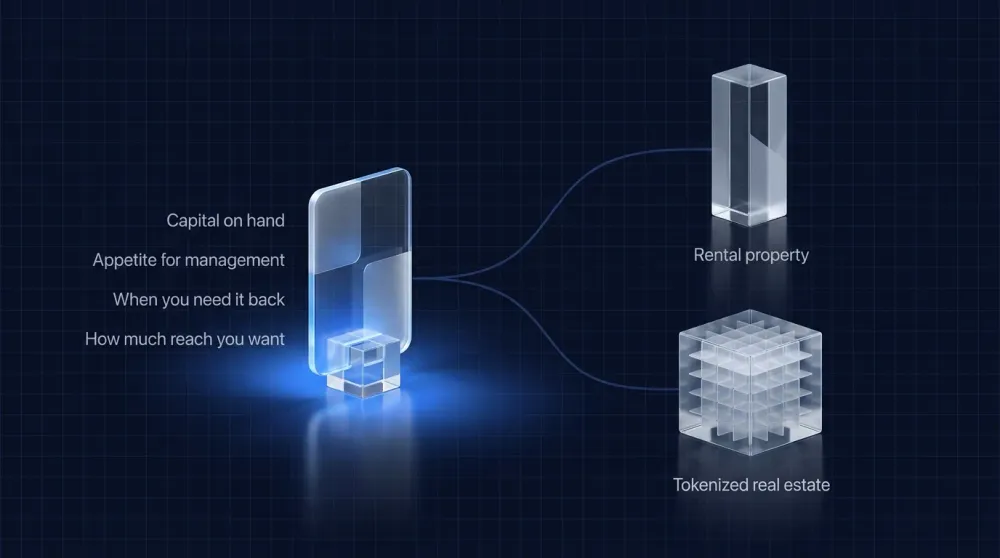
How much capital do you have, and how concentrated would it be? Under about $50,000, a single rental is either out of reach or dangerously concentrated, while tokenized participation works at any size.
How do you feel about management? If screening tenants and scheduling contractors sounds fine, direct ownership rewards that with control and leverage.
When might you need the money back? Direct property is a multi-year commitment with a slow, expensive exit.
Where do you want exposure? Limited to markets you can finance and reach, or spread across countries? That question alone settles it for a lot of people, and it's why tokenized real estate vs rental property ownership is rarely decided on cost alone.
Plenty of capital, tolerance for management, and a local market you know point to buying a rental property. Limited capital, no appetite for landlord duties, or a preference for geographic spread point to tokenized real estate vs rental property ownership.
Can You Do Both?
Yes, and treating this as either-or is where most comparison content quietly misleads people. Among rental property investing alternatives, tokenized participation is the one that sits alongside direct ownership most naturally instead of replacing it.
A common setup pairs direct ownership in a market you know well, where local knowledge and financing access are real advantages, with tokenized participation in places you could never buy into. The rental gives you leverage and control. The tokenized position gives you spread and reach with no extra work. That's usually where the fractional real estate vs direct ownership question lands once real numbers replace theory.
Sequencing works too. Someone saving for a down payment can hold tokenized participation in the meantime instead of sitting in cash. In the other direction, a landlord who doesn't want another building can extend their exposure through participation units rather than another mortgage and another tenant.
These are different tools, not competing verdicts. Choosing between tokenized real estate vs. buying a rental property is usually a question of proportion, based on your capital, your time, and how much of your life you want a building to take up.
Run the numbers against your own situation rather than an average. [Browse live Property Token Offerings on Mey Real](https://meyreal.io) and compare them against what a down payment in your market would actually buy. For a related comparison, see tokenized real estate vs. real estate crowdfunding.
FAQs
Q: Is tokenized real estate a good alternative to buying a rental property?
It's a real alternative if you don't have six-figure capital or any appetite for landlord duties, since it gives you property exposure at low minimums with almost no management. It isn't a replacement if you specifically want mortgage leverage, renovation control or established rental-property tax treatment, where direct ownership still wins.
Q: How much less capital do you need for tokenized real estate vs. buying a rental property?
About three orders of magnitude less. A median-priced US rental at $440,600 needs around $100,000 once you add the down payment and closing costs. Tokenized participation starts at the per-token minimum of 50 USDC, with no financing application or escrow period.
Q: Do you have to manage tenants with tokenized real estate?
No. The platform and its operating partners handle tenants, maintenance and compliance, and you get distributions tied to how the property performs without any landlord duties. The trade-off is control, since you don't pick tenants, set rent or decide on renovations.
Q: Which is more liquid, tokenized real estate or a rental property?
Tokenized real estate, though the gap is smaller than usually claimed. Selling a property takes weeks to months plus transaction costs, while a tokenized position can transfer much faster. Secondary markets are still thin, and RWA.xyz tracked about $202.8 million across 105 tokenized real estate assets in August 2026.
Q: Can you combine owning a rental property and holding tokenized real estate?
Yes, and for a lot of people that's the better answer. A common approach pairs direct ownership in a familiar local market, where financing and local knowledge are advantages, with tokenized participation elsewhere for spread. The rental gives you leverage and control; the tokenized position gives you reach without extra management.
Q: What are the tax differences between owning a rental property and holding property tokens?
Rental property has mature rules, where owners deduct qualifying expenses and depreciate the building, as set out in IRS Publication 527. Tokenized participation is newer, varies a lot by country, and is less settled. That difference is a genuine advantage for direct ownership. Speak to a qualified tax professional about your situation.
Q: Which has more risk, buying a rental property or tokenized real estate?
Neither is riskier as a category, but the risks differ. Direct ownership concentrates your money in one property, with vacancy, liability, illiquidity and leverage risk. Tokenized participation spreads exposure while adding platform, smart-contract and regulatory risk and taking away your control. Both stay exposed to the property market itself.
