

Most people who want to invest in foreign real estate never get past the flight search. The traditional route to acquire foreign real estate asks for a plane ticket, a lawyer you've never met, and an upfront sum most households can't cover.
Tokenized property access is a coordination layer that verifies a physical property, structures its legal ownership, and issues participation units against it, so a person abroad can hold a defined interest without traveling. It isn't a REIT. A REIT gives you a slice of a management team's whole holdings, while tokenized access maps your units to one named building.
The traditional routes still work, and this guide covers all four honestly. Tokenized real-world assets on chain reached $38.1 billion by August 2026, and Citi Institute's June 2026 outlook puts the tokenized asset market at $5.5 trillion by 2030 in its base case. A slice of that sits in property, where real estate tokenization and Property Token Offerings turn buildings into records you check from a laptop.
This guide covers different ways to gain exposure to real estate abroad, including tokenized property access. It is not financial, legal, or tax advice.
Key Takeaways
- Four routes let you access foreign real estate remotely: direct purchase, foreign REITs, crowdfunding, and tokenized property access.
- Tokenized property access through Property Token Offerings lowers the entry amount and removes most travel and legal friction.
- Currency and title risk apply to every remote route, not only tokenized ones.
- KYC checks are required whichever route you choose.
In This Guide
- Why Acquire Foreign Real Estate?
- What Are the Traditional Ways to Access Foreign Real Estate?
- What Goes Wrong With the Traditional Route to Foreign Property?
- How Can You Access Foreign Real Estate Without Leaving Home?
- How Do You Access Foreign Real Estate Remotely, Step by Step?
- What Do the Costs, Fees, and Currency Exposure Look Like?
- What Are the Risks of Accessing Foreign Real Estate?
- How Do the Foreign Real Estate Access Routes Compare?
- What Do These Routes Look Like in Practice?
- How Do You Get Started?
- Frequently Asked Questions
Why Acquire Foreign Real Estate?
Concentration is the quiet problem in most household holdings: if your salary, pension, and home all sit in one country, one policy change moves all three at once. Foreign real estate exposure breaks that link in three ways:
- Diversification. Property cycles in different countries don't move in step, so a downturn at home doesn't hit everything you hold.
- Currency hedging. An asset priced in another currency softens the blow when your own weakens.
- Faster-growing cities. Some cities add population, jobs, and tenancy demand faster than the one you live in.
The appetite is measurable. Dubai logged AED 419.94 billion in property transactions across the first half of 2026, spread over 112,850 deals. Among the benefits of Dubai real estate for foreigners, the structural one matters most: designated freehold zones let non-nationals hold title outright, unlike much of the region. Foreign participation in US real estate ran the other way, reaching $45.3 billion over the twelve months to March 2026 across 67,100 homes.
Cross-border real estate access isn't fringe. It's a well-worn path with badly built on-ramps.
What Are the Traditional Ways to Access Foreign Real Estate?
Three conventional routes exist: direct purchase, foreign REITs, and real estate crowdfunding. They differ on one axis above all others: how much of the property you touch.
Direct purchase
You find the property, fly out, hire local counsel, open a bank account, and wire the money. Costs stack fast: legal fees, agent commissions, transfer duty that swings by jurisdiction, and a conversion spread your bank rarely quotes. Financing is the harder wall, since many countries restrict lending to residents.
Some agencies advertise the ability to buy property abroad remotely through power of attorney. It works, and it hands legal authority to someone you met on a call.
Foreign REITs
A real estate investment trust owns and operates rent-generating property, and most are publicly listed, so accessing one is as simple as any listed security.
The compromise is choice. You're backing a management team's selection rather than a building you picked, so if you wanted the Lisbon block, a pan-European REIT won't offer it.
Real estate crowdfunding
Platforms pool small contributions into one property, usually through a special purpose vehicle, and minimums fall to the low thousands. In the US, these sit under SEC exemptions such as Regulation Crowdfunding, which caps what non-accredited participants contribute yearly.
Platform risk is the live concern: if the operator folds, your claim runs through their paperwork, not a public registry.
What Goes Wrong With the Traditional Route to Foreign Property?
Every traditional route leaks the same way. It works, then something outside your control adds a month. Four friction points do most of the damage:
- Travel cost is the obvious one, and the smallest.
- Local legal counsel is the expensive one, often thousands of dollars before anyone reads a title deed.
- Cross-border financing is the slow one, since underwriting a non-resident can pass ninety days.
- High minimums are the exclusionary one, locking people out of cities they can research from a desk.
Then there's the exit, which most guides skip. Leaving a property in a country you don't live in means re-engaging agents and counsel, then waiting on a registry that answers to nobody's calendar. Reading a foreign contract system is like sitting an exam in a language you don't speak: the words are there, the meaning isn't.
The friction is the story.
How Can You Access Foreign Real Estate Without Leaving Home?
Through tokenized property access, which replaces the registry queue with an on-chain record. Mey Network is an RWA tokenization ecosystem that converts verified real estate into onchain Property Token Offerings (PTOs), giving participants borderless, transparent access to real estate through MeyFi's staking, lending, and marketplace tools.
What tokenized and fractional property access looks like
Each unit maps to a defined portion of one named asset, never a pooled fund. Think of a title office with a glass-fronted filing cabinet: anyone can read the record, nobody can quietly reorder it. You check what you hold at 3 am from a phone rather than emailing an agent abroad.
How Property Token Offerings work
A PTO is the issuance event, and the sequence runs like this:
- The property is verified off-chain and its legal wrapper documented.
- A fixed number of participation units is issued against it on-chain.
- Compliant participants clear KYC and are assigned units at a set price.
- The record updates in minutes, not the six weeks a registry takes.
The full PTO guide covers verification and unit assignment in depth.
Pro tip. Ask for the registry reference number, then look the property up yourself in the local land registry. If nobody can give you one, stop there.
Minimums, KYC, and how participation settles
A direct cross-border purchase starts in the hundreds of thousands. The Chuong My land offering in Ha Noi, which has since closed, issued 2,000 tokens at 50 USDC per token on Mey Real. Identity checks, source-of-funds screening, and jurisdiction review all run before any unit is assigned, because compliance is your first line of defense against fraud.
See which international locations a coordination layer reaches today through tokenized property offerings on [Mey Real](https://meyreal.io).
How Do You Access Foreign Real Estate Remotely, Step by Step?
Five steps, in order, whichever route you pick.
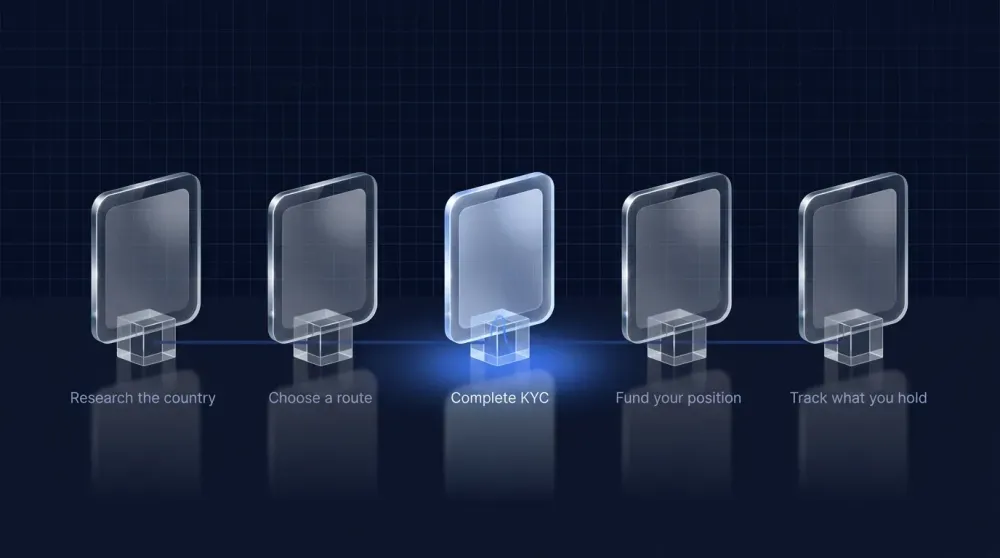
- Research the target country. Check foreign ownership rules first, since some countries bar non-residents from freehold. Then weigh transaction volume, tenancy demand, and currency stability.
- Choose an access route. Direct purchase for control, a REIT for simplicity, crowdfunding for a middle path, tokenized access for the lowest entry.
- Complete KYC. Passport, proof of address, and source-of-funds documents are standard on every route.
- Fund your position. Wire and conveyancing for direct purchase, a standard order for a REIT, a subscription for crowdfunding, a wallet transaction for tokenized units.
- Track what you hold. Traditional routes mean chasing statements. On-chain routes mean a public record.
Before step four, ask what nobody volunteers:
- Who holds the title, and where is it registered?
- What happens to the building if the platform closes?
- Can I transfer this in six months, and to whom?
Walk through the participation requirements on [Mey Real](https://meyreal.io) before you go further.
What Do the Costs, Fees, and Currency Exposure Look Like?
Knowing the mechanics is one thing. Pricing them is another, and the profile differs sharply by route:
- Direct purchase. Legal fees, agent commission, transfer duty, a wire fee, and an FX spread most banks bury in the conversion rate.
- Foreign REITs. A dealing commission on entry, plus the fund's management charge.
- Crowdfunding. A platform fee, usually an annual charge on the committed amount.
- Tokenized access. Fees disclosed upfront. The MeyFi platform publishes its structure for staking, lending, and transfers.
Currency risk in foreign real estate applies to all four. Hold a property in a country whose currency falls 15 percent against yours, and the asset can perform well locally while shrinking at home. USDC-priced PTOs remove the conversion step at entry, though the building still sits in a local economy. Currency is the weather, not the house.
Pro tip. Price the exit before you fund the entry, in fees and in months.
What Are the Risks of Accessing Foreign Real Estate?
The risks of foreign real estate are specific, and they deserve naming plainly.
- Legal and title risk. Registry quality varies enormously: clean digital registries in some jurisdictions, paper systems elsewhere where a competing claim surfaces years later.
- Currency risk. Covered above, and the most underestimated of the set.
- Platform and counterparty risk. Crowdfunding operators and tokenization platforms are companies, and companies fail. Ask what happens to the asset if one does.
- Transfer risk. Direct property is slow to exit. Tokenized units move faster, but only as fast as the pool willing to receive them.
- Regulatory risk. Rules on foreign ownership and tokenized assets change by jurisdiction, and often. Tax treatment stays unclear in many jurisdictions.
- Tax and reporting risk. The IRS treats directly held foreign property differently from foreign financial accounts, and platform-held positions can trigger reporting that a direct purchase does not.
None of these disqualify the category. They belong in the plan.
How Do the Foreign Real Estate Access Routes Compare?
Here is a quick comparison across the five dimensions that move the decision.
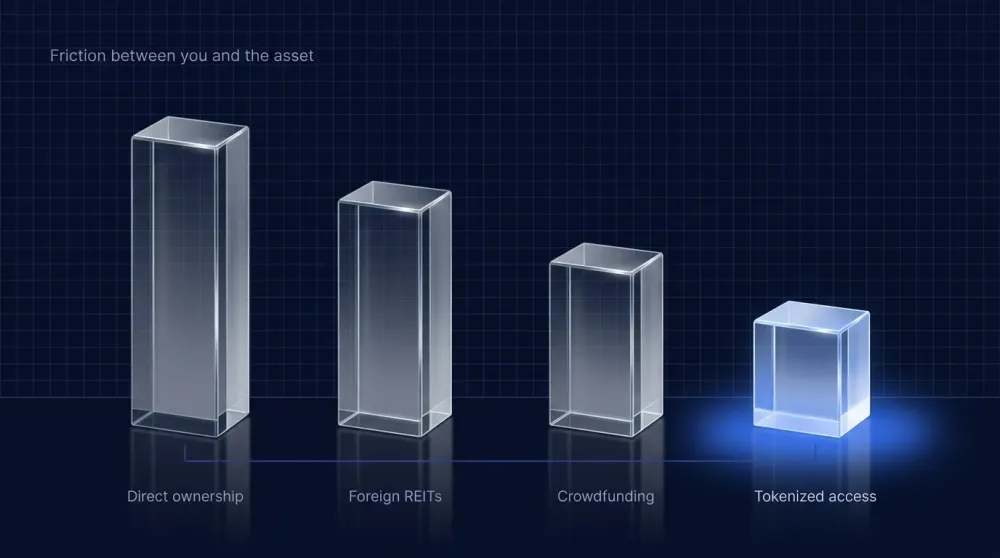
- Entry amount. Direct purchase starts in the hundreds of thousands, REITs at one unit price, crowdfunding in the low thousands. On the closed Chuong My offering, a tokenized unit was 50 USDC. None removes the need to fund your position in full.
- Speed of transfer. A direct sale runs on a registry calendar of weeks or months; REIT units move the same day, tokenized units in minutes once a receiving participant is found. Fast settlement does not guarantee a counterparty.
- Control. Direct purchase gives full control over the asset, tenants, and timing. A REIT gives none. Crowdfunding and tokenized access sit between: asset-level choice, no operational say.
- Geographic reach. Direct purchase limits you to countries where you meet residency and ownership rules; REITs reach wherever the fund is listed, and tokenized access reaches wherever a platform has verified an asset.
- Complexity. Direct purchase demands counsel, banking, and translation; a REIT requires an account that can hold listed units, tokenized access requires KYC and a wallet. Simpler onboarding is not simpler diligence.
What Do These Routes Look Like in Practice?
Three frameworks, illustrative except where noted.
Framework 1: Direct cross-border purchase (illustrative)
A €250,000 apartment in Portugal.
- Total cost. Roughly 6 to 8 percent on top in transfer tax, legal fees, and registration, plus flights and an FX spread.
- Timeline. Three to six months, from offer to registered title.
- Minimum outlay. Near €270,000 all in.
Framework 2: Tokenized property access (closed offering)
The Chuong My land offering in Ha Noi, which ran on Mey Real and has now closed.
- Ticket size. 2,000 tokens issued at 50 USDC each, so one unit cost 50 USDC.
- KYC turnaround. A few business days, after which the holding showed on-chain.
- What participants skipped. Flights, local counsel, a Vietnamese bank account.
Framework 3: Real estate crowdfunding (illustrative)
A US platform pooling into a European logistics asset.
- Minimum. Typically $1,000 to $5,000.
- Hold period. Three to seven years, during which the position is locked.
- Platform fee. An annual charge on the committed amount.
The gap between frameworks one and two isn't asset quality. It's how many people you need permission from.
How Do You Get Started?
Pick the country before the route. If a jurisdiction's ownership rules exclude you, it is a dead end, whichever way you go. Then work out what is holding you back, and let that pick the route:
- Short on capital. Tokenized access starts at one unit, crowdfunding at a few thousand. Direct purchase needs hundreds of thousands, so it is out.
- Short on time. Anything that skips conveyancing wins, because the legal transfer of title is what adds the months.
- You want control. Only direct purchase lets you pick the tenants, the timing, and the exit. Budget for travel and counsel.
Our perspective. The honest framing is narrower than the sector's marketing suggests. Tokenization doesn't make foreign property safe, and it doesn't remove title risk, currency exposure, or the need to read a contract you didn't write. What it removes is the queue: the flights, the introductions, the six-week registry wait, the sum that ruled you out. Verification quality still decides everything.
Start small and read the documentation yourself. The best time to access foreign real estate is after you've priced the exit, not before.
Explore the international locations open today through tokenized property offerings on [Mey Real](https://meyreal.io), and read the [RWA glossary](https://mey.network/blog/crypto-rwa-glossary) if the terminology is new.
Frequently Asked Questions
Can I participate in foreign real estate without traveling?
Yes. Foreign REITs, real estate crowdfunding platforms, and tokenized property access all work remotely from start to finish, with no flight required at any stage. You can also complete a direct purchase through power of attorney, though granting legal authority to a local representative introduces real risk.
What is the cheapest way to access foreign real estate?
Tokenized property access generally carries the lowest entry amount of the four routes. The Chuong My offering on Mey Real, now closed, issued units at 50 USDC each. Foreign REITs are also cheap to enter, starting at one unit, though they give you no say over which properties the fund holds.
Is tokenized real estate a legitimate way to access property abroad?
Yes, when the platform verifies the underlying asset, documents its legal structure, and runs proper KYC on every participant. Legitimacy rests on the off-chain work rather than the blockchain itself, so ask for the property documentation, the legal wrapper, and the governing jurisdiction before you assess any offering seriously.
What are the biggest risks of accessing foreign real estate?
Legal and title risk, currency risk, platform or counterparty risk, transfer risk, and regulatory change are the five that matter most. Title systems vary enormously between countries, and currency swings erase local gains once measured at home. Every one of these applies to tokenized routes too, not only traditional ones.
Do I need to be an accredited participant to access foreign real estate?
Not usually, and this surprises people. Direct purchase, foreign REITs, and tokenized property access carry no accreditation requirement at all. Some US crowdfunding offerings restrict participation or cap contribution amounts for non-accredited participants under SEC exemption rules, so confirm the terms of the specific offering before committing funds.
How does currency risk affect foreign real estate holdings?
If the local currency weakens against yours, a property can perform well domestically and still shrink once converted home, and the reverse applies when it strengthens. Stablecoin-denominated offerings remove conversion friction at the point of entry, though the underlying asset still sits inside a local economy and its currency.
What is the minimum amount needed to access foreign real estate remotely?
It depends entirely on the route you choose. Tokenized property access starts at a single unit, and on the closed Chuong My offering in Ha Noi, that unit was priced at 50 USDC. Crowdfunding platforms typically start between $1,000 and $5,000, while direct cross-border purchase starts in the hundreds of thousands.
