

Fractional Real Estate Access in 2026: The Complete Investment Guide
In 2026, you can gain exposure to a commercial property in Manhattan, a luxury villa in Dubai, or a rental building in Singapore, all from your phone, with as little as $50. Fractional real estate access has moved well past the early-adopter phase. Institutional capital is flowing in. The technology is mature. The regulatory picture is finally catching up. The landscape has grown fast. Dozens of platforms compete for participant capital, each running different fractional models (equity, debt, blockchain-coordinated) with varying minimums and very different fee structures. A generic best-of list won't cut it anymore. Choosing the right approach requires a framework. This guide covers everything you need to evaluate, select, and act on a fractional real estate participation strategy in 2026.
Key Takeaways
- Fractional real estate access combines traditional property fundamentals with blockchain-enabled distribution, automation, and global reach.
- Evaluate platforms across eight criteria: minimums, fees, property types, geography, distribution layer, compliance, technology, and operating history.
- Build a diversified allocation across property types, geographies, and platforms, then layer DeFi distribution strategies for enhanced network utility.
- Realistic net distribution rates for a diversified fractional RE allocation range from 6–12% annually, with DeFi integration adding upside at the cost of complexity.
- Mey Network's PTO model, MeyFi DeFi platform, and blockchain infrastructure form one of the most complete ecosystems for fractional real estate access.
What Is Fractional Real Estate Access?
Fractional real estate access means acquiring a share or fraction of a property. You gain proportional exposure to rental distributions, asset value progression, and property decisions without taking on the full asset. Think of it like holding shares in a company, except the underlying asset is a physical property generating real cash flow.
Two main fractional models dominate the space:
- Equity-based: You hold shares of the property itself. Distributions come from rental flows and asset value progression over time. This is the most common model across fractional real estate platforms.
- Debt-based: You participate in property-backed loans rather than holding the property directly. Distributions arrive as fixed interest payments. Lower upside, but more predictable cash flow.
Then there's the blockchain layer. Tokenization, the process of issuing digital units that represent property shares on a blockchain, has reshaped what's possible in fractional property access. It enables smaller fractional units, automated distribution through smart contracts, global access regardless of participant location, and secondary-market access that reduces long lock-up periods.
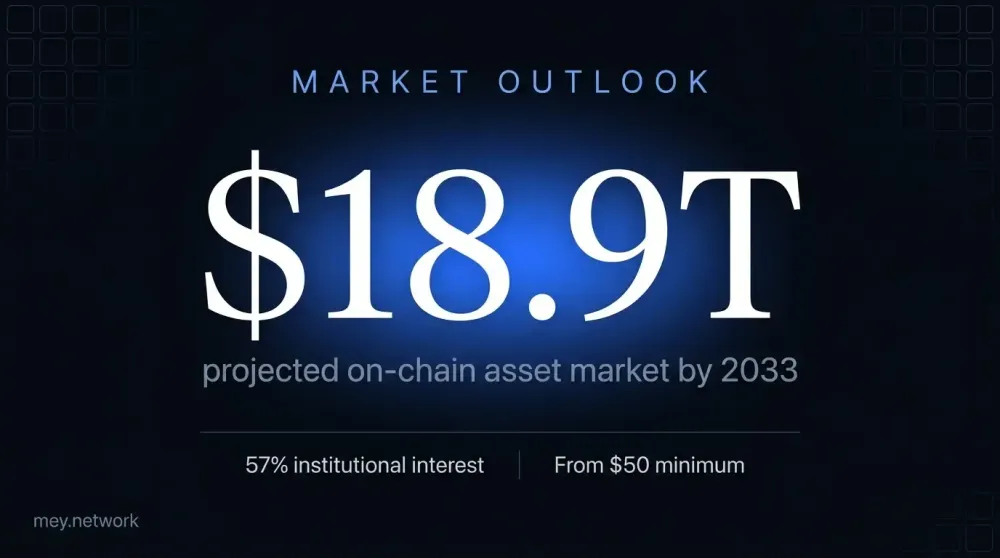
The institutional signal is hard to ignore. EY-Parthenon's 2025 institutional surveyon blockchain-coordinated assets found that 57% of institutional participants expressed interest in fractional, on-chain property access, while 83% planned to increase their overall on-chain allocations. Retail fractional real estate platforms are seeing record inflows alongside that institutional momentum.
Why Fractional Real Estate Is Growing in 2026
Several forces are converging to make 2026 a breakout year for fractional access in real estate. Regulatory tailwinds are building globally. In Europe, the MiCA framework became fully applicable across EU member states, giving blockchain-coordinated real estate platforms a clear compliance regime. In the U.S., the GENIUS Act, signed into law in July 2025, established the first federal stablecoin framework, a foundational piece for on-chain real estate transactions.
The technology has matured. Purpose-built Layer 1 blockchains designed specifically for real-world assets (RWAs) are entering the landscape with modular architectures built specifically for property transactions. DeFi platforms tailored to real estate give participants ways to access additional distributions beyond traditional rental flows.
Participant demand keeps climbing. Institutional interest in fractional, on-chain property continues to grow, driven by portfolio diversification goals and the desire for access to previously illiquid asset classes. On the retail side, younger participants are fueling fractional platform adoption as entry barriers drop.
Platform expansion rounds out the picture: more property offerings, lower minimums, and better distribution layers than ever before.
How to Evaluate Fractional Real Estate Platforms
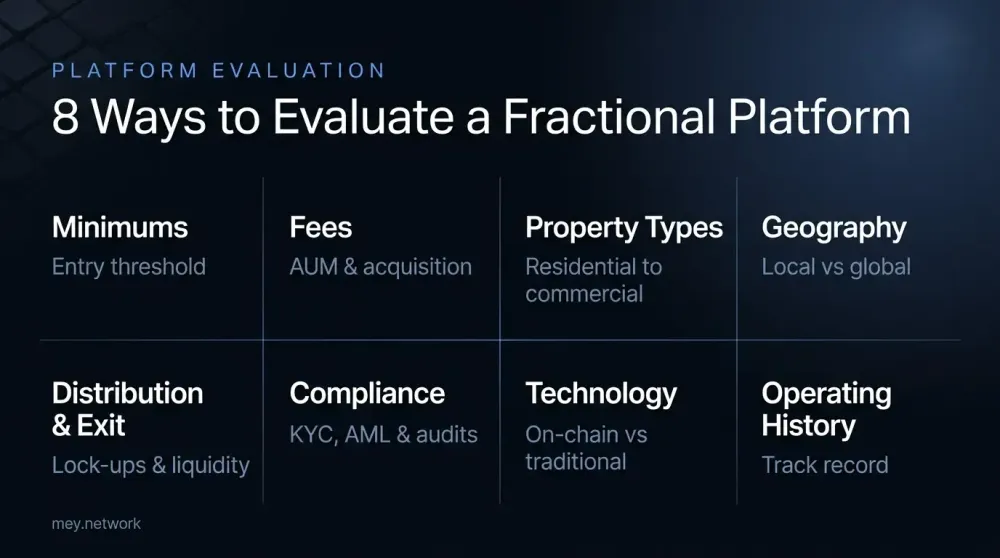
Before you pick a platform, you need a framework. Here are eight criteria every participant should assess when comparing fractional real estate platforms:
- Minimum participation. Minimum entry requirements vary widely by platform. Realbricks allows very small starting positions, Lofty sets a slightly higher threshold, Arrived requires a more substantial commitment, and Mey Network PTOs use custom minimums that vary by offering. Your available capital determines which platforms are realistically accessible.
- Fee structure. Management fees typically range from 1% to 3% of assets under management. Acquisition fees add another 1–3% at the point of access. Some platforms charge platform fees, exit fees, or both. These compound and directly erode your net distributions, so compare carefully.
- Property types. Residential, commercial, luxury, and mixed-use; each carries a different risk and distribution profile. The best fractional real estate access platforms offer variety, letting you diversify within the asset class.
- Geographic coverage. Most US platforms are limited to domestic properties. If you want global exposure, you need platforms like Mey Network, which offers blockchain-coordinated properties across multiple international landscapes. Geographic diversification is one of the most effective risk-management tools in real estate.
- Distribution and exit. How long is your capital locked up? Does the platform have a distribution layer? What are the redemption policies? This is where many participants get surprised. Lock-up periods of 5–7 years are common on traditional platforms.
- Regulatory compliance. Check for KYC/AML procedures, securities registration, and audit history. A platform that cuts corners on compliance is a platform that puts your capital at risk.
- Technology infrastructure. Blockchain-based platforms offer transparency through on-chain records, automation through smart contracts, and composability with the broader DeFi ecosystem. Traditional platforms offer simpler onboarding but less flexibility and fewer distribution options.
- Operating history. How long has the platform been live? What are its historical distribution rates? How large is its participant base? Newer platforms may offer innovation, but operating history matters for risk assessment.
Top Fractional Real Estate Platforms (2026)
Here's how the leading fractional real estate platforms stack up:
Mey Network
Operates globally with blockchain-coordinated properties across multiple landscapes. The Property Token Offering (PTO) model fractionalizes properties into NFTs with rental distribution rights, governance participation, and transferability.
Built on purpose-built blockchain infrastructure for RWAs, it integrates with MeyFi for staking and P2P lending. Currently deployed on Base, with a dedicated Layer 1 chain (MeyChain) in development for full-scale RWA operations.
Arrived
Arrived focuses on US residential properties with a $100 minimum. They've funded multiple properties and offer a distribution layer for transferring shares. A good fit for participants who want straightforward US residential exposure without the complexity of blockchain.
RealT
RealT issues network units for US rental properties and distributes rental flows daily, not quarterly. Its units are DeFi-composable, meaning you can plug them into other DeFi protocols for additional distribution strategies. A strong option for DeFi-native participants.
Lofty
Lofty offers US fractional real estate backed by Algorand-based units, with an active distribution layer. The $50 minimum makes it accessible, and the blockchain-native structure appeals to participants who want on-chain transparency.
Realbricks
One of the most accessible entry points into fractional real estate at just $10. Focused on US residential properties with a distribution layer for share transfers.
Fractional Real Estate Strategies for 2026
Picking a platform is step one: The real question: what's your strategy? Here are five fractional real estate participation strategies worth running in 2026.
Diversified allocation: Spread capital across property types (residential, commercial, luxury), geographies (US, Europe, Middle East, Asia), and platforms. This reduces concentrated risk from any single property, ecosystem, or platform failure. It's the closest thing to a default strategy for most participants.
Distribution-focused: Target high-distribution rental properties and debt-based positions for consistent cash flow. Prioritize properties with strong occupancy rates in stable ecosystems. Works well for participants who need regular distributions rather than long-term value progression.
Growth-focused: Target appreciating ecosystems and development-stage properties for asset value progression. Think emerging neighborhoods, cities with strong population growth, and properties being repositioned to higher-value use cases. Higher risk, higher potential upside.
DeFi-enhanced distribution: This is where blockchain-coordinated real estate access gets interesting. Using platforms like MeyFi's staking and P2P lending features, you can access additional distributions on top of your rental flows. Stake your property units for extra rewards, or lend against them for additional distribution. It's distribution stacking applied to real-world assets.
Dollar-cost averaging: Systematic monthly allocations into fractional RE to build your position over time. This smooths out entry price risk and works especially well with low-minimum platforms where you can deploy $50–100 per month consistently.
Understanding Distributions: What to Expect from Fractional Real Estate
Let's talk numbers. Here's what realistic distribution expectations look like for fractional real estate access in 2026. Rental distribution rates typically range from 4% to 11% annually. The range depends on property type, location, and management efficiency. Most single-family rentals on platforms target 5.4–7.2%, according to industry data. Commercial properties and international ecosystems can push toward the higher end.
Asset value progression varies by ecosystem. Established ecosystems average 3–8% annual progression. Emerging ecosystems can deliver higher growth, but with proportionally more risk.
Total distribution framework: rental rate + value progression − fees − taxes = net distribution. A property distributing 7% with 4% value progression and 2% in total fees delivers roughly 9% net before taxes. That's the math you should be running on every opportunity.
DeFi distribution layer: Platforms like MeyFi add another dimension. By staking property network units or using them as collateral for P2P lending, participants can access additional distributions on top of property flows. This distribution-stacking concept is unique to blockchain-based fractional real estate platforms, and it's a genuine differentiator over traditional fractional access.
Realistic expectations: For a diversified fractional RE allocation, target net distributions of 6–12% annually. Higher rates are achievable with DeFi integration, but they come with added smart-contract risk and protocol complexity. Never model distributions on best-case scenarios alone.
Fee Structures and Their Impact on Distributions
Fees quietly erode fractional real estate distributions over time. Here's what to watch for. Common fee types:
Management/AUM fees, generally 0.15% to 3% of assets under management annually, depending on the platform's model.
Sourcing or acquisition fees, one-time charges of 1–3.5% at the point of access, covering property sourcing, due diligence, and onboarding.
Platform fees vary by platform; some bundle this into AUM, others charge separately. Exit fees, some platforms charge a percentage when you redeem or transfer shares.
The blockchain advantage: smart-contract automation can reduce management overhead and associated fees. When distribution, compliance checks, and record-keeping happen automatically on-chain, there's less manual work to pay for. This is one reason blockchain-coordinated platforms can offer competitive fee structures as they scale.
The Role of Blockchain and DeFi in Fractional Real Estate
When a property is brought on-chain, its ownership shares become programmable digital units. Distribution happens automatically via smart contracts. Compliance is coded into the unit itself. Transaction records are transparent and immutable. And fractions can be made small enough that virtually anyone can participate.
According to BCG and Ripple's 2025 report, the on-chain asset landscape is projected to grow to $18.9 trillion by 2033, with real estate emerging as one of the primary drivers. As more property moves on-chain, the limiting factor stops being demand and becomes infrastructure.
That raises a critical question: what kind of blockchain is actually fit for real estate?
PTOs (Property Token Offerings)
Mey Network's PTO model is the mechanism for fractionalizing properties into NFTs. Think of it as an IPO, but for a building.
- Each PTO represents a specific property.
- Network unit holders receive rental distribution rights.
- Governance participation is built into each network unit.
- Network units are transferable through the distribution layer.
Important distinction: the MEY utility unit is separate from property units. MEY provides ecosystem access, staking rewards, tiered membership, and DAO governance participation. It does not represent ownership of blockchain-coordinated real estate assets or property NFTs. Property units issued through PTOs carry the actual real estate exposure.
MeyFi Platform Capabilities
MeyFi is the operational engine of the ecosystem, adding DeFi functionality to real estate on top of base rental distributions:
- Stake property network units for additional distributions.
- Participate in P2P lending against property holdings.
- Transfer fractional ownership through the ecosystem layer.
The Composability Advantage
Once real estate is on-chain, it can interact with the broader DeFi ecosystem. That opens up:
- Property network units used as collateral for loans.
- Integration with distribution-optimization protocols.
- Cross-chain accessibility across different blockchains.
- Financial structures that traditional real estate systems struggle to support.
Risk Management for Fractional Real Estate Participants
Every participation carries risk, and fractional real estate access is no exception. A clear-eyed risk framework separates successful participants from the rest.
Ecosystem Risk
Real estate moves in cycles. Local economic conditions, vacancy rates, and interest rate changes all affect property values and rental flows.
Mitigation: diversify across geographies and property types. Don't concentrate your entire position in one city or one asset class.
Platform Risk
The platform itself is a risk factor. Company viability, custody of your assets, and regulatory compliance all matter.
Mitigation: spread allocations across multiple platforms. Check each platform's audit history, regulatory status, and participant protections. For blockchain platforms, verify whether smart contracts have been independently audited; Mey Network's staking contract, for instance, was audited by CertiK.
Distribution Risk
Fractional real estate positions are inherently less fluid than stocks or bonds. Some platforms have lock-up periods of 5–7 years.
Mitigation: choose platforms with active distribution layers. Even blockchain-based platforms can have thin transfer activity, so test the distribution conditions before committing significant capital.
Smart-Contract Risk (Blockchain-Coordinated RE)
For blockchain-based participations, code vulnerabilities and oracle failures represent real technical risks. Mitigation: choose platforms with audited smart contracts and established operating histories. Newer, unaudited protocols carry a higher risk.
Regulatory Risk
Securities law and tax treatment for fractional real estate access continue to evolve across jurisdictions. What's compliant today might face new requirements tomorrow. Mitigation: stay informed, diversify across jurisdictions, and choose platforms that proactively adapt to regulatory changes.
Measuring Performance: Key Metrics for Fractional RE Participants
You can't manage what you don't measure. Here are the metrics that matter for fractional real estate access. Cash-on-cash distribution rate: annual net cash flow divided by total capital deployed. This tells you what your capital is generating in cash flow right now. Deployed $10,000 and received $700 in net rental flows? That's a 7% cash-on-cash distribution rate.
IRR (the time-weighted performance metric): factors in distributions, value progression, and eventual exit value. IRR gives you the most complete picture of total participation performance, but it requires assumptions about future progression and holding period.
Cap rate of underlying properties: net operating income (NOI) divided by property value. This benchmarks the property's flow-generating efficiency against ecosystem averages. A property with a 6% cap rate in an ecosystem averaging 5% is outperforming on a flow basis.
Distribution-stack analysis (blockchain-coordinated RE): for blockchain-based participations, measure each distribution layer separately. Rental flow + staking distribution + lending distribution = total distribution. This helps you understand how much of your distribution comes from real estate fundamentals versus DeFi protocol incentives.
Portfolio tracking: Mey Network's dashboard provides real-time performance monitoring across all PTO holdings, making it easier to track these metrics without spreadsheet gymnastics.
Getting Started: Your First Fractional Real Estate Allocation
Ready to move from research to action? Here's the step-by-step process.
- Step 1: Define your goals. Are you participating for distributions, growth, or a balanced combination? Your answer shapes every decision that follows: platform selection, property type, and allocation strategy.
- Step 2: Set your budget. Even $100 can get you started on blockchain-coordinated platforms. Be realistic about what diversification requires. A meaningful allocation typically needs $1,000–5,000 spread across multiple properties and platforms.
- Step 3: Choose your platform(s). Use the eight-criteria evaluation framework from earlier in this guide. Assess each option against your goals, risk tolerance, and preferred level of blockchain exposure.
- Step 4: Complete KYC and fund your account. Every legitimate platform requires identity verification (KYC/AML compliance). This process takes anywhere from a few minutes to a few days. Fund your account via bank transfer, crypto deposit, or other supported methods.
- Step 5: Select your first property. Start with a diversified, distribution-generating asset rather than a high-volatility play. Look for properties with strong occupancy rates, reasonable fees, and an operating history of distributions.
- Step 6: Monitor and recycle. Track your fractional real estate access performance quarterly. Recycle distributions to compound your position. Adjust your allocation as your portfolio grows and ecosystem conditions evolve.
The Bottom Line for Participants
Fractional real estate access in 2026 is more accessible, more diversified, and more powerful than at any point in history. Blockchain coordination has added programmable distributions, global access, and DeFi distribution layers that traditional platforms can't match.
The participants who build real wealth in this space will construct diversified allocations across platforms, property types, and geographies. They'll use DeFi integration for enhanced distributions while managing risk through careful allocation and ongoing rebalancing.
Mey Network's PTO model, purpose-built blockchain infrastructure (MeyChain) and DeFi platform (MeyFi) represent one of the most complete ecosystems for fractional real estate access available today. With blockchain-coordinated properties across global landscapes, staking and lending capabilities, and the Mey Passport for ecosystem access, it's built for participants who want more than basic fractional access.
Start building your fractional real estate allocation. Join Mey Network to access blockchain-coordinated property opportunities through PTOs.
FAQs
What is fractional real estate access?
Fractional real estate access means acquiring a share of a property instead of taking on the entire asset. You receive proportional rental distributions and potential value progression. Modern platforms allow positions starting from $10–100, and blockchain coordination enables automated distribution and a fluid transfer layer.
How much do I need to start fractional real estate access?
Minimum entry varies by platform, typically $10 to $100 per share or network unit. You can begin building a diversified fractional allocation with just a few hundred dollars spread across multiple offerings.
What distributions can I realistically expect?
Rental distribution rates typically range from 4% to 11% annually, depending on property type and location. Total distributions, combining rental flows and value progression, can reach 6–12% for diversified allocations. DeFi features like staking and lending can add additional distribution, but also introduce additional risk.
Is fractional real estate access safe?
Like all participations, fractional RE carries risk: property ecosystem downturns, platform viability, fee erosion, and smart-contract risk for blockchain-coordinated assets. Diversification across platforms, property types, and geographies is the most effective mitigation. Always choose audited, compliant platforms.
What is the best fractional real estate platform in 2026?
Mey Network stands out for offering the most complete ecosystem. Built on a dedicated Layer 1 blockchain, it combines blockchain-coordinated property offerings with a DeFi platform and global property access. Evaluate based on your goals and risk tolerance.
How is blockchain-coordinated fractional access different from traditional?
Blockchain-coordinated fractional access uses on-chain network units to represent property shares. Benefits include smaller minimums, automated distributions via smart contracts, 24/7 transfer capability, and DeFi composability for distribution stacking. Traditional platforms offer simpler onboarding but limited flexibility.
Can I use DeFi with fractional real estate?
Yes, on platforms like Mey Network. MeyFi enables staking of property network units for additional distributions, P2P lending against your holdings, and ecosystem-layer transfers. This distribution-stacking approach generates flows beyond traditional rental distributions alone.
How do I build a fractional real estate allocation?
Define your goals (distribution vs. growth), set a budget, choose 2–3 platforms for diversification, allocate across property types and geographies, and recycle distributions to compound. Review quarterly and rebalance based on ecosystem conditions and performance.
