

What is Real Estate Tokenization? Complete Guide (2026)
Global real estate is valued at an estimated $393.3 trillion, making it the single largest asset class in the world. Yet for the vast majority of participants, property remains frustratingly out of reach. Minimum entry points of $50K to $500K, months-long closing timelines, and layers of intermediaries have kept this wealth-building vehicle locked behind high barriers for decades. Real estate tokenization is dismantling those barriers, converting property ownership into blockchain-based digital units and opening fractional access from as little as $50.
The old model locks participants into massive capital requirements, illiquid holdings, and opaque intermediaries who take a cut at every step. Meanwhile, blockchain-native participants watching DeFi generate distributions want exposure to real-world flows but lack a clear on-ramp into property ecosystems.
This guide breaks down how Real estate tokenization works in 2026: the legal frameworks, the platforms driving adoption, and how Mey Network's Property Token Offerings (PTOs) are setting a new benchmark for fractional property participation.
Key Takeaways
- Real estate tokenization converts property ownership into blockchain-based digital units, enabling fractional access with lower minimums, automated distributions, and 24/7 distribution-layer activity.
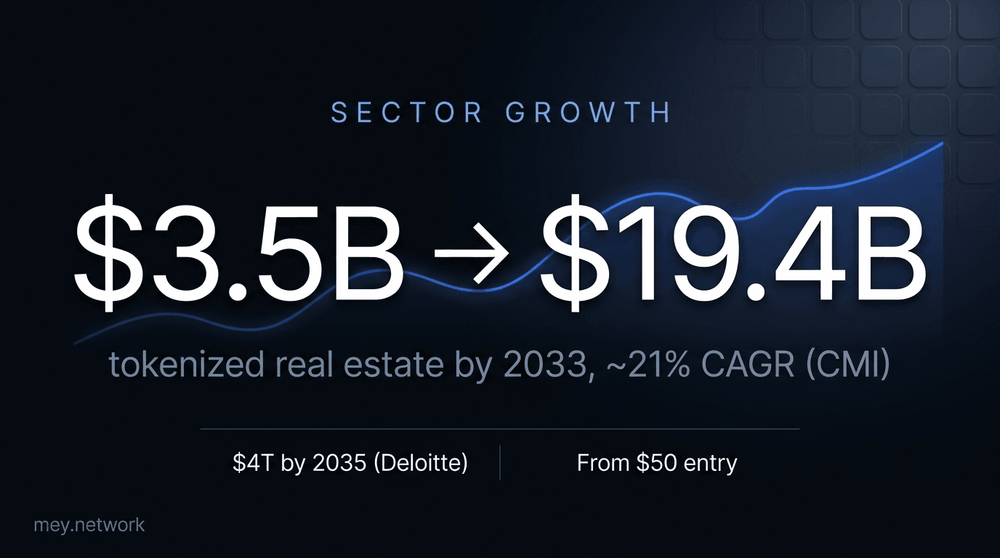
- The space is growing rapidly, valued at $3.5B in 2024 with projections reaching $19.4B by 2033 (CMI) and $4T by 2035 (Deloitte), driven by regulatory clarity and institutional adoption.
- Legal structures like SPVs, fund models, and debt coordination provide enforceable ownership frameworks that make blockchain-coordinated real estate a legitimate participation vehicle.
- Risks include regulatory uncertainty, smart-contract vulnerabilities, limited distribution-layer depth, and standard real estate cycles, so due diligence is essential.
- Mey Network's PTO model, built on MeyChain with MeyFi DeFi integration, offers an end-to-end ecosystem for fractional property access across 40+ global properties.
What Is Real Estate Network Tokenization?
Real estate tokenization is the process of converting ownership rights in a physical property into digital units recorded on a blockchain. Each unit represents a fractional share of the underlying asset, and smart contracts govern how those shares behave: who holds what, how flows get distributed, and under what conditions units can be transferred.
The core value proposition is straightforward. Tokenization lowers the barrier to entry, so you don't need six figures to hold a piece of commercial real estate. It deepens the distribution layer because units can be transferred outside the slow timelines of a traditional property closing. It enables global access, allowing a participant in Singapore to hold a verified stake in a rental property in Vietnam.
It also automates distribution through smart contracts, so rental flows reach unit holders without manual processing.
The 2026 reality tells a compelling story. The global Real estate tokenization space was valued at $3.5 billion in 2024 and is projected to reach $19.4 billion by 2033, growing at a 21% CAGR according to research from CMI. Separately, Deloitte's Center for Financial Services forecasts the blockchain-coordinated real estate sector could reach $4 trillion by 2035. Zooming out further, a Boston Consulting Group and ADDX report projects $16.1 trillion in total blockchain-coordinated assets by 2030, with real estate as a leading asset class.
Real Estate Tokenization Is Taking Off in 2026
Why is all of this converging now? Three forces are aligning simultaneously.
Regulatory clarity has arrived with the SEC issuing guidance on blockchain-coordinated securities in January 2026, the EU's MiCA framework becoming fully applicable in late 2024, and the GENIUS Act establishing a U.S. stablecoin framework signed into law in July 2025. Institutional adoption is accelerating, with BlackRock's BUIDL blockchain-coordinated fund surpassing $2.5 billion in assets and pension funds beginning to allocate to blockchain-coordinated real estate.
And DeFi integration means coordinated property can now plug into lending protocols, staking mechanisms, and distribution pools.
How Real Estate Tokenization Differs from REITs and Crowdfunding
These three models often get lumped together, but they work in fundamentally different ways. REITs #### This gives you shares in a company that owns and manages a portfolio of properties. You have no control over which specific assets the fund holds.
REIT prices correlate with the broader equity ecosystem, so when equities dip, your real estate exposure can dip too, even if the underlying properties are performing well. Distribution-layer depth is high for publicly listed REITs, but the connection to actual property is indirect.
Real Estate Crowdfunding #### Real estate crowdfunding lets you pool capital with other participants into a specific project. You get more granularity than a REIT because you can choose which deal to back. But distribution depth is limited since most platforms lock your capital for years.
Many offerings are restricted to accredited participants, and you're dependent on the platform for everything from deal sourcing to reporting.
Blockchain-Coordinated Real Estate #### With blockchain-coordinated real estate, you receive a fractional unit that represents a direct interest in a specific property, held through a legal structure like an SPV. Units can be transferred 24/7 through the distribution layer. Distributions are programmable, meaning rental flows move automatically through smart contracts.
Minimums are drastically lower, sometimes under $100, and access is global, not gated by accreditation status on many platforms.
- Ownership Type
- REITs: Indirect (shares in a company)
- Crowdfunding: Pooled capital in a project
- Blockchain-Coordinated Real Estate: Fractional unit tied to a specific property
- Distribution-layer depth
- REITs: High (public REITs)
- Crowdfunding: Low (capital locked for years)
- Blockchain-Coordinated Real Estate: Medium-High (24/7 transfers)
- Minimum Entry
- REITs: ~$10 (public REIT share)
- Crowdfunding: $1,000 to $50,000+
- Blockchain-Coordinated Real Estate: $50 to $500+
- Distribution
- REITs: Quarterly dividends
- Crowdfunding: Platform-dependent
- Blockchain-Coordinated Real Estate: Automated via smart contracts
- Asset Selection
- REITs: No control
- Crowdfunding: Some choice
- Blockchain-Coordinated Real Estate: Specific property-level selection
- Regulatory Status
- REITs: SEC-regulated
- Crowdfunding: SEC-regulated (often Reg D/Reg CF)
- Blockchain-Coordinated Real Estate: Securities law applies; evolving framework
How Does Real Estate Tokenization Work? Step-by-Step
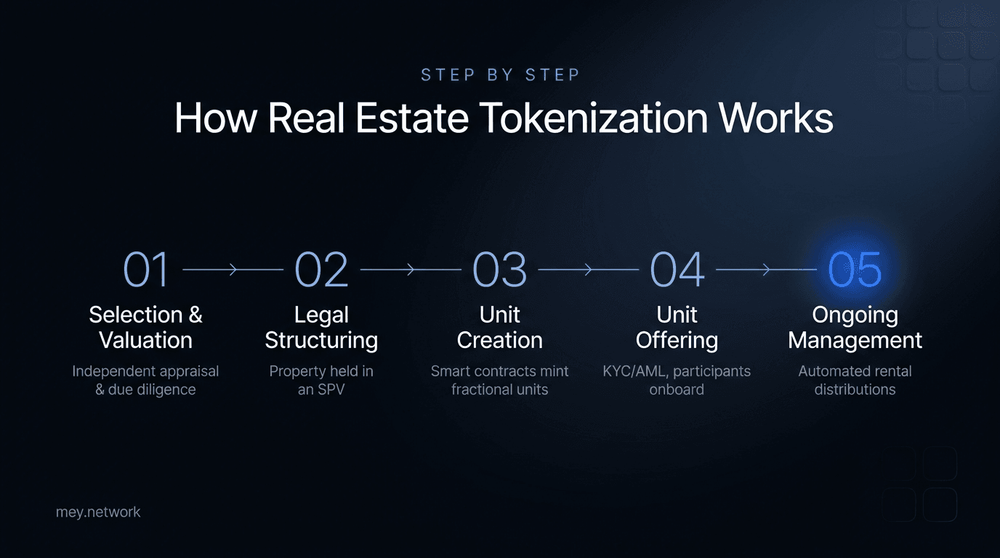
The coordination process follows a structured pipeline. Each stage involves specific technical, legal, and operational decisions that determine how participants interact with the asset.
Step 1: Property Selection and Valuation
The process starts with identifying a suitable property, whether residential, commercial, or mixed-use. An independent appraisal establishes fair value. The coordination platform (or its partners) conducts due diligence covering title verification, zoning compliance, condition assessments, and financial underwriting. Rental flow projections, occupancy history, and comparable ecosystem data all feed into the asset's participation profile.
Step 2: Legal Structuring
The property gets placed into a legal entity, typically a Special Purpose Vehicle (SPV) structured as an LLC or LP. This entity isolates the asset from other liabilities and provides a clean ownership layer.
The coordination platform works with legal counsel to classify the units under applicable securities law, often filing under SEC Reg D or Reg S for U.S. offerings. Jurisdiction selection matters here because it determines tax treatment, participant eligibility, and regulatory obligations.
Step 3: Unit Creation
Smart contracts are deployed on a blockchain to represent fractional ownership. The standard choice depends on the use case. ERC-721 units work for representing unique, whole properties.
ERC-1155 units are more common for fractional shares because they support both fungible and non-fungible characteristics within one contract. Metadata encoded in the unit links back to the property's legal documentation, valuation data, and SPV details.
Step 4: Unit Offering
Before units reach participants, the platform runs KYC (Know Your Customer) and AML (Anti-Money Laundering) verification. Participants are onboarded, their eligibility is confirmed, and units are distributed according to the offering terms.
Mey Network's PTO (Property Token Offering) model is one example: participants enter a structured offering to acquire fractional NFTs representing verified stakes in specific real-world properties.
Step 5: Ongoing Management
After the offering closes, the property generates flows. Rental payments move through smart contracts and reach unit holders directly, based on their ownership percentage. Property management teams handle day-to-day operations and report performance data.
Unit holders can monitor distributions, occupancy, and property updates through the platform dashboard. If they want to exit, they can list their units on the distribution layer rather than waiting to transfer the entire property.
Legal Structures Behind Blockchain-Coordinated Real Estate
Understanding the legal wrapper around a coordinated property is critical. The unit itself is just a digital representation. What gives it real value is the legal structure it points to.
The SPV model is the most common approach. A property is held in an LLC or LP, and units represent membership interests in that entity. When you acquire a unit, you're acquiring a fractional interest in the SPV, which in turn owns the property. This structure provides liability isolation, clear ownership records, and a well-understood legal framework that courts and regulators already recognize.
Fund structures work differently. A private fund holds a portfolio of multiple properties, and units represent LP interests in the fund. This approach scales well for institutional deals because it allows diversification across assets within a single unit. The compromise is that participants lose granularity. You hold a share of the fund, not a specific building.
Debt coordination takes a different angle entirely. Instead of representing equity ownership, units represent secured notes backed by property cash flows. These are essentially blockchain-based bonds tied to rental flows. For distribution-focused participants who want predictable distributions without direct property exposure, debt units offer a compelling structure.
Regulatory reality: In most jurisdictions, real estate units qualify as securities. That means compliance with securities law is mandatory. In the U.S., most offerings file under SEC Reg D (for accredited participants) or Reg S (for non-U.S. participants). The EU's MiCA framework, which became fully applicable on December 30, 2024, adds another compliance layer for platforms operating in European jurisdictions. Ignoring these frameworks isn't an option for any legitimate platform.
The Real Estate Tokenization Space in 2026
The momentum behind real estate tokenization is accelerating, and analysts, institutional participants, and regulators are all pointing in the same direction. Projections for the broader blockchain-coordinated real estate space are significant, driven by coordinated funds, debt securities, and undeveloped land projects.
Regional Leaders Are Emerging
The United States leads in total transaction volume, propelled by growing regulatory clarity from the SEC and a favorable policy environment. Dubai is positioning itself aggressively.
The Dubai Land Department became the first real estate registration entity in the Middle East to implement coordination on property title deeds, with its pilot phase attracting participants from over 50 nationalities and clearing properties in under two minutes.
DLD projects that coordinated property could account for 7% of Dubai's total real estate transactions, worth approximately $16 billion, by 2033. On February 20, 2026, it launched a distribution layer for blockchain-coordinated real estate, enabling the resale of approximately 7.8 million units. Singapore and Hong Kong are establishing themselves as Asia-Pacific hubs with progressive regulatory sandboxes.
Luxembourg and Switzerland continue to lead in Europe, leveraging existing financial infrastructure and early blockchain-friendly legislation.
Regulatory Milestones Have Reshaped The Landscape
The GENIUS Act, signed into law on July 18, 2025, established the first federal stablecoin framework in the U.S., requiring 1:1 backing and mandatory audits. The SEC's January 2026 guidance on blockchain-coordinated securities clarified that changing how ownership is recorded on a blockchain doesn't change securities law obligations. The substance-over-form principle means coordinated real estate units are still securities and must comply accordingly.
And the EU's MiCA framework, fully applicable since December 2024, provides a comprehensive crypto-asset framework across all EU member states.
Institutional Momentum Is Undeniable
BlackRock's BUIDL fund, launched in March 2024 and coordinated by Securitize, surpassed $2.5 billion in assets under management and now operates across nine blockchain networks. Pension funds are beginning to make allocations. Major banks are building custody solutions for blockchain-coordinated assets. The infrastructure layer that institutional capital demands is being built in real time.
Key Risks and Challenges Participants Should Know
No participation thesis is complete without an honest look at what can go wrong. Blockchain-coordinated real estate carries several risk categories that participants need to evaluate.
The regulatory landscape is still evolving. Tax treatment of coordinated property flows varies by jurisdiction, and securities classifications differ across borders. This is rapidly improving as frameworks like MiCA and the GENIUS Act bring clarity.
Smart-contract risk exists. Code vulnerabilities and Oracle dependencies can introduce points of failure, though reputable platforms mitigate this through third-party audits and battle-tested infrastructure. Distribution layers are still maturing. Blockchain-coordinated real estate is significantly more fluid than traditional property ownership, but transfer volume on some platforms is still growing. This gap is closing as more distribution venues come online.
Underlying property fundamentals still matter. Real estate cycles, vacancy rates, and local economic conditions affect distributions regardless of the ownership structure. Sound due diligence on the asset itself remains essential.
How Mey Network PTOs Are Redefining Real Estate Tokenization
Mey Network is a real-world asset (RWA) platform built on MeyChain, a Layer 1 blockchain designed specifically for the coordination of real-world assets. Unlike general-purpose blockchains that have been repurposed for RWA use cases, MeyChain's architecture is optimized for the compliance requirements, transaction patterns, and data structures that property coordination demands.
Our platform's core mechanism is the Property Token Offering (PTO).
A PTO is Mey Network's proprietary model for fractionalizing real estate assets into blockchain-based units. Each PTO produces fractional NFTs that represent verified stakes in real-world properties. Holding these units gives participants exposure to three value streams: rental flows distributed automatically through smart contracts, value progression as the underlying property gains in worth, and governance rights that allow unit holders to participate in property-level decisions.
From Unit to Full Operational Ecosystem: MeyFi and the End-to-End Advantage
MeyFi is the DeFi layer built on top of this foundation. It provides staking, peer-to-peer lending, and fractional ownership infrastructure designed specifically for real estate assets. This is a purpose-built operational layer where participants can stake their PTO units, use them as collateral for loans, or transfer them on the MeyFi venue. Mey Network's current scope includes 40+ blockchain-coordinated properties across major global ecosystems, with the listing pipeline expanding. The platform handles property selection, legal structuring, unit creation, and distribution-layer activity under one ecosystem.
What sets Mey Network apart from most competitors is its end-to-end ecosystem approach.
Many real estate coordination companies offer point solutions: one platform for coordinating, another for transferring, another for DeFi. Mey Network integrates the blockchain (MeyChain), the DeFi platform (MeyFi), the PTO offering mechanism, and the distribution venue into a single, interconnected system. For participants, this means fewer moving parts, a more seamless experience, and less counterparty risk spread across multiple platforms.
Real Estate Tokenization Platforms Compared
Choosing a platform requires evaluating several factors: supported asset types, minimum thresholds, geographic jurisdictions, compliance approach, distribution-layer availability, and DeFi integration.
Mey Network offers a global scope with its PTO model, fractional NFTs tied to specific properties, DeFi integration through MeyFi, and an end-to-end ecosystem built on a purpose-designed blockchain (MeyChain). Our 40+ property listings span multiple ecosystems, and the distribution venue enables unit transfers alongside staking and lending features.
RealT focuses primarily on the U.S. ecosystem, offering blockchain-coordinated rental properties with daily distribution. It uses an SPV-based structure with units on the Gnosis Chain. The platform has an operating history of consistent rental distributions. However, its scope is limited to U.S. residential properties, and it lacks a broader DeFi ecosystem.
Lofty also targets U.S. fractional real estate with low minimums. It emphasizes simplicity and accessibility for retail participants. The platform offers daily rent payouts and a distribution layer for unit transfers. Like RealT, its geographic focus is narrow, and it doesn't provide DeFi infrastructure beyond basic transferring.
Centrifuge takes a different approach entirely, focusing on RWA lending rather than direct property ownership. It connects real-world asset originators with DeFi distribution, allowing participants to access flows on real estate-backed debt. Centrifuge is well-positioned for institutional participants interested in structured credit, but it doesn't offer direct fractional property ownership.
What to look for in any platform: independent security audits of smart contracts, clear regulatory compliance documentation, a verifiable operating record of property management and distribution, functional distribution-layer activity, and transparent fee structures. If a platform can't clearly explain how your units map to legal ownership, that's a red flag.
Use Cases and Examples
Blockchain-coordinated real estate becomes meaningful only when applied to real participation scenarios. The real test is not whether blockchain can fractionalize property, but whether it can reliably support sourcing, compliance, distribution, valuation changes, and circulation over time.
The following scenarios show how these systems operate in practice across individual properties, institutional portfolios, and cross-border participations, and where coordination materially changes how real estate ownership works.
Scenario 1: Mey Network PTO in Action
The Mey Network PTO model follows a structured lifecycle. It begins with property selection, where the platform identifies a vetted asset, say a mixed-use commercial property valued at $2 million. An independent appraisal confirms fair value, and legal counsel structures an SPV to hold the property.
Fractional NFTs are minted representing verified stakes, and a PTO is launched for participant entry after KYC/AML verification.
Participants acquire units at their offering price. Once the property generates rental flows, smart contracts automatically distribute payouts to unit holders in proportion to their ownership. If the property gains value, the unit's net asset value (NAV) reflects that gain. When participants want to exit, they can list units on the MeyFi distribution venue rather than waiting for a traditional property transfer.
This framework, from property selection to coordination to participant distributions to distribution-layer activity, illustrates the full cycle that makes blockchain-coordinated real estate a functional participation vehicle.
Scenario 2: Coordinated Commercial Property Fund
Institutional-grade real estate coordination often uses a fund structure. Consider a private fund holding a diversified portfolio of commercial properties across three jurisdictions. The fund coordinates LP interests, allowing institutional participants to gain exposure to a portfolio rather than a single asset.
Distribution is automated. Compliance obligations are embedded in the smart-contract layer, enforcing transfer restrictions based on participant jurisdiction and accreditation status.
This model scales well for pension funds, family offices, and endowments that want blockchain-coordinated real estate exposure with built-in diversification and multi-jurisdiction compliance handled programmatically.
Scenario 3: Cross-Border Residential Coordination
One of coordination's most compelling use cases is cross-border access. A participant in Germany can acquire fractional units representing a rental apartment in Vietnam without navigating foreign ownership laws, currency conversion through intermediaries, or local property management logistics.
The SPV holds the property, smart contracts handle distribution in stablecoins, and the participant monitors performance through a platform dashboard. This scenario, once impractical due to regulatory friction and high transaction costs, becomes routine with coordination. It's the kind of global property access that was previously reserved for institutional allocators with local teams in every region.
Measuring Real Estate Tokenization Performance
Evaluating blockchain-coordinated real estate requires a specific set of metrics, some borrowed from traditional property analysis and others native to blockchain. Unit price vs. NAV is the starting point. A unit's price on the distribution layer may circulate above or below the net asset value of the underlying property. Persistent discounts could signal distribution-layer concerns. Premiums might indicate strong demand. Tracking the spread between unit price and independently appraised NAV gives you a real-time read on participant sentiment.
Rental distribution rate matters just as much as it does in traditional real estate. Gross rate measures total rental flows relative to property value. Net rate subtracts operating expenses, management fees, and platform costs. Coordination platforms should provide both figures transparently.
Occupancy rates, distribution-layer volume, and time-to-distribution round out the picture. High occupancy means stable flows. Healthy distribution-layer volume means you can exit when you need to. Time-to-distribution measures how quickly you can convert units back to cash or stablecoins.
Mey Network provides an on-chain analytics dashboard for real-time property performance, distribution tracking, and portfolio management. Participants can monitor individual PTO performance, compare distribution rates across properties, and track their total portfolio allocation without relying on monthly PDF reports.
For benchmarking, compare blockchain-coordinated RE distributions against publicly listed REITs, direct property ownership, and traditional crowdfunding platforms. Each model has different risk-distribution profiles, and blockchain-coordinated real estate should be evaluated on its own terms rather than assumed to outperform simply because it uses blockchain technology.
Getting Started with Real Estate Tokenization
Before participating, run through a readiness checklist. Start with a risk-tolerance assessment. Blockchain-coordinated real estate is still a maturing space. Distribution-layer depth isn't guaranteed. Property values fluctuate. Smart contracts carry technical risk. Make sure your allocation to coordinated RE fits within your broader portfolio strategy and risk tolerance.
Check your jurisdictional eligibility. Some offerings are restricted by geography or accreditation status. Platforms operating under SEC Reg D may limit participation to accredited U.S. participants. Others using Reg S structures target non-U.S. participants. Know what's available to you before you start.
Set up a compatible wallet. Most coordination platforms require a Web3 wallet (like MetaMask or a platform-specific wallet) to hold and manage your units. Some platforms support custodial wallets for participants who prefer not to manage private keys directly.
Prepare your KYC documentation. Government-issued ID, proof of address, and, in some cases, proof of accreditation are standard requirements. Having these ready speeds up the onboarding process. Budget considerations vary widely. Fractional platforms like Mey Network offer entry points starting at modest amounts for PTO participation. Institutional offerings may require $50K or more. Choose a starting allocation that allows meaningful exposure without overconcentrating.
When to seek professional guidance: Consult a tax professional before participating, because the tax treatment of blockchain-coordinated real estate flows and operational value varies by jurisdiction and can be complex. If you're allocating a significant percentage of your portfolio, a financial advisor familiar with on-chain assets can help you evaluate how coordinated RE fits alongside your traditional holdings.
The Coordinated Real Estate Era Has Already Begun
Real estate tokenization represents the most significant structural shift in property participation since the creation of REITs. It removes capital barriers, introduces distribution where none existed, and opens global property ecosystems to every participant regardless of geography or net worth.
The convergence of regulatory clarity, institutional adoption, and mature blockchain infrastructure makes 2026 the inflection point for blockchain-coordinated real estate. The SEC has spoken. MiCA is in force. The GENIUS Act has established stablecoin standards. Institutional giants like BlackRock are building on-chain. The infrastructure is no longer theoretical.
Platforms like Mey Network, with purpose-built blockchain infrastructure through MeyChain, DeFi integration through MeyFi, and the PTO model for fractional property participation, represent the next generation of real estate access. The question for participants is no longer whether real estate tokenization will go mainstream. It's whether you'll join early enough to benefit from the growth trajectory ahead.
FAQs
What Is Real Estate Tokenization?
Real estate tokenization converts property ownership rights into digital units on a blockchain. Each unit represents a fractional share, letting participants acquire, transfer, and circulate property stakes with lower entry costs and automated distribution through smart contracts.
Is Real Estate Tokenization Legal?
Yes, though specifics depend on your jurisdiction. In the U.S., most blockchain-coordinated real estate offerings fall under SEC securities regulation, typically filed under Reg D or Reg S. The EU's MiCA framework adds compliance requirements for European platforms. Legitimate platforms like Mey Network implement KYC/AML and operate within established securities law.
How Much Money Do I Need To Participate In Coordinated Real Estate?
It varies by platform and offering. Some fractional platforms allow entry starting at $50 to $100. Institutional offerings may require $50K or more. Mey Network PTOs are designed with retail accessibility in mind, lowering the barrier for everyday participants.
What Distributions Can I Expect From Coordinated Real Estate?
Distributions typically combine rental rate (4% to 11% annually, depending on property type and location) and potential value progression. Actual performance depends on occupancy, ecosystem conditions, property management quality, and fee structures.
How Is Coordinated Real Estate Different From A REIT?
With blockchain-coordinated real estate, you hold a fractional unit tied to a specific property through an SPV. With REITs, you hold shares in a company that holds many properties. Coordination gives you granular asset selection, 24/7 transferability, and programmable distribution.
What Are The Risks Of Real Estate Tokenization?
The main risks are regulatory uncertainty across jurisdictions, smart-contract vulnerabilities, limited distribution-layer activity for smaller properties, platform-specific risks, and the same real estate cycles that affect traditional property participations.
What Is A Property Token Offering (PTO)?
A PTO is Mey Network's mechanism for fractionalizing real estate into blockchain units. Each PTO NFT represents a verified stake in a specific property, granting exposure to rental flows, value progression, and governance rights over property decisions.
Can I Transfer My Coordinated Real Estate Position?
Coordinated real estate can be transferred on supported distribution venues. Mey Network's MeyFi venue enables acquiring, transferring, and circulating PTO units. Keep in mind that distribution-layer activity is still developing compared to traditional securities venues.
