

Dubai property worth **AED 917 billion** changed hands in 2025, across more than 270,000 transactions, and almost none of it was reachable from a laptop in Lagos, Manila, or São Paulo. Dubai real estate tokenization is the answer being marketed to that problem, though whether you can actually acquire property in Dubai on-chain as a foreigner has a narrower answer than the headlines suggest. Most coverage never gets that far.
Dubai's land authority has put a number on the ambition: **tokenized assets at up to 7 percent** of the emirate's property sector by 2033, around AED 60 billion, or USD 16 billion. What rarely gets mentioned alongside that figure is that nearly all of the activity so far runs through one blockchain, and the pilot behind the headlines spent its early phases open only to holders of an Emirates ID.
So the real question is not whether Dubai is tokenizing. It's which door a foreigner is allowed through. What follows is the mechanics end to end, and for the general version first, read **how tokenization works end to end** and **what a PTO is**.
Key Takeaways
- Foreigners can buy Dubai property conventionally inside zones designated under **Regulation No. 3 of 2006**, but Dubai's official tokenization platform still requires a valid Emirates ID. The two routes have different gates.
- Most search demand around Dubai real estate tokenization is tied to XRPL-based platforms. Mey Network runs on a general-purpose public blockchain instead, which is a separate route worth understanding.
- Accessing Dubai property on-chain requires KYC, a funding method, and a grasp of AED and USD stablecoin conversion. Check first whether your units represent registered title, an SPV interest, or a contractual claim.
- Regulation here is jurisdiction-specific and still moving. Treat this as a starting point, not legal verification.
This guide explains how Dubai real estate tokenization works and how to access it. It's educational, not financial, legal, or tax advice, and property values or participation benefits are not guaranteed.
What Is Dubai Real Estate Tokenization?
Dubai real estate tokenization is a property access model that verifies a Dubai asset, converts it into digital participation units, and records every transfer on-chain for participants anywhere in the world.
What the unit legally represents varies, and this is the part worth reading twice. It can be ownership tied directly to the property title, beneficial ownership through a Special Purpose Vehicle registered as the owner, or a contractual claim on rent and sale proceeds. UAE structures commonly use the SPV route: a vehicle incorporated under UAE law holds the property, and your units represent an interest in that vehicle.
Picture a title deed as a receipt locked in one filing cabinet in one city. Tokenization replaces the cabinet with a shared record several parties read at once, while the deed still lives where the law says it must.
The DLD made that explicit with the region's first **property token ownership certificate**, tying a digital holding back to the official register instead of a private database. Platforms operating outside that program cannot offer the same link.
Same word, three legal positions.
Can Foreigners Acquire Dubai Real Estate On-Chain?
Two answers, depending on the route. Most articles give only the flattering one.
Buying conventionally: yes. UAE government guidance on foreign ownership of Dubai real estate is unusually plain. Foreigners who do not live in the UAE, and expatriate residents, may acquire freehold ownership without time restriction, usufruct, or leasehold of up to 99 years in areas designated under Article 3 of **Regulation No. 3 of 2006**, with title deeds issued by the Land Department (**u.ae**). The annex names 23 areas by plot number, Dubai Marina and Palm Jumeirah among them.
Through Dubai's official tokenization program: not yet. Prypco Mint restricts tokenized property to UAE residents aged 21 and over holding a valid Emirates ID. Its first listing was funded in a day, drawing **224 participants across more than 40 nationalities**. Read that carefully. Forty nationalities, every one an Emirates ID holder. Nationality was diverse. Residency was not optional.
That list is amended by decree, not by press release. In 2025, the DLD opened 128 plots on Sheikh Zayed Road and 329 in Al Jaddaf to freehold conversion. So if you have been researching the benefits of Dubai real estate for foreigners, the honest starting point is not the upside. It's the map, checked plot by plot, then the residency line drawn across it.
One critical distinction most tokenization content skips: designation is set plot by plot, and residency rules for the tokenized route are set separately by the platform's regulator. Neither is settled by a marketing page. Non-residents reaching tokenized property today use platforms outside the government program.
Pro tip: Ask any platform two questions. Which designated plot the property sits on, and whether an Emirates ID is required at signup. A vague answer is your answer.
How Dubai Real Estate Tokenization Works, Step by Step
Four stages, in order. Skip one and the structure stops being tokenization and becomes a database.
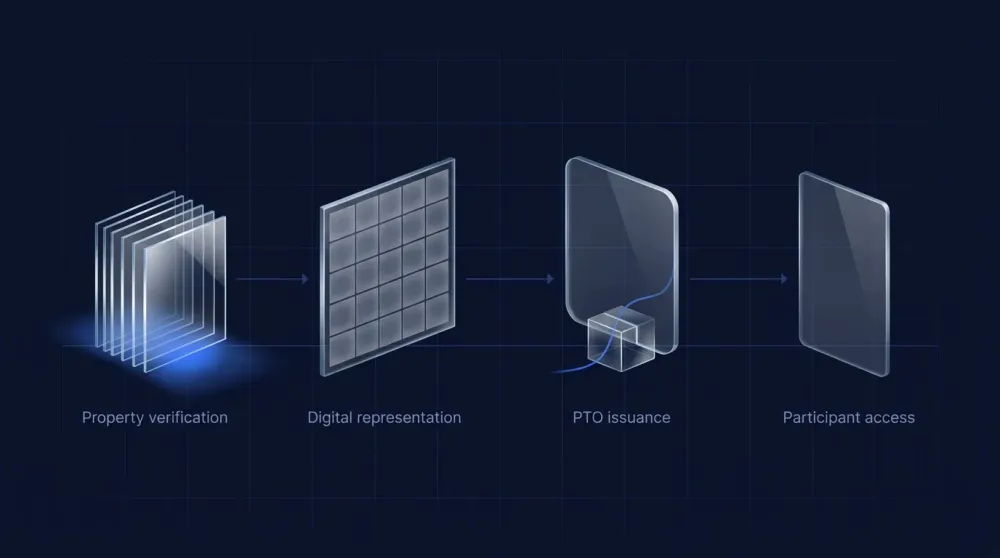
1. Property verification. The asset is checked against the official register: title, encumbrances, service charges, developer status, zone designation. Slowest stage, and the one deciding whether everything after holds.
2. Digital representation. The verified property maps to a defined set of participation units, each a fixed slice of the whole. The unit count is set at issuance, not adjusted later.
3. PTO issuance. Units are released through a Property Token Offering, with disclosed counts, pricing, and compliance conditions attached at the protocol layer rather than bolted on afterward.
4. Participant access. A verified participant completes KYC, funds an account, and obtains units. The on-chain record updates, and the property register reflects the arrangement under the issuing jurisdiction's rules.
Verification first, always. A chain records a defective title as faithfully as a clean one.
Why Does Most Dubai Tokenization Coverage Point at One Blockchain?
Because most of it describes a single government program rather than the category. Two access models exist, and they are built for different readers.
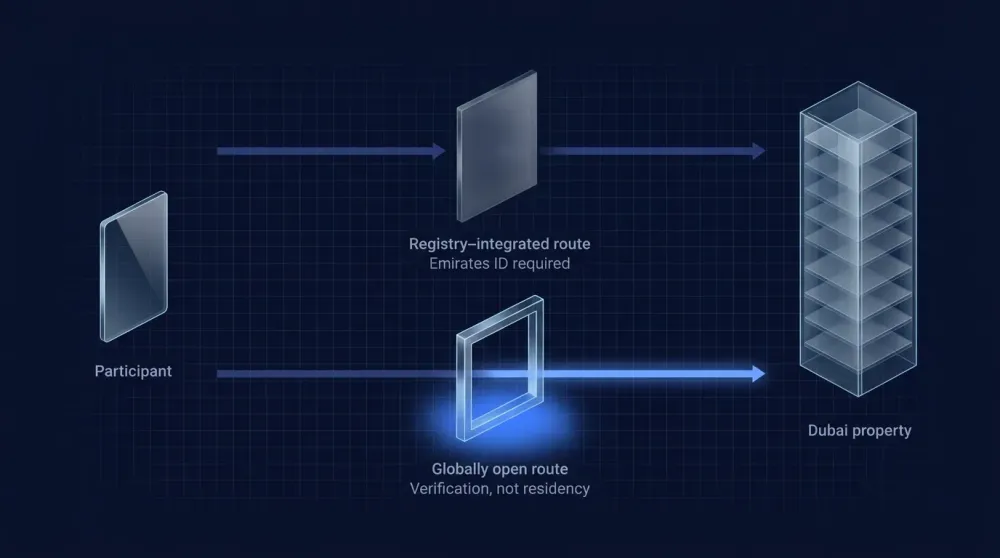
The registry-integrated model. Dubai's government-backed pilot runs through **Prypco Mint**, launched by the DLD on 25 May 2025 alongside VARA, the UAE Central Bank and the Dubai Future Foundation, recording activity on the XRP Ledger. Its integration with the official property register is the deepest available anywhere. What it has not been is globally open: participation restricted to Emirates ID holders aged 21 and over, priced in dirhams, no digital currencies accepted at funding. For a foreign participant, that is a closed door.
The globally-open model. A second group of platforms issues tokenized property regardless of residency, on general-purpose public blockchains, funded in stablecoins, with verification rather than an Emirates ID as the gate. Mey Network works this way: an RWA tokenization ecosystem that converts verified real estate into onchain Property Token Offerings (PTOs), giving participants borderless, transparent access to real estate through MeyFi's staking, lending, and marketplace tools, with the tooling at **MeyFi**. What it lacks is a national registry integration on the DLD's terms, which is why the SPV documents carry more weight here.
Neither model is the finished version. One is deep in a single register and narrow on who may join. The other is open on who may join and shallower on registry linkage. Anyone telling you XRP Dubai real estate tokenization is the whole story is describing a pilot, and searching XRP property tokenization in Dubai will surface that same pilot rather than the wider field.
Two models, two constraints.
What You Need to Access Dubai Property On-Chain
Three requirements, none optional.
- KYC and identity verification. Passport or national ID, proof of address, and a source-of-funds declaration on larger amounts. Turnaround typically runs one to three business days. Compliance is not a hurdle placed in front of you. It is what stands between you and a platform that takes anyone's money.
- A funding method. Either fiat rails into a regulated account, or stablecoins into a wallet you control. Most cross-border tokenization runs on USDC or a comparable USD-pegged unit, removing correspondent banking from the path.
- A grasp of AED and USD conversion. The dirham has been pegged to the US dollar at roughly 3.6725 since 1997, making AED and USD-stablecoin conversion unusually stable next to most emerging-market currencies. Stable is not permanent. A peg is a policy choice.
Pro tip: Before funding anything, walk through the participation requirements and confirm which entity holds your units, under which jurisdiction's law. If a platform cannot answer that in one sentence, stop.
Costs, Minimums & Regulation Basics
Minimums have fallen fast. Dubai's pilot opened at AED 2,000 and has since advertised entry from AED 1,000, roughly USD 270. Mey prices its live PTO units at 50 USDC each. Tokenization did not make property cheap. It stopped the smallest possible participation from being an entire apartment.
Costs to check before committing, in the order they bite:
- Issuance or platform fees, charged at the point of access.
- Ongoing administration, usually annual, usually a percentage of value.
- Transfer costs, network fees plus any platform charge when units change hands.
- DLD registration fees, conventionally 4 percent of property value.
- Conversion spread, the quiet one, applied every time you move between fiat and stablecoins.
Regulation runs on several levels. The Dubai Land Department governs the property register and freehold designation, RERA covers brokers, developers, and escrow, and **VARA** licenses tokenization platforms and sets their AML, custody, and cybersecurity conditions. Federally, the Securities and Commodities Authority supervises token-based offerings and the Central Bank enforces AML rules, while the DIFC and ADGM run separate regimes through the DFSA and FSRA. Tax is light by comparison: no capital gains tax on property proceeds, 5 percent VAT on commercial property, residential largely exempt.
That structure is specific to Dubai. A platform serving you from elsewhere answers to a different regulator, and you should know which before funding an account. These rules have been amended repeatedly since 2024, so verify the current framework.
Risks of Dubai Real Estate Tokenization
Four risks deserve naming, and none get solved by a good user interface.
- Regulatory risk. Frameworks here are young. A rule change in Dubai, or where you hold residency, can alter what you may hold or how you are taxed. Cross-border participation multiplies the rulebooks applying to you.
- Platform risk. The chain does not fail. The operator might. If your units represent an interest in an SPV rather than registered title, your position rests on that vehicle's documents and whoever administers it. Read the structure before the brochure.
- Currency and FX exposure. You may fund in USD stablecoins, hold an AED-denominated asset, and report in a third currency. The peg absorbs one leg. Not the others.
- Transfer depth. Tokenized property is more divisible than a whole apartment. Divisible is not easily transferable. Dubai's pilot only opened participant-to-participant transfers in February 2026, across roughly 7.8 million units and about $5 million of property over 10 assets. Real progress, small pool. Assume you may need to hold.
On-chain transparency is not the same as off-chain competence.
Dubai Real Estate Tokenization vs. Traditional Dubai Property Ownership
Four dimensions separate the routes, and the contrast does not run one way.
- Capital required. A conventional freehold-zone purchase starts in the hundreds of thousands of dirhams, plus 4 percent DLD registration and agent costs. A tokenized participation starts in the hundreds. What it does not give you is the same instrument: a defined slice, not a whole deed.
- Complexity. The conventional route means a broker, a bank, a developer, an escrow account, and in-person steps. The tokenized route compresses that into an account, a verification pass, and a funding transfer, then adds new homework: chain, custodian, issuer, legal wrapper.
- Transferability. Selling a Dubai apartment runs on a registry calendar, weeks to months. Transferring participation units can settle in minutes where a compliant route exists. Where none exists yet, minutes becomes indefinitely, and that risk sits with you.
- Foreign ownership process. Both pass through the same freehold-zone gate. The conventional route adds banking relationships and often physical presence. The tokenized route removes the travel and the correspondent bank, and Dubai's own program adds a residency gate the conventional route never had.
Same law, different door.
How to Get Started
Four steps, and the order matters.
- Confirm the zone. Check whether the property sits in a designated freehold area. Verify with the DLD or a licensed adviser, not the listing page.
- Verify the operator. Which entity issues the units, which regulator licenses it, and whether an SPV sits between you and the deed.
- Complete KYC and fund carefully. Passport, proof of address, source of funds.
- Start with one unit. Then read the reporting before doing anything else.
For context on reaching property outside your own country, see foreign real estate access broadly, and for the checklist that applies to every listing, see essential due diligence for tokenized real estate.
Our view, plainly: the Dubai story is being told as a chain story when it is really a registry story. What makes Dubai interesting has little to do with which ledger it settled on, and everything to do with a property authority deciding a digital record could sit beside an official one. The chain is not the moat.
See which properties are accessible through Property Token Offerings on Mey Real, and explore it as part of your own research.
FAQs
Can foreigners access Dubai real estate through tokenization?
Only partly. Non-residents can buy Dubai property conventionally inside designated freehold zones under Regulation No. 3 of 2006, but Dubai's government-backed tokenization platform currently admits only UAE residents aged 21 and over who hold a valid Emirates ID. Non-residents reach tokenized property through platforms operating outside that program, under a different legal structure entirely.
How does Dubai real estate tokenization work?
Four stages run in sequence. A property is verified against the official register, held by a Special Purpose Vehicle or registered directly, converted into a fixed number of participation units, then issued through a Property Token Offering to participants who complete KYC. The on-chain record tracks transfers while legal title stays registry-governed.
Is Dubai real estate tokenization regulated?
Yes, at several levels. VARA licenses tokenization platforms in Dubai and sets their AML, custody, and cybersecurity conditions. The Dubai Land Department governs the property register, RERA covers brokers and escrow, the Securities and Commodities Authority supervises federally, and the DIFC and ADGM operate separate regimes through the DFSA and FSRA.
How much do you need to access Dubai property on-chain?
Far less than a conventional purchase requires. Dubai's government-backed pilot has advertised entry from AED 1,000, roughly USD 270, having opened at AED 2,000. Mey prices its published Property Token Offering units at 50 USDC each. Budget separately for platform fees, ongoing administration, transfer costs, and conversion spread, which headline minimums never include.
Is tokenized Dubai real estate safe?
Safety depends on the structure, not the chain. Four risks apply: regulatory change across multiple jurisdictions, operator failure at platform level, currency exposure between stablecoins and dirham-denominated assets, and thin transfer depth in a young category. The blockchain record itself is reliable. The legal wrapper and the operator underneath are what you actually verify.
How do I get started with Dubai property on-chain?
Work in order. Confirm the property sits in a designated freehold zone, verify which entity issues the units and which regulator supervises it, check whether an SPV holds the title rather than you, then complete KYC and obtain a single unit as a test. Read the reporting before scaling further.
