

Real estate has always produced rent. What kept most people out was the cost of entry: a large down payment, a mortgage, and the ongoing work of tenants, repairs, and management. Tokenization removes most of that and turns rent into an on-chain income stream, which is why real estate passive income is now within reach for people who have no interest in becoming landlords.
The change is structural. Instead of buying a whole building, a participant holds tokens representing a fractional share of it and receives a proportional slice of the rent automatically, on a set schedule. There is no lease to negotiate and no property to manage. The asset continues to operate, and distributions continue to be paid to holders.
The category has scale behind it. The tokenized real-world asset market reached roughly $38 billion in August 2026 (RWA.xyz), and is projected to reach $9.4 trillion by 2030 (Boston Consulting Group x Ripple, 2025), though tokenized real estate is still an early slice of that total.
This guide sets out exactly how tokenized property pays rent: how money moves from tenant to holder wallet, what distributions are realistic, how often they arrive, and what reduces them. The figures are deliberately conservative and labeled as examples, because real estate passive income is a real outcome rather than a guaranteed one.
This article is educational and does not constitute financial, legal, or tax advice. Tokenized real estate carries risk, including possible loss of capital. All figures shown are illustrative examples rather than guarantees. Do your own research and speak to a licensed professional.
Key Takeaways
- Real estate passive income from tokenized property means recurring rental distributions to token holders, paid automatically, without a landlord's workload.
- Money flows from tenant to SPV, costs are deducted, net income is split by token holding, and a smart contract distributes to holders, generally in stablecoins, monthly or quarterly.
- Realistic net rental yields on stabilized property generally fall in the 4% to 8% range. Double-digit "rental" yields deserve close scrutiny.
- Rent and token appreciation are two different things. Total return combines both, and this guide focuses on the rent.
- Staking or reinvesting distributions, for example, through MeyFi, can compound rent into a larger participation benefit, while vacancy, liquidity, fees, and tax remain the main risks.
What "Passive Income" Actually Means in Tokenized Real Estate
Here, it means recurring rental distributions paid to token holders with no operational involvement on their part. No tenant screening, no maintenance. You hold tokens, and your share of net rent arrives monthly or quarterly.
Tokenized property can produce value in two distinct ways, and it helps to separate them:
- Rental yield, the cash flow from rent, which is what this article covers.
- Capital appreciation, the change in the token's value if the property's worth rises over time.
Both matter, and they behave differently. Rental yield is the steady stream. Appreciation is an uncertain gain realized only when you dispose of the position. This guide is about the income stream.
Calling it passive is accurate because operators and professional property managers handle the physical asset, including leasing, maintenance, and compliance, while smart contracts handle the accounting and the payout. The holder's only job is to hold. That division of labor is the whole point of using tokenized property for passive income.
How Tokenized Property Pays Rent: The Money Flow
You can trace the path end to end. This is the chain that turns a tenant's monthly payment into passive income from tokenized property in a holder's wallet.
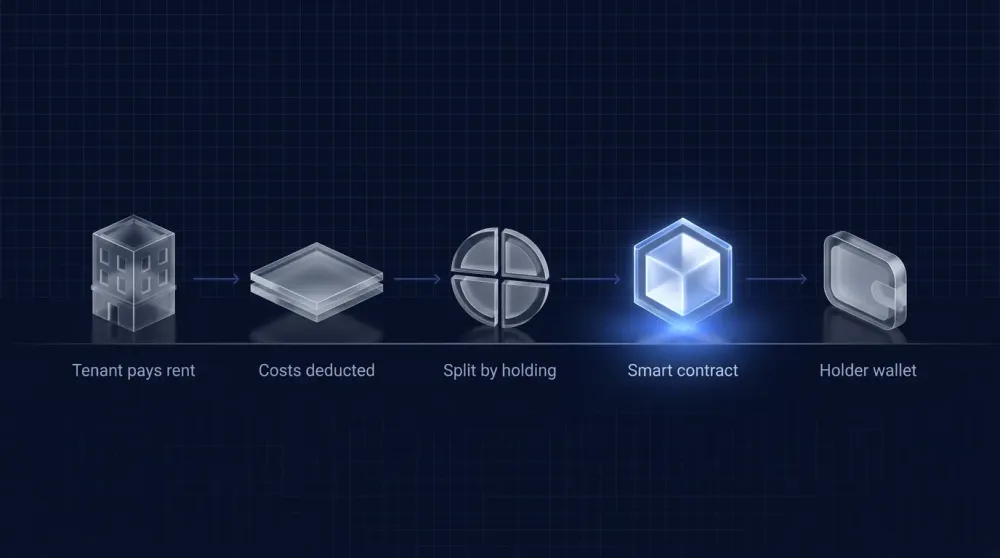
Step 1: Tenants pay rent
It starts where all real estate income starts. A tenant pays rent, and that gross rental income is collected at the property level inside the SPV, the legal entity that holds the building. Nothing on-chain has happened yet. This is conventional real estate doing what it does.
Step 2: Operating costs are deducted
Gross rent is not what gets distributed. Management fees, maintenance, property taxes, and insurance come out first, leaving net rental income, which is the figure that actually drives distributions. Any platform quoting yields against gross rent is showing you a flattering number, so confirm that a figure is stated net.
Step 3: Net income is split by token holding
Net income is divided according to tokens held. Your share equals your tokens divided by total tokens issued. Hold 500 tokens out of a 10,000-token supply, and you have 5% of the net rent. The allocation is proportional, and the calculation is visible on-chain.
Step 4: Smart contracts distribute to holders
A distribution smart contract executes the payout automatically, allocating each holder's share. Payments generally arrive in stablecoins such as USDC or USDT, or as an internal platform balance.
Stablecoins keep the value predictable. Circle holds the majority of USDC reserves in the Circle Reserve Fund, an SEC-registered government money market fund holding cash, short-dated US Treasuries, and overnight Treasury repurchase agreements, with the remainder in cash at large banks. Holdings are published weekly, and a Big Four firm provides monthly third-party assurance that reserves exceed USDC in circulation (Circle). That insulates a distribution from crypto market swings between payouts.
Step 5: Distributions arrive on a schedule
The distribution reaches the holder's wallet monthly or quarterly, depending on the offering. From tenant to token holder, the whole path is automated and auditable.
That is the mechanism behind tokenized rental income.
Real Estate Passive Income Math: A Worked Example
A concrete calculation shows the scale. Take a $1,000 holding in a property targeting a 7% net rental yield.
- Annual: $1,000 × 7% is about $70 a year
- Monthly: $70 ÷ 12 is about $5.83 a month
Scaled up, the proportions hold. Each figure below assumes roughly 7% net.
- Holding, $1,000. Approx. per year, $70. Approx. per month, $5.83.
- Holding, $5,000. Approx. per year, $350. Approx. per month, $29.17.
- Holding, $25,000. Approx. per year, $1,750. Approx. per month, $145.83.
- Holding, $100,000. Approx. per year, $7,000. Approx. per month, $583.33.
These figures are illustrative. Actual real estate passive income depends on the specific property, its occupancy, its fee structure, and its target yield. A building at 95% occupancy distributes very differently from one that is half empty. Treat the maths as a framework rather than a forecast, and verify the offering's real net yield rather than a marketing figure.
At portfolio scale, real estate passive income compounds through consistency rather than through any single large position. An allocation spread across several tokenized properties turns a set of modest net yields into a blended distribution stream, which holds up better against the vacancy or fee pressure that can hit any one asset. The same discipline that governs a conventional rental portfolio applies here, with the difference that tokenization lowers the capital needed to build that diversification and automates the collection. For an income-focused holder, the goal is a stable, repeatable distribution rather than the highest headline number on any single offering.
How Much Can Holders Receive? Realistic Yield Ranges
For stabilized residential and commercial properties, net rental yields typically range from 4% to 8%. As a benchmark, Global Property Guide tracks gross residential rental yields across more than 80 countries and puts the US average at 6.71% for Q2 2026, from a survey completed in June 2026 (Global Property Guide). Net yields sit below gross once costs come out.
Yields vary by asset type:
- Stabilised residential. Typical net yield, ~4–7%. Income stability, High. Notes, Broad tenant demand makes distributions steady but modest.
- Commercial / office. Typical net yield, ~6–8%. Income stability, Medium. Notes, Stronger cash flow, with tenant-concentration risk.
- Emerging-market property. Typical net yield, Higher. Income stability, Lower. Notes, The higher yield reflects higher risk.
Five levers move the number: location, occupancy, asset class, fees, and leverage. A well-located, fully occupied building with lean fees distributes more of its rent to holders. A vacancy or a fee-heavy structure eats into the net figure.
One reality check. Sustained double-digit "rental" yields are uncommon for stabilized property. An offering advertising 15% to 20% as pure rental yield, with no explanation, deserves heavy scrutiny. Figures like that usually reflect leverage, elevated risk, or marketing presented as income.
The durable approach to real estate passive income is consistent rather than aggressive: pick well-occupied assets, hold across more than one property, and let distributions accumulate. A single 6% property is fine. Three of them, distributing on staggered schedules, smooth out the month-to-month variation. That looks more like a small income portfolio than a bet on one building, and the difference is what separates durable income from chasing the highest advertised figure.
Rent vs. Token Appreciation: Two Different Things
Two forms of value can accrue at once, and it is worth being deliberate about which one you are after.
Cash flow (rent) is the recurring distribution described above. Predictable, and suited to income now.
Value growth (token price) is what happens if the underlying property appreciates and the token becomes worth more on disposal. Uncertain, and suited to building value over time.
Total return is distributions plus appreciation. Some participants prioritize cash flow for the regularity of monthly income. Others accept a lower current yield for the prospect of stronger appreciation. Neither is inherently right, and the choice depends on whether you want an income stream or a growth position. Crypto real estate passive income is generally framed around the former, so net yield stays the relevant metric for income-focused holders.
Stacking Benefits: Compounding Rent with Staking
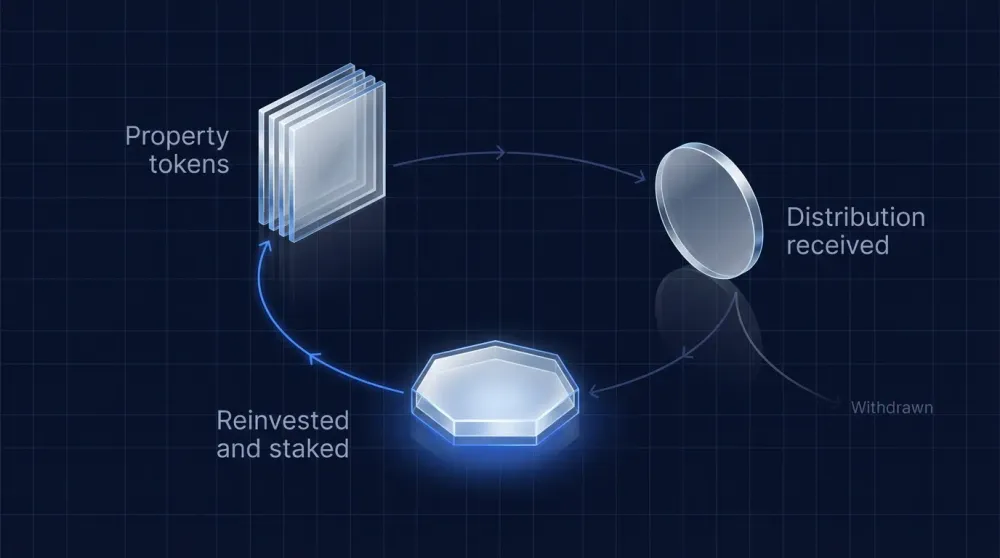
Tokenized property allows a step that a traditional rental does not. After rent arrives, the same property tokens can be put to work for an additional layer.
The mechanism is compounding. Instead of withdrawing every distribution, a holder can reinvest it, and on some platforms, property tokens can also be staked. Mey Network is an RWA tokenization ecosystem that converts verified real estate into onchain Property Token Offerings (PTOs), giving participants borderless, transparent access to real estate through MeyFi's staking, lending, and marketplace tools. MeyFi is built for exactly this. Its participation layer lets PTO units be deployed through staking and P2P lending, and its documentation describes $MEY staking in four tiers, Dolphin, Shark, Whale, and SVIP, where APR increases with the size of the stake, and rewards are claimable at maturity (Mey Network docs).
One caveat on that. The tier structure is documented rather than live: mey.network currently shows $MEY staking as coming soon, and no APR figures are published, so treat the tiers as the designed model rather than a shipped product with known rates.
A simple compounding illustration. A $10,000 holding at 7% net rental yield produces roughly $700 a year in rent. Reinvesting that rent instead of spending it, and adding a staking layer, lifts the effective annual figure above the base 7%. The exact number depends on the staking terms and is not guaranteed. Withdrawing everything keeps you at a flat 7%. Over several years, the reinvesting path pulls meaningfully ahead. Figures are illustrative, and staking carries its own risk.
A caution on compounding: reinvestment works best when the underlying rent is reliable. Layering a staking return over a shaky, half-occupied property compounds the volatility rather than the income. Establish the income base first, on a stabilized asset producing steady net rent, then add the staking layer. In that order, real estate passive income can grow faster on-chain than through a single traditional rental, because both reinvestment and staking happen automatically instead of requiring you to buy another property. For the full mechanics, see our companion guide on RWA staking.
Payout Details Worth Understanding
The questions that come up most are answered directly.
Payment frequency (monthly vs quarterly)
Most tokenized property distributes rent monthly or quarterly. Monthly suits cash flow. Quarterly reduces processing overhead. The offering documents state the schedule, so confirm it before participating.
Payment currency (stablecoins vs fiat off-ramp)
Distributions generally arrive in stablecoins such as USDC or USDT, which hold a steady dollar value. You can hold them, redeploy them, or move them through a fiat off-ramp into local currency. Some platforms credit an internal balance available for withdrawal on demand.
Occupancy and vacancy
Rent depends on tenancy. A vacant unit reduces net income and shrinks the distribution for that period. Diversified, multi-unit properties cushion this. Single-tenant assets feel it much harder. Occupancy is the biggest source of variation in tokenized rental income, so occupancy history is a data point worth asking for.
Fees that reduce net yield
Management fees, platform fees, and maintenance reserves come out before distribution. They explain the gap between an advertised gross yield and the net figure you actually receive. A transparent platform itemizes them.
Risks to Your Distributions
Real estate passive income is durable but not risk-free. Here are the main exposures.
Vacancy or tenant default reduces or suspends distributions. A vacant unit produces no rent.
Liquidity. Disposing of tokens depends on secondary-market depth, and the market is young: RWA.xyz tracked roughly $202.8 million across 105 tokenized real estate assets as of August 6, 2026 (RWA.xyz). Exiting a niche asset may take patience or a price concession.
Smart-contract and platform risk. Defects, exploits, or operator failure can affect capital. Platforms with independent audits are preferable.
Regulatory and tax treatment. The IRS treats digital assets as property and taxes income derived from them (IRS, Digital Assets). Rental and token income may be taxed differently depending on your circumstances.
Currency and stablecoin considerations. Stablecoins are robust but not risk-free. A depeg, however unlikely, would affect the value of a distribution held in that coin.
Mitigation follows a consistent pattern: diversify across several properties rather than one, use audited and compliant platforms, and review a property's occupancy history before participating.
How to Start Receiving Rental Distributions from Tokenized Property
The process is short.
- Pick a compliant platform with audited contracts.
- Complete KYC and whitelisting.
- Review the property, its net yield, its occupancy, and its fees.
- Acquire the tokens.
- Receive distributions on the stated schedule.
- Optionally stake or reinvest to compound.
Done in that order, these steps turn property into a recurring income stream. For anyone ready to move, Mey Network's Property Token Offerings and MeyFi are built to hold fractional real estate and, where you want it, to compound the distributions.
FAQs
How does tokenized real estate generate passive income?
Tenants pay rent to the property's legal entity; operating costs are deducted to arrive at net income; and a smart contract splits that net income among token holders according to their shares. The distribution reaches each holder's wallet automatically, generally in stablecoins, with no management required from the holder.
How often is rental income paid to token holders?
Most tokenized property distributes rent monthly or quarterly, depending on the offering. Smart contracts trigger the payout on a fixed schedule, so each holder receives a proportional share automatically. The exact timing is stated in the offering documents, so confirm it before you participate.
Is tokenized rental income paid in crypto or fiat?
Generally, in stablecoins such as USDC or USDT, which hold a steady dollar value, or as an internal platform balance. You can keep them, redeploy them, or convert to local currency through a fiat off-ramp. Some platforms support direct fiat withdrawal.
Can rental income be lost if the property is vacant?
Yes. Rent depends on tenancy, so vacancy or default reduces or suspends distributions for that period. Diversified, multi-unit properties cushion the effect better than single-tenant assets. Reviewing a property's occupancy history before participating is one of the most effective protections available.
What's the difference between rental yield and token price appreciation?
Rental yield is the recurring cash flow from rent. Token price appreciation is the increase in a token's value if the property's worth rises. Yield arrives along the way. Appreciation is only realized on disposal. Total return combines both, and this article focuses on the yield component.
Can distributions be increased by staking property tokens?
Often, yes. Platforms such as MeyFi allow property tokens to be deployed through staking or P2P lending for a participation benefit beyond rent, and allow distributions to be reinvested to compound. Extra benefit carries extra risk, and staking rewards are not guaranteed, so review the terms first.
Is income from tokenized real estate taxed?
Generally, yes. The IRS treats digital assets as property and taxes income derived from them, and rental distributions may be taxable as income. Treatment varies by country and by holding structure. This is not tax advice, so speak to a qualified tax professional about your situation.
