

What Is Fractional Ownership in Real Estate? Complete Explainer
Imagine holding a piece of a luxury apartment building in Vietnam or a commercial property in Dubai, without needing hundreds of thousands of dollars upfront. That's the core idea behind fractional ownership in real estate, and it's gaining serious momentum.
Here's the reality most participants face: with an estimated $16 trillion global housing finance gap and property prices climbing across major ecosystems from the U.S. to the UK to Asia, traditional real estate access remains locked behind high capital requirements, long holding periods, and hands-on management. For the majority of participants worldwide, building a real estate portfolio has simply been out of reach.
This guide breaks down exactly what fractional ownership is, how the mechanics and legal structures work, where blockchain technology is taking it next, and whether it could be the right participation approach for you.
Key Takeaways
- Fractional ownership lets multiple participants share direct ownership of a specific property, with proportional flows and value progression, starting at significantly lower capital than traditional real estate.
- Legal structures like TIC, LLC, and LP each offer different balances of liability protection, control, and flexibility. Know which one your position uses.
- Fractional ownership differs from timeshares (usage rights only, no ownership) and REITs (indirect ownership, no asset specificity) by offering direct stakes in specific properties.
- Tokenization is reshaping fractional ownership with lower minimums ($50 to $100), smart-contract-based distribution, and distribution-layer activity.
- Always evaluate rental rate, cap rate, fee structure, value progression potential, and exit options before committing capital to any fractional property position.
What Is Fractional Ownership in Real Estate?
Fractional ownership is a participation model where multiple holders collectively share ownership of a property. Each holder has a proportional stake, and that stake comes with proportional benefits, responsibilities, and flows. Think of it like holding shares in a company, except instead of a corporation, the "company" is a specific property, and your "dividends" come from rental flows rather than corporate profits.
You hold a real piece of a real asset.
In traditional setups, ownership fractions typically range from 1/8 to 1/2 of a property. That means anywhere from two to eight holders might co-own a single building or unit. Blockchain-based coordination, which we'll cover later, enables much smaller fractions, opening the door to participants who might only have $50 or $100 to start. So what do you actually receive as a fractional holder? Three things, mainly. First, proportional flows from rents collected on the property. Second, potential value progression if the property gains worth over time. And third, depending on the specific structure, possible usage rights to the property itself.
How Fractional Ownership Works: The Mechanics
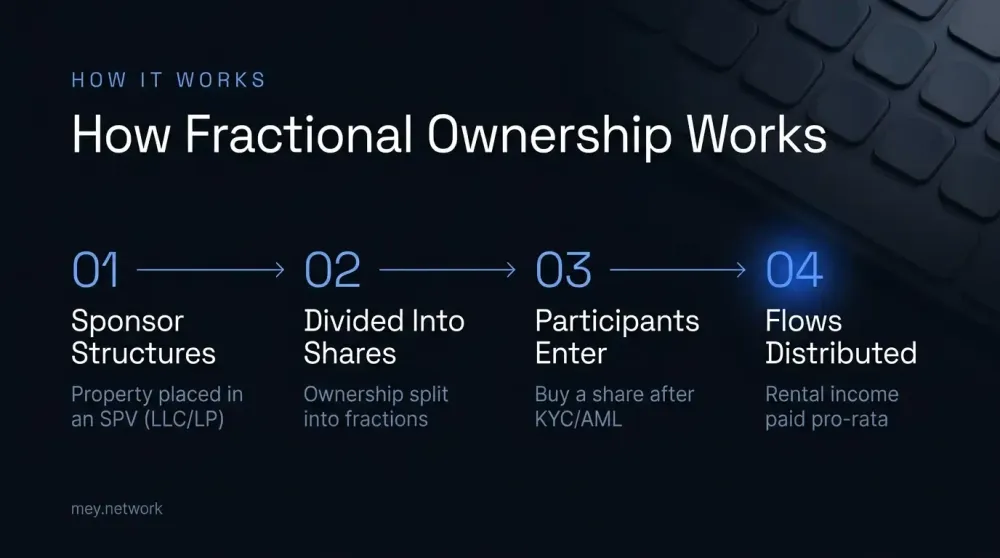
The process follows a fairly straightforward path, even though the legal paperwork behind it can get detailed. A sponsor structures the deal. A platform, developer, or participation firm creates a legal entity, typically an LLC (Limited Liability Company) or LP (Limited Partnership), to acquire the property.
The entity acquires the property and divides ownership into shares or fractions.
Participants enter. Each holder takes their share, paying a proportional amount of the acquisition price plus legal and admin fees. A $1 million property with a 1/10 share means roughly $100,000 plus your portion of closing costs. Ongoing costs get split. Maintenance, property taxes, insurance, and management fees are divided proportionally. Flows reach you directly. Rental income is distributed based on ownership percentage. Major property decisions may require a vote among holders.
Legal Structures for Fractional Real Estate Ownership
The legal framework behind fractional ownership matters a lot. It determines your liability, your rights, and how you can exit the position. Here are the three most common structures.
Tenancy in Common (TIC) is the simplest form of partial property ownership. Each holder has an undivided interest in the property, meaning you hold a percentage of the whole thing, not a specific unit. TIC shares can be transferred, accessed, or inherited independently. The downside? If one co-holder gets sued, creditors could potentially go after the property.
LLC ownership adds a layer of protection. The LLC holds the property title, and holders own membership interests in the LLC rather than the property directly. This shields your personal assets from property-related lawsuits. Most modern fractional ownership platforms use this model.
Limited Partnership (LP) structures are common for larger commercial properties. A general partner manages day-to-day operations, while limited partners hold shares and receive flows with liability protection.
Key legal documents to review before any fractional property position: the operating agreement, the fractional ownership agreement, and the property management contract. These spell out fees, decision-making rights, and exit procedures.
Fractional Ownership vs. Timeshares vs. REITs
This is where people get confused, so let's clear it up.
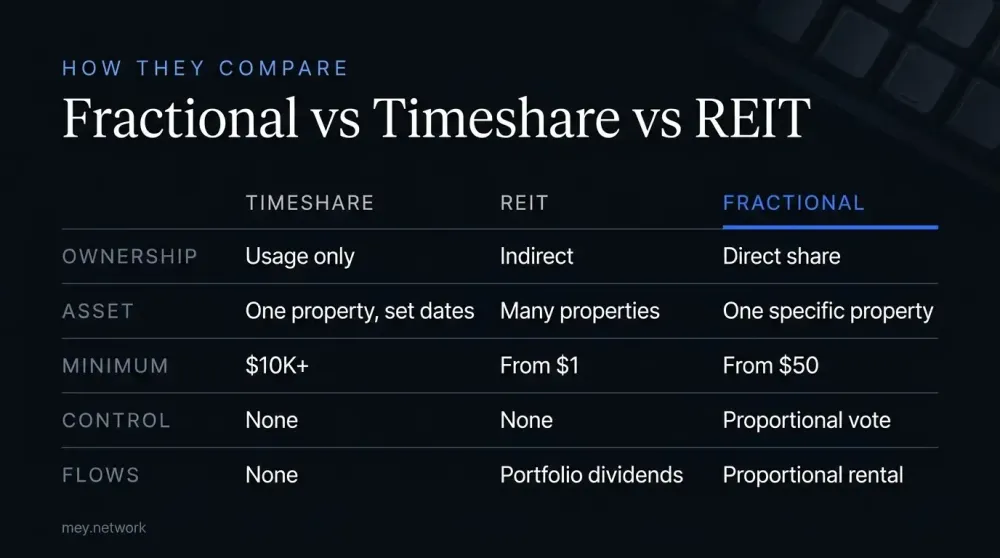
Timeshares give you the right to use a property during specific time periods. You book your two weeks in Cancun, you show up, you leave. But you don't own the property. Timeshares almost always depreciate, and they're notoriously difficult to retransfer.
REITs let you hold shares in a company that owns many properties. It's indirect ownership with public-ecosystem activity. Convenient for entering and exiting, but you have zero control over which specific properties the REIT holds. Fractional ownership sits between these two. You hold a deeded share of a specific property, with direct ownership, proportional rental flows, and value progression tied to that exact asset.
Here's a quick comparison framework:
- Ownership Type
- Timeshare: Usage rights only
- REIT: Indirect (shares in a company)
- Fractional Ownership: Direct (share of specific property)
- Asset Specificity
- Timeshare: One property, limited dates
- REIT: Portfolio of many properties
- Fractional Ownership: One specific property
- Distribution-layer depth
- Timeshare: Very low
- REIT: High (public ecosystem)
- Fractional Ownership: Low to moderate
- Minimum Entry
- Timeshare: $10K to $50K+
- REIT: As low as $1 (public REITs)
- Fractional Ownership: $10K to $100K+ (traditional); $50 to $100 (coordinated)
- Control
- Timeshare: None
- REIT: None
- Fractional Ownership: Proportional voting rights
- Flows
- Timeshare: None (usage only)
- REIT: Dividends from the portfolio
- Fractional Ownership: Proportional rental flows
Pros and Cons of Fractional Ownership
Every position has compromises. Here's an honest look at both sides.
The advantages are real:
- Lower barrier to entry. You don't need $400K+ to hold real estate. Fractional structures bring that down significantly, and coordinated platforms push it even lower.
- Shared maintenance costs. Property upkeep, taxes, and insurance are split among holders, reducing the financial burden on any single participant.
- Equity building. Unlike renting, you're building ownership in a tangible asset that can gain value over time.
- Portfolio diversification. Real estate behaves differently from stocks or crypto, making it a strong hedge against overall portfolio volatility.
- Access to premium properties. Take a position in high-quality commercial or luxury residential properties that would otherwise be out of reach individually.
A few considerations worth understanding:
Collective decision-making. Major decisions are made collectively, which works best when platforms have clear governance frameworks in place. Ecosystem conditions apply. Like any asset class, property values and rental flows can fluctuate, so fractional ownership works best as a long-term wealth-building strategy.
Distribution-layer depth varies by platform. Traditional fractional structures can be less fluid than public ecosystems, though coordinated platforms with active distribution venues are increasingly closing this gap.
How Blockchain Is Evolving Fractional Ownership
Blockchain-based coordination takes the fractional ownership concept and pushes it further. The real estate coordination space reached approximately $3.5 billion in 2024 and is projected to grow to $19.4 billion by 2033, according to research from CMI. Meanwhile, over 60% of participants, both retail and institutional, are already participating or planning to participate in blockchain-coordinated assets, with real estate as a top choice, per CoinLaw's 2026 analysis.
Here's what coordination changes:
- Smaller fractions. Traditional fractional ownership might require $50,000+. Coordinated platforms allow entry points as low as $50 to $100.
- Programmable distribution. Smart contracts (self-executing code on a blockchain) automatically distribute rental flows to unit holders on a set schedule. No intermediary. No delays.
- 24/7 distribution-layer activity. Coordinated property fractions can be transferred on distribution venues at any time, dramatically deepening circulation compared to traditional shares that can take months to transfer.
- Global access. A participant in Lagos, London, or Lima can join the same coordinated property offering. Geography becomes far less of a barrier.
- How does it work? A property is coordinated into digital units on a blockchain. Each unit represents a verified fraction with encoded ownership rights, flow entitlements, and governance votes. Everything is transparent, on-chain, and auditable.
- Mey Network is one platform building in this space. Through Property Token Offerings (PTOs), Mey Network creates fractional NFTs representing real-world property stakes. These units come with rental flow exposure, value progression potential, and the ability to transfer on the MeyFi venue. It's the traditional fractional ownership model, upgraded with blockchain infrastructure.
Who Is Fractional Real Estate Ownership Best For?
Fractional ownership won't suit every participant. Here's who tends to benefit most.
Participants with limited capital who want real estate exposure without $100K+ minimums. The average first-time homebuyer in the U.S. is now 40 years old, according to Fortune. Fractional property participation offers an alternative path.
Distribution-focused participants who want rental flows without property management headaches. Collect your proportional share of rent without fielding maintenance calls at 2 AM.
Diversification-focused participants are adding real assets to a portfolio heavy on stocks, bonds, or crypto. Real estate has historically offered lower correlation to equity ecosystems, smoothing portfolio performance during volatile periods.
The risk profile is moderate: real estate fundamentals (property values, rental demand, interest rates) plus structural risks (co-holder dynamics, platform reliability, fees). Go in with your eyes open.
Use Cases and Scenarios
Let's walk through three scenarios to make this concrete.
Scenario 1: Traditional Luxury Fractional Ownership
Eight participants acquire a $2.4 million vacation property in Aspen, Colorado. Each puts in $300,000 for a 1/8 stake with six weeks of personal usage per year. Annual shared costs total $48,000 ($6,000 per holder). Over five years, the property gains 25% to $3 million, making each share worth $375,000, a $75,000 gain before annual costs.
Scenario 2: Blockchain-Based Fractional Position
A $5 million mixed-use building is coordinated through a PTO on Mey Network, divided into 50,000 units at $100 each. A participant acquires 250 units ($25,000 total). At a 7% annual rate distributed automatically via a smart contract, they receive roughly $1,750 in rental flows per year. Their units are transferable on MeyFi's distribution venue at any time.
Scenario 3: Same Capital, Three Paths
A participant with $25,000 across three vehicles:
- Asset Specificity
- Traditional Fractional: One vacation property
- REIT: 50+ properties
- Coordinated Fractional: One commercial property
- Annual Rate (Est.)
- Traditional Fractional: 3 to 5%
- REIT: 4 to 6%
- Coordinated Fractional: 6 to 9%
- Distribution-layer depth
- Traditional Fractional: Low (months to transfer)
- REIT: High (any active day)
- Coordinated Fractional: Moderate (distribution venue)
- Annual Fees
- Traditional Fractional: 1 to 2% + maintenance
- REIT: 0.5 to 1% expense ratio
- Coordinated Fractional: 1 to 2% platform fee
- Control
- Traditional Fractional: Proportional vote
- REIT: None
- Coordinated Fractional: Unit-weighted vote
REITs offer the easiest entry and exit. Traditional fractional gives you a tangible asset with potential usage rights. Coordinated fractional blends asset specificity with deeper distribution-layer activity.
Key Metrics for Evaluating Fractional Ownership Positions
Before you take a position in any fractional property, run the numbers on these five metrics. Rental rate (gross and net after fees/taxes). For commercial fractional assets in strong ecosystems, net rates of 4 to 11% are common, though this varies widely by property type and location.
Cap rate of the underlying property tells you how the asset is valued relative to its flows. Average cap rates for U.S. net lease properties ranged from roughly 5.3% to 7.5% in Q4 2025, depending on property type, per B+E's net lease report.
Fee structure is where distributions quietly erode. Look at management, transaction, platform, and performance fees. Stack them against projected flows and make sure the math works.
Historical and projected value progression give you the full distribution picture. Research local ecosystem trends, the development pipeline, and demand drivers for the specific property.
Distribution-layer options and exit timeline might be the most overlooked factor. Is there a distribution venue? Are there lock-up periods? Traditional fractional ownership can take months. Coordinated structures with active distribution venues offer significantly faster settlement.
Your Entry Point Into Real Estate
Fractional ownership makes real estate participation accessible to a much broader audience. Whether through traditional legal structures or blockchain-powered coordination, the core promise is the same: hold a piece of quality real estate without needing hundreds of thousands of dollars.
The real estate coordination space is expanding rapidly, outpacing the broader real estate sector. Mey Network's PTO model sits at the center of this shift, combining lower minimums, faster settlement, programmable distribution, and borderless property access into a single platform. The investment thesis hasn't changed. The infrastructure has.
Frequently Asked Questions
What is fractional ownership in real estate?
Fractional ownership in real estate is a structure where multiple participants collectively acquire a single property, with each holding a proportional share, traditionally between 1/8 and 1/2 of total ownership. Each holder receives rental flows and value progression proportional to their stake. Blockchain-based coordination has expanded this model by enabling fractional positions with minimums as low as $50, broadening access beyond high-net-worth individuals to retail participants globally.
Is fractional ownership the same as a timeshare?
Fractional ownership and timeshares are fundamentally different structures. A timeshare grants usage rights to a property during designated time periods but confers no actual ownership stake, equity, or claim to value progression. Fractional ownership provides a legally deeded share of the underlying asset, entitling the holder to proportional rental flows, value progression, and voting rights on property decisions. Fractional ownership is classified as a real estate participation, while a timeshare is a prepaid vacation product with no equity component.
How is fractional ownership different from a REIT?
Fractional ownership gives you a direct stake in one specific property you can choose. REITs are publicly listed companies holding portfolios of many properties. Fractional offers asset specificity and potentially higher distributions on individual properties, while REITs provide deeper distribution-layer activity through public-ecosystem listing.
How much money do I need for fractional real estate?
Traditional fractional ownership typically requires a position of $10,000 to $100,000 or more, depending on the property. However, blockchain-based coordination platforms have dramatically lowered the barrier to entry, allowing participants to acquire property units for as little as $50 to $100, making real estate accessible to nearly anyone.
Can I transfer my fractional ownership share?
Yes, though distribution-layer activity depends on the ownership structure. Traditional fractional shares may take weeks or months to transfer through private negotiations. Coordinated ownership offers a significant advantage. Units can be transferred on distribution venues, enabling faster settlement and providing participants with more flexible exit options.
Is fractional real estate ownership regulated?
Yes, it is regulated under multiple frameworks. Traditional structures like TICs, LLCs, and LPs follow state and federal property laws. Coordinated offerings must comply with U.S. SEC regulations and MiCA in Europe. Reputable platforms also implement KYC and AML verification to protect participants.
What are the biggest risks of fractional ownership?
Key risks include limited distribution-layer depth, potential disagreements between co-holders, property cycles, and ongoing management fees that reduce distributions. For coordinated fractional ownership, additional risks include smart-contract vulnerabilities, platform dependency, and evolving regulatory landscapes that could impact how units are classified and transferred.
How does blockchain improve fractional ownership?
Blockchain enables smaller minimums, automates rental distribution through smart contracts, and creates transparent on-chain ownership records. It also allows 24/7 distribution-layer activity for faster circulation, removes geographic barriers so participants worldwide can join, and reduces reliance on intermediaries, lowering overall transaction costs.
