

Conventional crypto staking usually means locking a volatile token to earn more of the same volatile token. RWA staking works the other way round. You commit tokens tied to real-world assets such as property, treasuries, and private credit, and the yield is backed by real income like rent and interest rather than protocol emissions alone. For anyone who wants returns that don't evaporate when a token price falls, that is a genuinely different proposition.
The timing helps. Real-world assets are among the fastest-growing segments of digital finance. The tokenized real-world asset market is projected to reach $9.4 trillion by 2030 (Boston Consulting Group x Ripple, 2025), and RWA.xyz tracked roughly $38 billion of distributed on-chain value in August 2026 (RWA.xyz). As more assets move on-chain, more of them become available to stake.
This guide explains what RWA staking is, where the yield genuinely comes from, what APYs are realistic in 2026, the risks that matter, and how to start. It separates durable, asset-backed yield from the temporary kind, gives you a red-flag rule, and works through an example using tokenized property.
> This article is educational and does not constitute financial, legal, or tax advice. Staking real-world assets carries risk, including possible loss of capital. All APYs and figures shown are illustrative examples rather than guarantees. Do your own research and speak to a licensed professional.
Key Takeaways
- RWA staking means committing tokenized real-world-asset tokens to a protocol to earn yield backed by real income, such as rent, interest, and coupons, rather than token emissions.
- Always identify the yield source. Real asset income is durable. Emissions-heavy yield can disappear when incentives end.
- Realistic APYs in 2026 run roughly 3% to 3.5% for tokenized treasuries and 4% to 5% at the major tokenized private credit venues, with rent-backed property varying by occupancy. Any "sustainable" yield above about 20% is a red flag.
- The most underrated exposure is settlement and counterparty risk, because the off-chain-to-on-chain path is longer than it looks, alongside smart-contract, liquidity, and tax risk.
- Diversifying across audited platforms, favoring asset-backed yield, and starting small are the core safeguards. Mey Network's MeyFi shows how property tokens can be staked or lent for a layer on top of rent.
What Is RWA Staking?
RWA staking is committing tokenized real-world-asset tokens to a protocol in order to receive rewards. You deposit tokens representing a real asset; the protocol either puts them to work or uses them to coordinate the network, and a return accrues to you.
The core difference from ordinary crypto staking is where the reward comes from. In traditional staking, rewards come from network security incentives and token emissions: new tokens paid for helping secure a chain. Here, rewards are tied to how the underlying real asset performs, whether that's rent from real estate, interest from loans, coupons from treasuries, or fees from commodities. There is a real economic engine behind the number.
The assets that qualify fall into several categories:
- Tokenized real estate (rent-producing property)
- Tokenized treasuries (short-term government debt)
- Private credit (loans to businesses)
- Commodities (gold, metals, energy)
- Invoices and trade receivables
RWA staking vs. traditional crypto staking
| Factor | RWA staking | Traditional crypto staking | |--------------------------------|-------------------------------------------------|-----------------------------------------| | Source of yield | Real asset income: rent, interest, coupons | Network rewards plus token emissions | | Volatility and correlation | Lower, tied to real cash flows | Higher, tied to crypto markets | | Backing | A real, off-chain asset | The protocol's own token | | Main risk | Off-chain settlement, credit, and platform risk | Price of the staked token, and slashing |
That contrast, RWA staking vs crypto staking, is the main reason people diversify into it. The return doesn't rise and fall purely with the crypto market's direction.
Where Does the Yield Actually Come From?
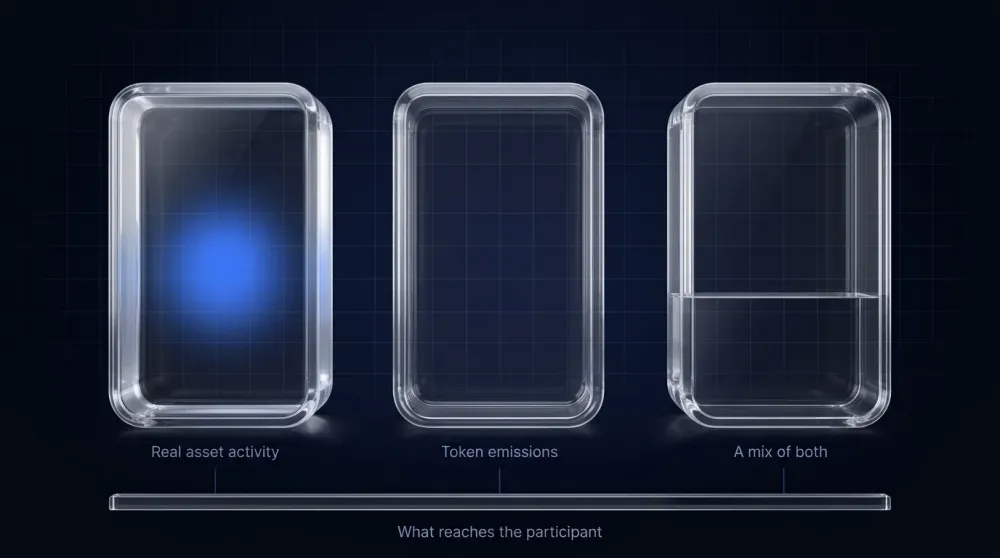
This is the question that matters most, so here it is directly. Yield comes from one of three places, and knowing which one tells you whether it is likely to last.
Real asset income (the durable kind)
This is the category that holds up, generated by the asset doing its job in the real economy:
- Rent from real estate
- Interest from private credit and loans
- Coupons from treasuries and bonds
- Storage or production fees from commodities
When yield on real-world assets is earned this way, the payout traces back to an actual cash flow. If the building is tenanted and the tenant pays, the distribution follows.
Protocol incentives and token emissions
Many platforms add extra rewards paid in their own token to bootstrap early participation. These can inflate the headline APY, but they are funded by token issuance rather than asset income. They may be generous one quarter and gone the next. Emissions are not inherently a problem, as long as you can tell them apart from real yield.
Hybrid models
Plenty of programs combine the two: a base of real asset income plus a layer of incentives. The discipline is in reading the split. A platform paying 5% from rent and 3% from token incentives is a very different risk profile from one paying 5% from rent and 25% from emissions.
The conclusion is simple. Durable yield here is backed by real cash flows. Emissions-heavy yield can be temporary, so confirm where the number comes from before you commit capital.
How RWA Staking Works: Step by Step
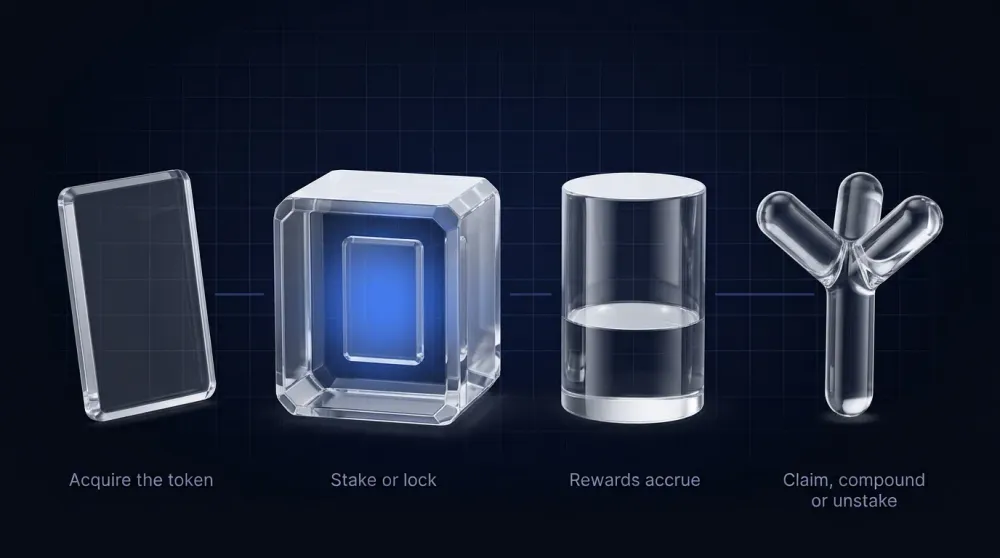
Four stages, from acquiring the asset to collecting rewards.
Step 1: Acquire a tokenized real-world asset
The underlying token comes first, whether that's property tokens through a Property Token Offering or tokenized treasuries. This is the real asset component. For background on how a property becomes a token, our real estate tokenization guide covers the pipeline.
Step 2: Stake or lock the tokens in the protocol
You deposit the tokens into a staking contract. Read the terms closely. Some programs impose a lock-up period, and many include an unbonding window, which is a delay between requesting your tokens back and actually receiving them. Locked tokens can't be sold, so understand the commitment before you make it.
Step 3: Receive rewards
Rewards accrue from asset income, from incentives, or from both. Depending on the design, they arrive as more of the same token, as a different token, or through a rebasing mechanism where your balance grows automatically to reflect what has accrued. These RWA staking rewards are your compensation for locking up capital.
Step 4: Claim, compound, or unstake
The final stage is deciding what to do with the rewards: claim them to a wallet, compound them by restaking to grow the position, or unstake and exit after any unbonding period. Compounding is where staking tokenized assets can meaningfully outperform simply holding.
Types of RWA Staking Models
The category isn't uniform. Four models dominate.
Direct asset-income staking (rent-backed property tokens)
You stake tokens whose yield comes straight from asset income, classically, rent-backed property tokens. The structure is transparent and easy to reason about, because the return maps to the rent.
Yield-bearing and rebasing tokens
Some tokenized treasury products accrue value automatically, and there are two distinct designs worth telling apart. Under a value-accruing design, your token count stays the same, and each token becomes worth more. Under rebasing, the token price stays near $1, and your token count increases.
Ondo Finance runs both versions of the same product, which makes the difference concrete. USDY is value-accruing, where "the accruing yield of USDY tokens gets accumulated into the price," while rUSDY rebases, holding $1.00 per token and splitting into more tokens instead (Ondo Finance). Neither requires a manual claim. A lot of coverage conflates the two, so check which design a product uses before assuming your balance will change.
Liquid staking for RWAs
Liquid staking issues a receipt token representing your staked position, which you can use elsewhere while the original stays locked. It preserves some flexibility instead of fully immobilizing your capital during a lock-up.
Lending-style yield (P2P and pooled lending against RWAs)
Here, you supply capital against real-world collateral and earn interest from borrowers. Mey Network is an RWA tokenization ecosystem that converts verified real estate into onchain Property Token Offerings (PTOs), giving participants borderless, transparent access to real estate through MeyFi's staking, lending, and marketplace tools. MeyFi spans several of these models. Its participation layer allows PTO units to be deployed, its documentation describes $MEY staking in four tiers (Dolphin, Shark, Whale and SVIP) where APR rises with the size of the stake (Mey Network docs), and it operates a P2P lending model where loans are backed by real-estate NFTs held under custodial oversight by Meey Finance, with what the documentation calls conservative loan-to-value ratios (Mey Network docs).
Two caveats there. The tier structure is documented rather than live, since mey.network currently shows $MEY staking as coming soon and publishes no APR figures. And no numeric LTV is published, so "conservative" describes the policy rather than a ratio you can check.
RWA Staking APY: What's Realistic in 2026?
Set expectations with current figures. These move over time, so treat them as context rather than fixed commitments. Note that tokenized treasury yields have compressed significantly over the past year, and a lot of published guidance still quotes the older, higher numbers.
| Asset type | Typical APY (Aug 2026) | Source of yield | Risk | |------------------------------------|--------------------------------|----------------------------------|----------------------------| | Tokenized treasuries | ~3–3.5% | Government interest | Lowest | | Tokenized private credit | ~4.3–5.2% at major venues | Loan interest | Real credit risk | | Rent-backed property | Varies with occupancy and fees | Rental income | Property and platform risk | | Fixed-rate / incentivised products | Can be higher | Mixed asset income and emissions | Sustainability varies |
Those figures are grounded in primary sources. Ondo's own site showed USDY at 3.55% APY in late July 2026 (Ondo), and RWA.xyz put the sector-wide average for tokenized treasuries at 2.99% on August 2, 2026 (RWA.xyz). On the credit side, Maple Finance currently advertises 5.2% on syrupUSDC, 5.0% on syrupUSDG, 5.0% on institutional secured lending, and 4.3% on syrupUSDT (Maple).
The spread between the two is the useful part. Tokenized private credit pays roughly 1.5 to 2 percentage points more than tokenized treasuries, and that gap is compensation for taking corporate credit risk rather than government credit risk.
The red-flag rule: any "sustainable" yield above roughly 20% deserves deep skepticism. Real assets rarely generate that level of durable return without heavy leverage, concentrated risk, or emissions doing the work. A 25% APY isn't automatically fraudulent, but it demands an explanation, and if a platform can't give you one, stay cautious.
RWA yields are often steadier than crypto-native yields because they are anchored to real cash flows that don't care about daily market moves. Rent gets paid whether the market rises or falls, which makes this a diversifier rather than another correlated exposure.
Risks of RWA Staking (and How to Manage Them)
No honest account skips the risks. Here are the main ones.
Settlement and counterparty risk
This is the most understated exposure. The path from off-chain income to an on-chain wallet, a tenant paying rent, or a borrower repaying a loan before anything gets distributed, is longer and less visible than a purely on-chain transaction. If the borrower defaults or the servicer fails, the yield doesn't arrive. Real-world assets come with real-world counterparties.
Smart-contract and platform risk
Staking contracts can contain defects or be exploited, and platforms can fail operationally. Audited protocols with a track record and clear custody arrangements are preferable. Mey Real lists Certik and QuillAudits under "Audited & Supported by Trusted Partners" (Mey Real), and Mey Network has a public CertiK Skynet listing (CertiK).
Liquidity and lock-up risk
Lock-ups and unbonding periods restrict when you can exit, and secondary markets for RWA tokens can be thin. Capital you might need in the near term does not belong in a staking contract.
Regulatory and tax risk
Many RWA tokens are treated as securities, and rules vary by country. On tax, the IRS treats digital assets as property and treats staking rewards as taxable income, citing Revenue Ruling 2023-14 and, more recently, TC Memo 2026-46 (IRS, Digital Assets). Expect a tax liability on rewards and get professional advice.
Yield-sustainability risk
Emissions-driven APY can fall sharply once incentives are withdrawn. This is where the 20% red flag applies. If most of a program's yield is emissions, assume the headline number is temporary.
A workable risk framework: diversify across two or three audited protocols, favor real-asset-backed yield over emissions, verify the legal structure behind the tokens, and start with a modest allocation before scaling. These measures are conservative, and they are how you keep what you earn.
RWA Staking vs. Other Yield Options
| Option | Source of yield | Typical APY | Volatility | Backing | Liquidity | |-----------------------|--------------------------------|---------------------------------|----------------|--------------------|---------------| | RWA staking | Real asset income | ~3–5%, higher on riskier assets | Lower | Real assets | Medium | | Crypto staking | Emissions and network security | Varies widely; ETH near 2.67% | High | The protocol token | High | | DeFi lending | Borrower interest | ~2.7–3.5% on major stablecoins | Medium to high | Crypto collateral | Medium | | Savings and bonds | Bank or government interest | ~2–5% | Lowest | Bank or government | High |
The position this approach targets is bond-like stability with a slightly better yield, without the full volatility of crypto-native staking. It won't outperform a strong bull market in altcoins, and it isn't as instantly liquid as a savings account. That middle ground is the point.
How to Start Staking Real-World Assets
The path from evaluation to a staked position:
- Pick an audited RWA platform with clear disclosures.
- Complete KYC.
- Acquire the RWA tokens, for example, property tokens via a PTO.
- Stake them, noting any lock-up or unbonding terms.
- Track the rewards and compound where it makes sense.
- Understand the unstaking terms before you need to exit.
Followed in order, these steps take you from theory to earning yield on real-world assets. For anyone ready to move, Mey Network's MeyFi is built to put tokenized property to work.
FAQs
What is RWA staking in simple terms?
RWA staking means locking tokens tied to real-world assets, such as property or treasuries, into a protocol to receive rewards. Unlike ordinary crypto staking, the yield comes from real income like rent or interest, so it depends less on crypto price swings and more on how the underlying asset performs.
How is RWA staking different from regular crypto staking?
Regular crypto staking pays you in new tokens for helping secure a network, so the reward tracks that token's price. The RWA version pays from real asset income: rent, loan interest, bond coupons. That makes RWA staking rewards steadier and less correlated with crypto markets, though they carry real-world credit and settlement risk instead.
Where does the yield come from?
From three possible places: real asset income such as rent, interest and coupons, protocol token emissions, or a hybrid of both. Durable yield traces to actual cash flows, while emissions-based yield is funded by token issuance and can fade. Check the split before staking, because it tells you whether the return will last.
How much APY can RWA staking generate?
It depends on the asset. In August 2026, tokenized treasuries paid roughly 3% to 3.5%, and the major tokenized private credit venues paid 4.3% to 5.2%. Rent-backed property varies with occupancy and fees. Any "sustainable" RWA staking APY above roughly 20% warrants heavy scepticism.
Is RWA staking safe? What are the main risks?
No yield is risk-free. The main risks are settlement and counterparty risk when the off-chain income path breaks, smart-contract and platform risk, liquidity and lock-up risk, regulatory and tax risk, and yield-sustainability risk. Manage them by using audited platforms, favouring real-asset-backed yield, diversifying, and starting small.
Can tokenized real estate be staked for an extra layer?
Often, yes. Platforms such as MeyFi allow property (PTO) tokens to be deployed through staking or P2P lending for a participation benefit beyond the rent those tokens already generate. It layers the benefit, but it adds lock-up and smart-contract risk, so understand the terms and don't commit capital you'll need soon.
Are there lock-up periods when staking real-world assets?
Frequently. Many staking programmes impose a lock-up, meaning a minimum staked period, and an unbonding window, meaning a delay before withdrawal after you request an exit. During both, the tokens can't be sold. Check the specific terms before staking so you aren't caught needing liquidity you can't reach.
How do you start staking real-world assets?
Pick an audited RWA platform, complete KYC, acquire RWA tokens such as property tokens through a PTO, stake them while noting the lock-up terms, then track and optionally compound the rewards. Confirm the unstaking rules at the outset. A modest initial position lets you learn a platform's mechanics before committing more.
