

The idea that you need a big down payment before you can touch real estate is about a decade out of date. Working out how to invest in real estate with little money in 2026 means choosing between at least five real routes, each with a minimum you can check.
This guide covers five main methods: REITs, crowdfunding, tokenized property access, house hacking, and wholesaling. Tokenized access is the newest, and it sits inside a market that reached roughly $38 billion in August 2026 (RWA.xyz), and is projected to reach $9.4 trillion by 2030 (Boston Consulting Group x Ripple, 2025). It's one option among several, not the answer for everyone.
This guide is educational and covers multiple ways to start with limited capital. It is not financial advice, and results vary by method and are not guaranteed.
Key Takeaways
- There are at least five real ways to invest in real estate with little money: REITs, crowdfunding, tokenized property access, house hacking, and wholesaling.
- Tokenized real estate access starts at Mey Network's verified 50 USDC/token minimum, below most crowdfunding minimums and far below a traditional down payment.
- Each method trades off differently on liquidity, control and effort, so there's no single best low-capital method for everyone.
- House hacking and wholesaling are the only near-zero ongoing-capital routes, though both take far more active work than REITs, crowdfunding, or tokenized access.
Can You Really Invest in Real Estate With Little Money?
Yes. Several real routes exist that don't involve a traditional down payment, and some of them start at single-digit dollars.
Here's the context. The median existing-home sale price hit $440,600 in June 2026 (NAR), with median down payments of 10% for first-time buyers and 23% for repeat buyers (NAR). Add closing costs of 2 to 5% (Freddie Mac), and buying directly needs tens of thousands of dollars.
Every method below exists because that barrier shut most people out, and they aren't equivalent. Some give you a slice of a portfolio, others get you into a building you live in, and one involves owning no property at all. If you're researching how to invest in real estate with little money, read the trade-offs before the minimums.
REITs: The Lowest-Effort Way to Start
A REIT is "a company that owns – and typically operates – income-producing real estate or real estate-related assets," and REITs "have to distribute at least 90 percent of their taxable income for the year" (SEC Investor Bulletin). That rule is law rather than policy, which is why REITs are known for dividends.
Minimum: the price of one share, and often much less. Schwab and Fidelity both offer fractional shares of US-listed stocks and ETFs from $1 (Schwab, Fidelity), though the SEC notes that "not every brokerage firm offers fractional share investing" (SEC).
What you get: Nareit reported a 3.69% dividend yield for the FTSE Nareit All Equity REITs index as of May 29, 2026 (REITWatch, June 2026). Listed REITs trade like stocks, so you can sell on any trading day.
The trade-off: you own equity in a company, not a claim on a specific building, and REIT prices move with the stock market, dropping on days when property fundamentals haven't changed. The effort is near zero, and so is the control.
Real Estate Crowdfunding
Crowdfunding platforms pool money into specific properties or property funds. Minimums vary a lot by platform and by whether an offering is open to everyone.
- Fundrise: "as little as $10" for a taxable account, with a $1,000 minimum for retirement accounts (Fundrise).
- RealtyMogul: $5,000 on its REITs, while individual property deals run "$25,000 to $50,000" and are "only open to investors who qualify as 'Accredited Investors' as defined by the SEC" (RealtyMogul).
- CrowdStreet: "minimum investments start at $25,000 but may be higher for certain offerings," accredited only (CrowdStreet).
That accredited-investor line is the wall most people hit. The SEC defines it mainly as net worth over $1 million excluding your home, or income over $200,000 on your own, or $300,000 with a spouse or partner, in each of the last two years, with the same expected this year (SEC).
The trade-off: these positions are usually illiquid, often locked for years with little or no redemption, and you're relying on the sponsor's underwriting. Our crowdfunding deep dive compares the model against tokenized access in detail.
Tokenized Real Estate / Property Tokens
Tokenized real estate turns a verified property into on-chain participation units, so one property can be accessed by many people at very small ticket sizes.
Mey Network is an RWA tokenization ecosystem that converts verified real estate into onchain Property Token Offerings (PTOs), giving participants borderless, transparent access to real estate through MeyFi's staking, lending, and marketplace tools.
Minimum: the Chuong My listing in Ha Noi, Vietnam, issued 2,000 tokens at 50 USDC per token, so a participant gets a defined proportional share for 50 USDC. That's below RealtyMogul's $5,000 REIT minimum and far below CrowdStreet's $25,000, though above Fundrise's $10 entry.
What participants hold: a unit tied to one specific identified property, recorded onchain, with distributions traceable on-chain rather than reported quarterly. Units can be held, staked, or transferred through MeyFi. A unit isn't a deed, a vote on management, or a promise of any fixed benefit.
The trade-off: this is the newest of the five routes, and it carries platform, smart-contract, and regulatory risk that the listed REITs don't.
Cross-border reach is the standout feature, since buying property abroad normally means foreign ownership rules, financing, and remote management.
House Hacking & Low-Down-Payment Financing
House hacking means buying a small multi-unit property, living in one unit, and renting out the rest, so your tenants cover part of the mortgage on a home you also own.
The financing is what makes it work on limited capital. FHA-insured loans allow down payments "as low as 3.5% of the purchase price," eligible properties are "one-to-four unit structures," and the loan has to finance a principal residence (HUD, HUD 203(b)). The 2026 FHA loan limits confirm multi-unit eligibility, with low-cost-area floors of $541,287 for one unit rising to $1,041,125 for four (HUD Mortgagee Letter 2025-23).
Rent from the other units can help you qualify. FHA policy counts it as effective income, using 75% of the lesser of appraised fair market rent or actual lease rent where there's no rental history, with three months' PITI in reserves on three- and four-unit properties (HUD Mortgagee Letter 2023-17). Fannie Mae allows the same on an owner-occupied two- to four-unit home, capping it at the PITIA for borrowers without documented management experience (Fannie Mae B3-3.8-01).
Minimum: 3.5% down plus closing costs of 2 to 5%. On a $400,000 duplex that's roughly $14,000 down and $8,000 to $20,000 in closing costs, so $22,000 to $34,000 all in. That's a fraction of a conventional investment-property purchase, and it's the best way to invest in real estate with little money if you want the deed rather than just exposure.
The trade-off: you're a landlord living on site, so tenant issues arrive at your door. You're concentrated in one property, and you have to actually live there, since FHA programmes are limited to primary residences.
Real Estate Wholesaling: The No-Capital Route
Wholesaling means putting a property under contract and assigning it to an end buyer for a fee, without ever owning it. The capital requirement is close to zero. The effort and legal exposure are the highest of the five.
The rules have tightened, which most wholesaling content skips. South Carolina now defines wholesaling in statute and says that "advertising or marketing real estate owned by another individual or entity with the expectation of compensation falls under the definition of 'broker' and requires licensure," while making clear that assigning a contract right by itself does not (S.C. Code § 40-57-30(44), with SC Real Estate Commission guidance).
Oklahoma's SB 1075, effective November 1, 2025, requires wholesalers to disclose in writing before signing that they intend to assign at a higher price, to give notice of the homeowner's two-business-day cancellation right, and to hold earnest money in an Oklahoma escrow account at a federally insured institution (Oklahoma SB 1075). Missing disclosures make the contract unenforceable by the wholesaler. This gets widely misreported, so to be precise: SB 1075 is a disclosure law, not a licensing mandate, though licensing obligations come up separately under Oklahoma's Real Estate License Code.
Minimum: earnest money, often a few hundred to a few thousand dollars, plus marketing costs.
The trade-off: this is a business, not an investment. It runs on deal flow, negotiation and a buyer list, and the rules differ by state, so check where you are before your first contract.
How Much Do You Actually Need for Each Method?
Every route in this guide to investing in real estate with little money, side by side.
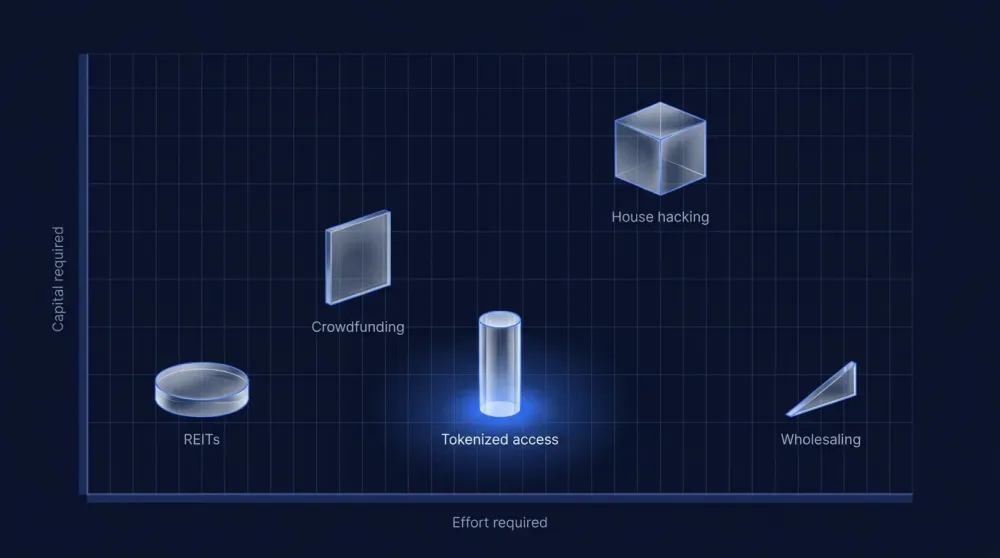
- Method, REITs. Minimum capital, From $1 with fractional shares. Effort, Very low. Liquidity, High; trades daily. Control, None.
- Method, Crowdfunding. Minimum capital, $10 (Fundrise) to $25,000 (CrowdStreet, accredited only). Effort, Low. Liquidity, Low; multi-year holds typical. Control, None.
- Method, Tokenized property. Minimum capital, 50 USDC per token (verified Chuong My example). Effort, Low. Liquidity, Moderate; secondary markets still thin. Control, None.
- Method, House hacking. Minimum capital, 3.5% down plus 2–5% closing costs. Effort, High; you're an on-site landlord. Liquidity, Very low. Control, Full.
- Method, Wholesaling. Minimum capital, Earnest money plus marketing costs. Effort, Very high; it's a job. Liquidity, N/A; no asset held. Control, N/A.
The pattern is consistent enough to be a rule, and it's the most useful thing to know about how to invest in real estate with little money: the less capital a method needs, the more effort or the less control it demands. Wholesaling needs the least money and the most work. REITs need almost nothing and give you no say at all. House hacking is the only route that hands you both a deed and a low entry cost, and it charges for that in personal involvement.
Risks of Investing in Real Estate With Little Money
Working out how to invest in real estate with little money means accepting risks that bigger positions don't carry.
Leverage risk. A 3.5% down payment means 96.5% financing (HUD). With that little equity, a small price drop puts you underwater, and the mortgage doesn't adjust to your circumstances.
Concentration risk. House hacking on limited capital puts everything into one property in one market. The US rental vacancy rate was 7.3% in Q2 2026 (U.S. Census Bureau, CB26-116), but a single unit is either occupied or it isn't.
Platform risk. Crowdfunding and tokenized platforms are companies, and companies fail. RealtyShares, which had deployed more than $870 million across 1,100-plus projects, stopped accepting new investors in November 2018 after it couldn't raise more capital (HousingWire). That was a business failure, not fraud, which is exactly why it's worth remembering.
Illiquidity. Crowdfunding locks money up for years, direct property takes months to sell, and only listed REITs give you genuine daily liquidity.
Regulatory risk. Wholesaling rules change state by state, and tokenized real estate treatment varies by country.
Fee drag. Small positions suffer most from platform and management fees. A 1% annual fee is nothing on $100,000 and a lot on $500.
Which Low-Capital Method Is Right for You?
Three questions narrow the ways to invest in real estate with little money down to one.
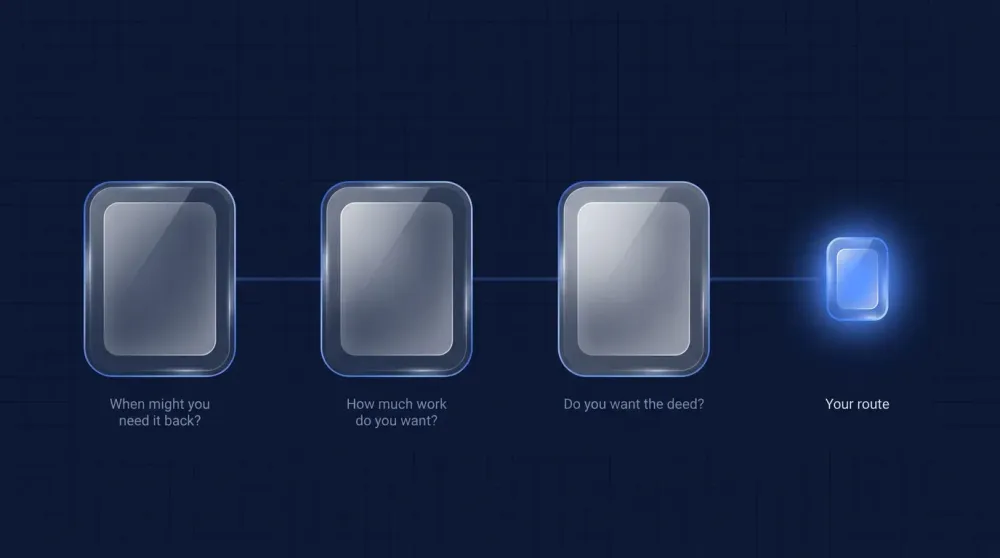
How much can you commit, and when might you need it back? Under $1,000 and short-term: REITs, for the liquidity. Under $1,000 and long-term: tokenized participation or Fundrise. $22,000 or more and happy to live there: house hacking.
How much work do you want? Least to most: REITs, crowdfunding, tokenized access, house hacking, wholesaling. The method you'll actually stick with beats the optimal one you give up on.
Do you want to own the building? Only house hacking gives you title on a small budget. The other three give exposure without ownership, and wholesaling gives neither. It's the one point where how to invest in real estate with little money and how to own property with little money give different answers.
The common mistake is choosing on minimum alone. The cheapest entry point isn't the best way to invest in real estate with little money if it locks your capital for five years and you need it in eighteen months. Most of how to invest in real estate with little money comes down to knowing which constraint binds you hardest.
How to Get Started Today
Pick the method that matches your actual constraints, and start smaller than you think you should.
Work out your time horizon first, since it rules out more options than your budget does. Pick one method rather than three. Commit an amount you could lose in full without it mattering. Check the platform before you fund it, which for crowdfunding and tokenized platforms means the legal structure, the audit position and what your holding entitles you to.
How to start investing in real estate with little money has a different right answer for someone with $50 who might need it next month than for someone with $22,000 who's happy to live in a duplex. Both answers are valid, and only one of them involves us.
If you want the lowest available minimum with cross-border reach, tokenized access is the route. [Browse live Property Token Offerings on Mey Real](https://meyreal.io) and compare the numbers against the other four above. Either way, how to invest in real estate with little money comes down to matching the method to your time horizon rather than to the smallest number on the page.
FAQs
Q: How can I invest in real estate with little money?
Five routes work on limited capital: REITs from $1 through fractional shares, crowdfunding from $10 on Fundrise, tokenized property access from 50 USDC per token, house hacking with FHA financing at 3.5% down, and wholesaling with only earnest money. Each trades off differently on effort, liquidity and control.
Q: What's the cheapest way to start investing in real estate?
REITs are cheapest by absolute minimum, since Schwab and Fidelity both offer fractional shares from $1, and Fundrise starts at $10 for taxable accounts. Wholesaling technically needs the least capital of all, just earnest money, but it demands serious time, negotiation skill and knowledge of your state's current rules.
Q: Can I invest in real estate with $100?
Yes. $100 buys fractional shares of a listed REIT, clears Fundrise's $10 taxable-account minimum, and covers two 50 USDC participation units in a tokenized property offering. It won't cover a down payment on anything, so direct ownership routes like house hacking stay out of reach at that level.
Q: Is tokenized real estate a good option if I have little money to invest?
It offers one of the lowest minimums available, 50 USDC per token in Mey Network's verified Chuong My listing, plus cross-border reach the other low-capital routes don't give you. It also carries platform, smart-contract and regulatory risk that listed REITs don't, and secondary markets stay thinner than in established markets.
Q: What's the difference between REITs and real estate crowdfunding for low-capital investors?
REITs are publicly traded companies holding property portfolios, and their shares trade daily from $1 fractionally. Crowdfunding pools money into specific properties or private funds, usually locking it up for years with little redemption. REITs win clearly on liquidity, while crowdfunding gives you exposure to specific deals rather than an index.
Q: Is it risky to invest in real estate with little money?
Yes, in specific ways. Low down payments mean high leverage, where small price drops wipe out your equity. Small positions concentrate risk and suffer more from fees. Crowdfunding and tokenized platforms carry business-failure risk, and RealtyShares stopped accepting new investors in 2018 after deploying over $870 million.
Q: How much money do I actually need to start investing in real estate?
It depends entirely on the route. One dollar buys a fractional REIT share. Ten dollars opens a Fundrise taxable account. Fifty USDC buys a tokenized property participation unit. House hacking needs 3.5% down plus 2 to 5% closing costs, so roughly $22,000 to $34,000 on a $400,000 duplex.
