

Three years into a crowdfunding deal, you open the dashboard and find no annual filing, no word on the building, and nothing to check against. Tokenized real estate vs real estate crowdfunding is the comparison that starts at exactly that moment. Both models promise cheaper access to property, and only one shows you the asset.
Most comparisons get the structure wrong, treating tokenization as crowdfunding with a blockchain bolted on. Real estate crowdfunding is a securities offering held inside a private fund. Tokenized real estate is a transferable digital unit tied to one verified property. That difference sets your minimum, your exit route, and how much you are allowed to see.
Crowdfunding has had more than a decade and a settled regulatory framework. Tokenization arrived later. What follows covers what each model is, where they split, a comparison across six dimensions, the risks under both, and an honest answer to which wins for whom. Begin with what real estate tokenization is if the category is new.
This comparison is educational, not financial or investment advice. Fees, minimums, and terms vary by platform and are not guaranteed.
Key Takeaways
- Real estate crowdfunding is a securities offering, equity or debt, inside a private fund. Tokenized real estate is a digital, transferable unit tied to a specific asset. Structurally different, not differently branded.
- Tokenized property access generally starts lower. Mey Network's verified Chuong My offering priced units at 50 USDC, against crowdfunding minimums of $10 to $25,000 by platform.
- Crowdfunding platforms are often opaque about how the underlying asset performs. On-chain distribution is more auditable, because every movement carries a timestamp and a hash.
- No universal winner exists. It depends on whether you value an established track record or a shorter exit path.
Table of Contents
- What is real estate crowdfunding?
- What is tokenized real estate?
- How do the two models actually differ?
- What minimums does each model require?
- Can you exit early?
- What fees and costs does each side carry?
- Which model gives you more control and transparency?
- How does the regulatory structure differ?
- How do the two compare, side by side?
- What are the risks of each model?
- So which one actually wins?
- What do real examples look like?
- Can you use both?
- Frequently asked questions
What Is Real Estate Crowdfunding?
Real estate crowdfunding is a securities offering that pools capital from many people, places it into a private fund or a single deal, and allocates the outcome under a written operating agreement. A property that once needed one wealthy backer can be funded by a thousand small ones.
What you hold is a stake in a legal entity. The entity holds the property.
Here is how real estate crowdfunding works. Two shapes exist. Equity crowdfunding gives you a slice of the entity that owns the asset. Debt crowdfunding funds a loan secured against the property, which puts you nearer the front of the repayment queue and further from any upside. Sponsors raise under one of two federal exemptions, Regulation Crowdfunding or Regulation A+, then deploy the money and report annually.
Familiar, regulated, and slow.
What Is Tokenized Real Estate?
Tokenized real estate is a digital participation unit that records a claim against one verified property, moves between wallets by smart contract, and settles each transfer on a public ledger. Both the asset and every movement of the unit are on the record.
The unit is what you hold, and a Property Token Offering (PTO) creates it. For the issuance detail, read what a Property Token Offering is, and for the structure underneath, how tokenized real estate works, step by step.
How Do Tokenized Real Estate and Real Estate Crowdfunding Actually Differ?
The difference is structural, and it lives in three places.
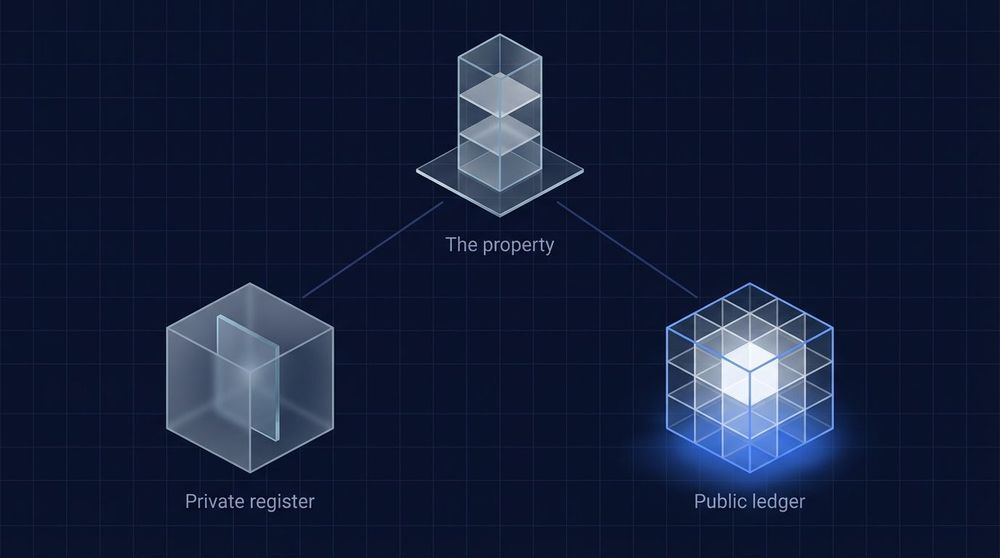
What you hold. A crowdfunding position is an interest in a fund or deal entity, recorded in a private register the platform keeps. A property token is a unit recorded on a public chain, addressed to your wallet. One is an entry in somebody's ledger. The other is an entry in everybody's.
Who keeps the record. Crowdfunding platforms control the register and your dashboard. On-chain distribution writes to a ledger neither the platform nor you can quietly edit.
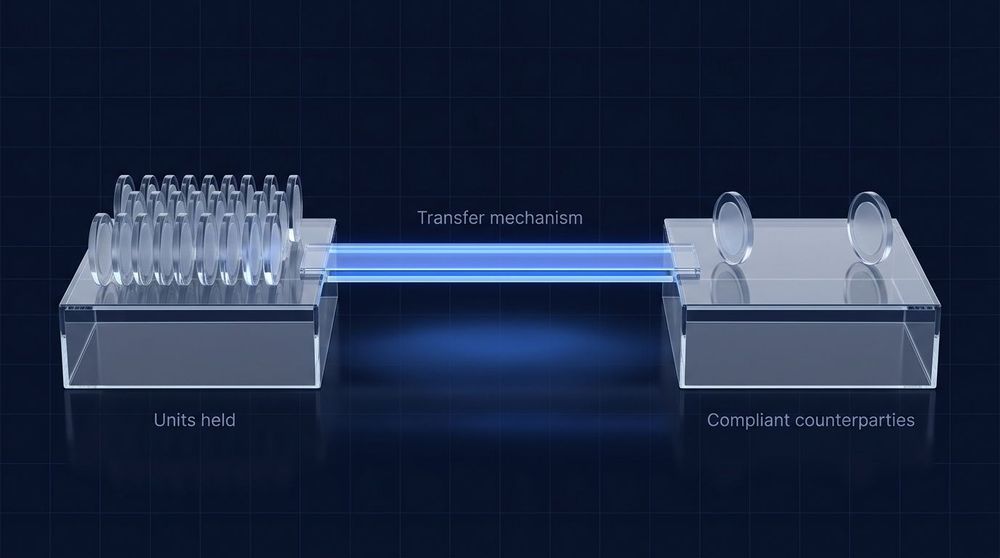
What moves. A crowdfunding stake usually cannot move during the hold. A token transfers whenever a compliant counterparty exists. Whether one exists is the catch.
What Minimums and Capital Does Each Model Require?
Consider the threshold difference. It is the first thing most people notice.
Real estate crowdfunding platforms set wildly different minimums. Fundrise opens at $10 for its flagship funds, while CrowdStreet states a $25,000 minimum and accepts accredited investors only. Regulation Crowdfunding also caps what one person may commit across all offerings in twelve months, at the greater of $2,200 or 5 percent of the lesser of annual income or net worth.
Tokenized property access sets its floor at the unit price. Mey Network's Chuong My offering in Ha Noi, Vietnam, issued 2,000 tokens at 50 USDC each.
One unit at 50 USDC is a different world from a $25,000 minimum.
Can You Exit Early?
Rarely on the crowdfunding side. Conditionally on the token side.
Securities bought through Regulation Crowdfunding generally cannot be resold for one year. CrowdStreet calls private placements illiquid, and published reviews put its typical hold period at three to five years. Fund products soften the lock-up without removing it. Fundrise offers quarterly redemption windows, charges roughly 1 percent to exit some holdings inside five years, and can halt redemptions in stressed conditions.
A token transfers as soon as a compliant counterparty appears. That is the capability. Here is the limit. An offering of 2,000 units leaves a thin pool of counterparties on the day you want out, so a faster mechanism does not produce a faster exit.
Mechanism is not the same as demand.
What Fees and Costs Does Each Model Carry?
Both sides charge in layers.
Crowdfunding stacks them. Fundrise publishes 0.15 percent in annual advisory fees plus a 0.85 percent management fee on its real estate funds. Deal platforms add sponsor compensation at the asset level, which is charged inside the deal, not by the platform, and is easy to miss.
Token structures charge at issuance, for custody of the asset, and per transaction on-chain. Network fees are small and visible. Issuance and custody costs are neither.
Pro tip: Request the all-in cost of a full cycle, platform fee plus sponsor compensation, before comparing offerings.
Which Model Gives You More Control and Transparency?
Tokenized structures win this one on record-keeping.
Regulation Crowdfunding issuers must file an annual report on Form C-AR within 120 days of their fiscal year end. Many simply do not. Kingscrowd's review found that only 31.4 percent of rounds closed in 2022 filed one, falling to 24.4 percent of 2024 rounds. A quarterly dashboard is a summary written by the platform. It is not an audit trail.
On-chain distribution leaves a different kind of trail. Each transfer carries a timestamp, an amount, and a hash, its unique fingerprint. Anyone can read all three on a block explorer.
However, there is an important nuance. A public ledger proves that funds entered a contract. It cannot prove that a tenant paid.
On-chain transparency is not the same as off-chain competence.
How Does the Regulatory Structure Differ, Reg CF and Reg A+ vs. Token-Based Models?
Crowdfunding sits inside two named exemptions, Regulation Crowdfunding and Regulation A+. Tokenized property sits inside a framework still being written.
Under Regulation Crowdfunding, an issuer may raise up to $5 million in a 12-month period. Regulation A+ runs larger, with Tier 1 at $20 million and Tier 2 at $75 million over the same window, and Tier 2 caps what non-accredited investors may commit.
Token-based structures follow the rules where the issuer and the holder sit. The European Union's Markets in Crypto-Assets Regulation sets operator obligations across member states. In the United States, the Internal Revenue Service treats digital assets as property, and the Howey Test, a 1946 legal standard, decides whether a unit is a security.
Compliance is not optional. It is your first line of defense against fraud.
How Do the Two Models Compare, Side by Side?
Six dimensions separate them. Each block below says what a route can and cannot do.
Minimums. Crowdfunding opens at $10 on fund products and $25,000 on deal platforms, capped per person under Reg CF. Tokenized access opens at one unit, 50 USDC in Mey Network's example. Neither works below its own floor.
Exit. Crowdfunding carries a one-year statutory restriction, and three-to-five-year holds, softened by quarterly redemption on some funds. Tokens transfer on demand under compliance rules, but cannot produce a counterparty that does not exist.
Fees. Crowdfunding stacks advisory and management fees on top of sponsor compensation. Tokens charge issuance, custody, and network costs. Neither publishes every layer up front.
Control and transparency. Crowdfunding gives you a dashboard and an annual filing that fewer than a third of issuers submit. Tokens give a public record of every transfer. Neither sees inside the building.
Regulatory structure. Crowdfunding runs on Reg CF and Reg A+, both settled. Token models run on jurisdiction-specific rules still in motion. Settled rules will not bend. Rules still being written could change next year.
Risk. Crowdfunding concentrates risk in the sponsor and the fund. Tokens concentrate it in the platform, the custodian, and the code. Neither removes the building's own risk.
Read the offering documentation at https://meyreal.io before comparing structures.
What Are the Risks of Each Model?
Both carry real risks, and they are not the same.
Real estate crowdfunding risks:
- Sponsor and platform failure. A deal is only as sound as the operator running it, and platforms in this category have collapsed before.
- A locked position. No exit route exists partway through the hold on most deal offerings.
- Reporting gaps. The annual filing is required and often absent.
Tokenized real estate risks:
- Platform and custody risk. An entity off-chain still holds the deed, and its failure becomes your problem.
- Smart contract risk. Code holding collateral is a target. Chainalysis attributes $2 billion stolen in 2025 to North Korean hackers alone.
- Regulatory uncertainty. Classification and tax treatment remain unsettled in most countries.
Pro tip: Ask what happens to your position if the platform shuts down tomorrow.
So Which One Actually Wins?
Neither wins universally, and any article claiming otherwise is selling something.
Real estate crowdfunding wins for readers who want a decade of platform history, a named exemption, and a tax treatment their accountant knows. If a five-year hold does not trouble you, the established route is calmer.
Tokenized real estate wins for readers who care about the entry price, prefer a visible record to a quarterly summary, and want a transfer mechanism that exists even when demand is thin. It also wins for readers outside the United States, where crowdfunding platforms are usually closed to non-residents.
Our view is narrower than the category's marketing. Tokenized real-world assets (RWAs) stood at $38.3 billion on 25 August 2026, and Citi Institute forecasts $5.5 trillion by 2030. Tokenization fixes the record and the way transfers settle. It does not fix vacancy, and it never makes a tenant pay.
What Do Real Examples Look Like?
Three frameworks, three sets of numbers to demand up front.
Framework 1: A Crowdfunding Deal, Illustrative
Work from a published platform structure, not a promoted deal. Fundrise at a $10 minimum with quarterly redemption, or CrowdStreet at $25,000 with a three-to-five-year hold and accreditation required. Measure four things: the minimum, the hold period, the fee stack from platform to sponsor, and whether the last annual report was filed.
The fourth is the test nobody runs.
Framework 2: Tokenized Property Access
Mey Network's Chuong My offering supplies a real structure. It issued 2,000 property tokens at 50 USDC a unit and has since closed, so treat it as a worked example, not an open offering.
Measure the unit price, the time from application to approval, the custodial entity behind the asset, and the on-chain distribution history.
Framework 3: A Reader Who Used Both, Pending Data
No published record compares one person's experience across both models, so treat this as an evidence checklist until a real anonymized case is supplied. Ask for the entry date on each side, the amount committed, the exit attempt and its cost, and the gap between what the platform reported and what could be verified.
Dates are hard to fake.
Can You Use Both?
Most readers should, and the split is simple.
Real estate crowdfunding for beginners has the easier on-ramp, because the structure is familiar, the disclosure duties are defined, and the tax treatment is settled. Use it as the anchor position. Tokenized property access is the smaller position beside it, where the minimum is low enough to learn on, and the record is open enough to check.
Mey Network is an RWA tokenization ecosystem that converts verified real estate into onchain Property Token Offerings (PTOs), giving participants borderless, transparent access to real estate through MeyFi's staking, lending, and participation tools.
Start narrow on the newer side. Take one unit and read the contract activity yourself. Anyone comparing this with direct ownership should also read tokenized real estate against buying a rental property.
See how the participation layer handles property tokens at https://meyfi.io.
Frequently Asked Questions
Is tokenized real estate better than real estate crowdfunding?
Neither is better in every case. Tokenized real estate offers lower minimums, a public record of every movement, and a transfer mechanism that exists during the hold. Real estate crowdfunding offers a decade of platform history, defined federal exemptions, and settled tax treatment. Match the model to what you value most.
What's the minimum to start with real estate crowdfunding vs. tokenized real estate?
Real estate crowdfunding platforms range widely. Fundrise opens at $10 for fund products, while CrowdStreet requires $25,000 and accreditation. Tokenized property access is priced per unit instead. Mey Network's verified Chuong My offering issued 2,000 tokens at 50 USDC each, which is a substantially lower floor than almost any deal platform.
Which is more liquid, real estate crowdfunding or tokenized real estate?
Tokenized real estate has the faster mechanism. Regulation Crowdfunding securities generally cannot be resold for one year, and deal platforms run three-to-five-year holds. Property tokens transfer whenever a compliant counterparty exists. A small offering leaves few counterparties, so the mechanism is quicker without guaranteeing a quicker exit.
Are tokenized real estate platforms regulated the same way as crowdfunding platforms?
No. Crowdfunding platforms operate under named United States exemptions, Regulation Crowdfunding capped at $5 million and Regulation A+ at $20 million or $75 million by tier. Tokenized structures follow jurisdiction-specific rules such as the European Union's Markets in Crypto-Assets Regulation. Classification and tax treatment remain unsettled in many countries.
What are the risks of real estate crowdfunding vs. tokenized real estate?
Real estate crowdfunding risks concentrate in the sponsor, the fund, and missing annual filings, since fewer than a third of issuers file theirs. Tokenized risks concentrate in platform and custody failure, smart contract exploits, and regulatory uncertainty. Both models still leave you fully exposed if the underlying building itself underperforms.
Can I use both real estate crowdfunding and tokenized real estate?
Yes, and many readers should. Use crowdfunding as the anchor position, where disclosure duties and tax treatment are defined, and the platform history is long. Use tokenized property access as the smaller position beside it, where the minimum is low enough to learn on and every transfer is publicly verifiable.
How does real estate crowdfunding work?
A sponsor registers an offering under Regulation Crowdfunding or Regulation A+, then raises capital from many backers through a platform. Equity crowdfunding places that money into the entity owning the property. Debt crowdfunding lends against it instead. You hold a stake in the entity and wait out a multi-year hold.
Related Reading
- What real estate tokenization is, the pillar guide underneath this comparison.
- How tokenized real estate works, step by step, for the end-to-end structure.
- What a Property Token Offering is, for issuance mechanics.
- Tokenized real estate against buying a rental property, the sibling comparison.
- Mey Real, where Property Token Offerings are listed and issued.
