

Five applicants had passed Vietnam's initial review, each facing a 10-trillion-dong capital bar. Yet on October 14, 2026, the list of licensed crypto-asset service providers was still empty. That wait drives most Vietnam crypto headlines, but licensing is only half of the pilot. The other half, a rule on what must back Vietnamese crypto assets, matters more to anyone weighing tokenized property in Vietnam.
Vietnam's crypto-asset pilot is a five-year regulatory regime that screens applicants, licenses providers, and supervises issuance to bring digital assets onshore, with a real asset behind every one issued. It leaves property law and land-use certificates untouched. The five years began on September 9, 2025. The Ministry of Finance grants each license, and its State Securities Commission runs the process.
Providers first, property later.
This article describes Vietnam's regulatory framework for general information and is not legal advice. Confirm current rules with a Vietnam-licensed lawyer before acting.
Status was last checked on October 14, 2026.
Key Takeaways
- As of October 14, 2026, Vietnam had issued no license under its crypto-asset pilot, though five applicants had passed the initial review.
- Vietnam crypto regulation rests on four instruments, from Resolution 05/2025/NQ-CP to Decree 284/2026/ND-CP, effective September 1, 2026.
- Resolution 05 requires a real underlying asset behind every crypto asset issued, yet it never names real estate.
Table of Contents
- Has Vietnam issued its first crypto-asset license?
- What rules has Vietnam put in place since 2025?
- What does a provider need to win a license?
- When does the six-month clock for domestic holders start?
- What does the pilot mean for property networks built in Vietnam?
- How does a provider license differ from a land-use certificate?
- What are the open questions and limitations?
- Our perspective
- Frequently asked questions
Has Vietnam issued its first crypto-asset license?
No Vietnam crypto license had been issued under the pilot as of October 14, 2026. Vietnam News reported on August 29, 2026, that five applicants had passed the initial review, which grants no permission to operate.
On September 15, 2026, Deputy Finance Minister Nguyen Duc Chi said in Vienna that Vietnam expected its first crypto-asset service providers to be licensed and operating in 2026.
One earlier date has already passed. In May, Chi said official activity could start as early as the third quarter, and the quarter ended without a reported license.
Pro tip: Check the dates in any Vietnam crypto news, since the first license sets several rules in motion.
Five applicants, zero licenses.
What rules has Vietnam put in place since 2025?
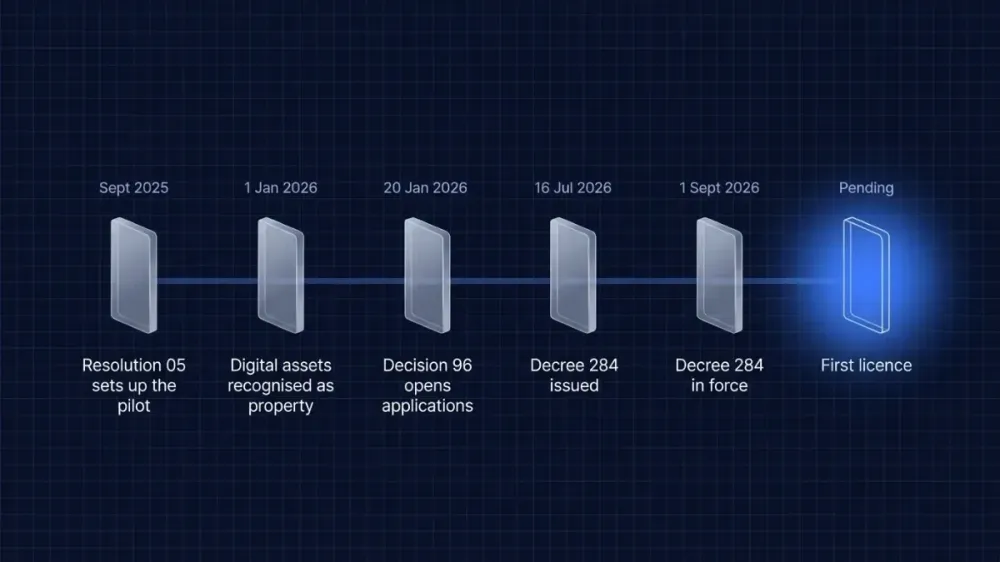
Vietnam crypto regulation since 2025 rests on four instruments. Under Vietnam's crypto laws, crypto is legal to hold as property but is not legal tender or a lawful means of payment.
- September 9, 2025. Resolution 05/2025/NQ-CP opened a five-year pilot covering issuance, custody, and licensed providers.
- January 1, 2026. The Law on Digital Technology Industry took effect, recognizing digital assets as property.
- January 20, 2026. Decision 96/QD-BTC set out the licensing procedure, and applications opened.
- July 16, 2026. The government issued Decree 284/2026/ND-CP, the pilot's penalty framework, effective September 1, 2026.
In its June 19, 2026, update, the Financial Action Task Force (FATF) kept Vietnam under increased monitoring, with virtual-asset rules still on Vietnam's action plan.
What does a provider need to win a license?
To win a Vietnam crypto license, a provider needs bank-scale capital and a review by three state bodies.
- Capital. Article 8 of Resolution 05 sets a floor of 10 trillion dong, roughly $380 million, in paid-in charter capital.
- Ownership. At least 65% of that capital must come from institutions, and foreign holdings are capped at 49%.
- Review. The Ministry of Finance decides, with the State Bank of Vietnam and the Ministry of Public Security checking anti-money-laundering and cybersecurity controls.
Reported applicants include bank affiliates and a securities firm. A crypto license here looks more like a bank charter than a business permit.
When does the six-month clock for domestic holders start?
The six-month clock starts only when the Ministry of Finance issues its first license, so it had not started as of October 14, 2026.
After those six months, Resolution 05 requires domestic activity to run through licensed providers. Article 9 of Decree 284 then fines organizations 30 million to 50 million dong, and individuals half that, for using unlicensed ones.
Pro tip: Count six months from the first license, not from September 1, 2026, when only Decree 284 took effect.
No license, no clock.
What does the pilot mean for property networks built in Vietnam?
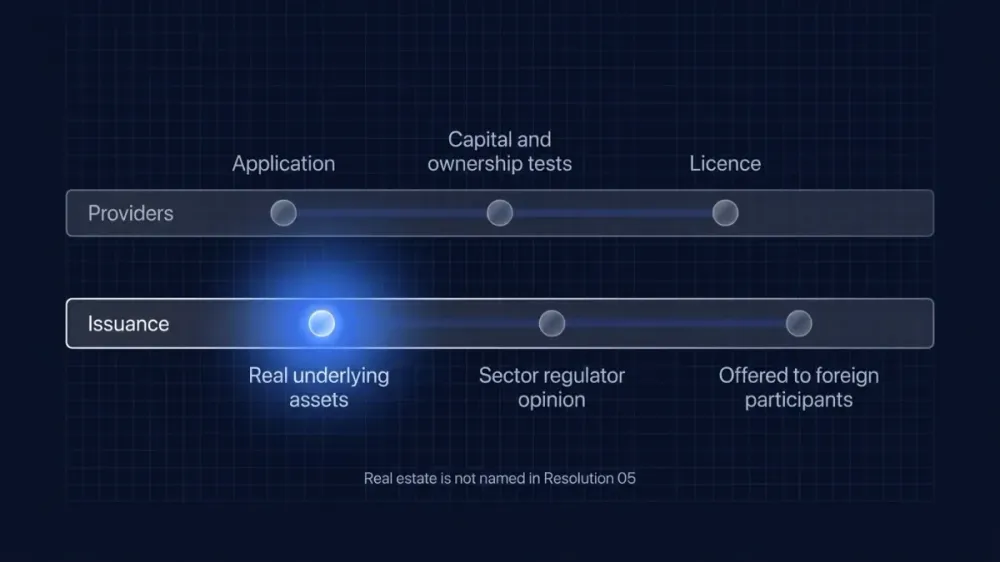
Property networks face a pilot that requires crypto assets to be issued against real underlying assets, excluding securities and fiat currencies, yet never names real estate.
The backing rule gives real-world asset tokenization, or RWA tokenization, a place in the pilot, while real estate tokenization waits on a sector regulator.
The only property signal came in a June 2026 Vietnam News report quoting To Tran Hoa of the State Securities Commission's crypto-asset board. The report said that issuers must obtain opinions from the relevant sector regulators where assets involve real estate, commodities, or infrastructure.
Media coverage and the rules differ in four places.
- Who may issue. Coverage implies any platform can issue. Article 5(1) limits issuers to Vietnamese limited-liability or joint-stock companies.
- What may back an asset. Coverage implies property is approved. Article 5(2) names no asset class.
- Who may take part. Coverage implies Vietnamese participants can join. Article 6(1) restricts offering and issuance to foreign participants.
- Who signs off. Coverage implies the securities regulator decides alone. Real estate reportedly also needs a sector regulator's opinion.
See how the coordination layer handles property verification
How does a provider license differ from a land-use certificate?
A provider license authorizes a company to serve holders of crypto assets. A land-use certificate proves who holds a property right. Neither substitutes for the other.
- What it proves. The license proves that a company may run crypto-asset services. The certificate proves a land-use right or a building's ownership.
- Who issues it. The Ministry of Finance issues the license, and state land authorities issue the certificate.
- What it allows. A licensed provider may offer services such as custody. A certificate holder may use, pass on, or assign the right.
- What it cannot do. A license grants no right over a building. A certificate still cannot be checked remotely in most provinces.
Our guide to land-use certificates tracks the national land database, which held data on more than 68 million parcels by mid-September 2026.
Two documents, two jobs.
What are the open questions and limitations?
Four questions about Vietnam crypto laws stayed open through October 14, 2026.
- When the first license will arrive, now that the third quarter has passed.
- Whether real estate will be accepted as an underlying asset and which regulator will weigh in.
- How the foreign-only offering rule will be supervised.
- How the pilot will interact with pending changes to land and housing laws.
The design has a cost. A 10-trillion-dong threshold concentrates the pilot in a handful of bank-scale providers. The pilot can also be amended, and nothing in it changes who holds a land-use certificate.
Pilots move. Title records do not.
Our perspective
License headlines are about providers. For property, we think the real-asset rule and the reported sector sign-off matter most because trust in tokenized property starts there.
We are Mey Network, ecosystem infrastructure for tokenized property access, built by a team from the Hanoi-based proptech company Meey Group, founded in 2019. We build onchain property records that point back to verifiable documents.
Whatever the Vietnam crypto news brings next, our ecosystem starts with real assets.
Explore it as part of your own research process
This article describes Vietnam's regulatory framework for general information and is not legal advice. Confirm current rules with a Vietnam-licensed lawyer before acting.
Frequently asked questions
Has Vietnam issued its first crypto-asset license?
No, Vietnam had still not issued its first crypto-asset license as of October 14, 2026. Five applicants had passed the initial review by late August 2026, and on September 15, 2026, Deputy Finance Minister Nguyen Duc Chi said that the first providers were expected to be licensed and operating in 2026.
Is crypto legal in Vietnam?
Yes, crypto is legal to hold in Vietnam, and digital assets have been counted as property since the Law on Digital Technology Industry took effect on January 1, 2026. Crypto is not a Vietnamese digital currency and may not be used for payment. Only State Bank of Vietnam notes and coins are legal tender.
What is Resolution 05/2025/NQ-CP?
Resolution 05/2025/NQ-CP is the resolution that set up Vietnam's five-year crypto-asset pilot, effective September 9, 2025. It covers the offering and issuance of crypto assets, related services including custody, and the licensing of service providers by the Ministry of Finance. Every crypto asset issued must be backed by a real underlying asset.
When does the six-month transition for domestic holders begin?
The six-month transition for domestic holders begins when the Ministry of Finance issues its first crypto-asset license. No license had been issued as of October 14, 2026, so the period had not started. Once it runs out, holders face Decree 284 fines for using providers the ministry has not licensed.
What does a company need to obtain a crypto license in Vietnam?
A company needs at least 10 trillion dong in paid-in charter capital to obtain a crypto license in Vietnam, with at least 65% of it from institutions and with foreign holdings capped at 49%. It applies under Decision 96/QD-BTC, and the Ministry of Finance decides after a review with two other state bodies.
What is Decree 284/2026/ND-CP?
Decree 284/2026/ND-CP, issued on July 16, 2026, and in force from September 1, 2026, is the penalty framework for Vietnam's crypto-asset pilot. It fines providers that offer crypto-asset services without a license and, once the six-month transition has ended, domestic holders transacting through providers the Ministry of Finance has not licensed.
Does Vietnam's crypto-asset pilot cover real estate?
Vietnam's crypto-asset pilot does not name real estate. Resolution 05 requires crypto assets to be issued against real underlying assets, excluding securities and fiat currencies. A June 2026 Vietnam News report on the pilot said that issuers needed the relevant sector regulator's opinion where assets involved real estate, commodities, or infrastructure.
Can real estate be tokenized in Vietnam?
No rule in force as of October 14, 2026, set out a dedicated route for tokenized real estate in Vietnam. Land-use rights are proven by land-use certificates, and holding participation units in a tokenized property does not put the holder's name on a certificate or into the national land database.
Is Vietnam crypto friendly?
Vietnam is crypto-friendly only within a licensed framework. The pilot recognizes crypto assets and creates a licensing route, but it sets a bank-scale capital threshold and limits issuance to foreign participants. The Financial Action Task Force (FATF) kept Vietnam under increased monitoring in June 2026, partly over virtual-asset rules.
