

For more than a year, tokenization commentary treated the CLARITY Act as the gate that property on a blockchain was waiting behind. On September 15, 2026, the Senate declined to open it, and the rules behind onchain property records were the same the next morning, as they would have been had the bill passed. Most CLARITY Act crypto coverage skips that part, so this CLARITY Act update explains why.
The CLARITY Act is a US digital-asset bill that sorts tokens into categories, assigns each to a regulator, and sets registration paths to end disputes over which agency is in charge. Tokenized stocks and bonds stay under securities law. Its formal name is the Digital Asset Market Clarity Act (H.R. 3633), and its definitions reach every token, from a network's own coin to a tokenized fund. It is not a property law, and it creates no route of its own for tokenized real estate. A classification bill, start to finish.
This article describes US legislative developments for general information and is not legal advice. Confirm how the rules apply to you with a qualified lawyer.
Key Takeaways
- The CLARITY Act Senate vote on September 15, 2026, failed 49 to 50 on a procedural motion to begin debate, 11 votes short of the 60 votes required.
- Under the Senate Banking Committee text, tokenized versions of assets already covered by securities law would have stayed under that law, with state property transfer and recording rules left untouched.
- A motion to reconsider preserves one path to a second CLARITY Act vote before the 119th Congress ends in early January 2027.
Table of Contents
- Did the CLARITY Act pass the Senate?
- What is the CLARITY Act, and what would it have changed?
- What does the vote mean for tokenized property?
- Which rules govern tokenized assets in the US without the bill?
- How does the US outcome compare with rules elsewhere?
- What happens to the CLARITY Act next?
- What are the limitations of this analysis?
- Our perspective
- Frequently asked questions
Did the CLARITY Act pass the Senate?
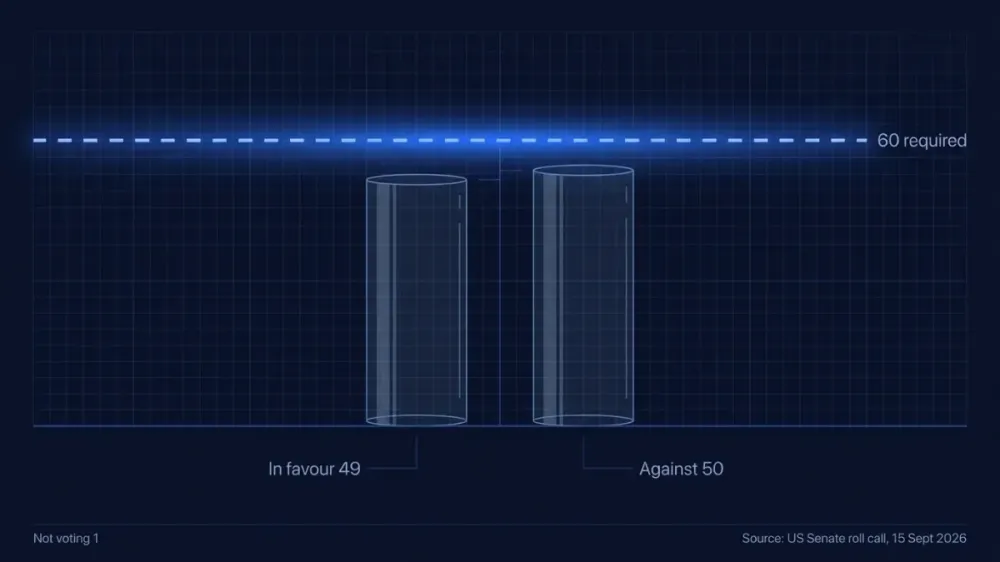
No, the CLARITY Act did not pass. On September 15, 2026, the US Senate voted 49 to 50 against taking up the bill, 11 votes short of the 60-vote threshold, according to the Senate roll call vote.
The CLARITY Act news read like a final defeat, but senators never voted on the bill itself.
The question was cloture on the motion to proceed, a step that needs three-fifths of senators before the chamber can take up the bill. Think of it as voting on whether to open the meeting.
All 49 yes votes were Republican. Senators Collins, Hawley, Moran, and Tillis, also Republicans, voted no, and Democrat Chris Coons did not vote.
Tillis voted no because only a senator on the winning side can enter a motion to reconsider (a request to hold the vote again), which, in Orrick's reading, "preserves a path to revive the bill."
In a July 22 statement, seven Democratic negotiators said that ethics, consumer protection, and illicit finance provisions needed strengthening. Senators Lummis, Boozman, and Scott later said their final text of September 14 carried 126 substantive changes made at Democrats' request, along with new ethics language and legal protections for developers.
The day before the vote, 18 attorneys general from 17 states and the District of Columbia asked senators to vote no unless state enforcement powers were "fully preserved." Orrick also lists payments to stablecoin holders as unresolved before the vote.
Procedural, not final.
What is the CLARITY Act, and what would it have changed?
H.R. 3633, the CLARITY Act, is a bill that would divide digital assets between the US securities and commodities regulators and set registration routes for intermediaries, the firms that hold and move tokens.
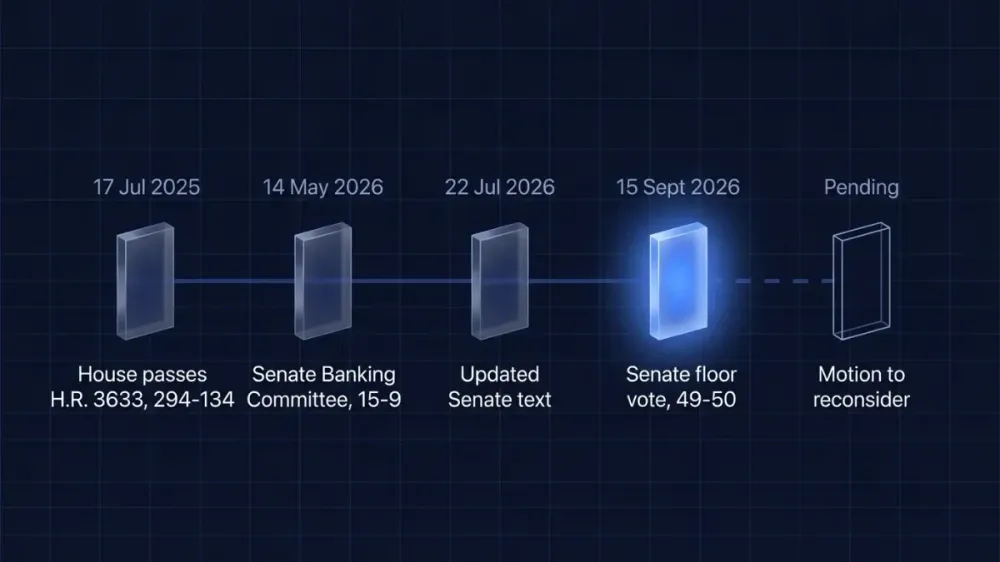
The House passed it 294 to 134 on July 17, 2025. The Senate Banking Committee approved it 15 to 9 on May 14, 2026, and an updated Senate text followed on July 22, 2026.
A digital commodity (a token tied to how a blockchain network runs, such as that network's own coin) would have gone to the commodities regulator. Assets already covered by securities law, tokenized stocks and bonds included, would have stayed with the securities regulator. The bill works like a school schedule, assigning teachers to classes and leaving the building to whoever holds the deed.
Two regulators, two lanes.
What does the vote mean for tokenized property?
Very little changed for tokenized property, because the Senate text offered it no route of its own.
Section 505 of the Senate Banking Committee text says a tokenized version of an asset already covered by securities law is treated, "for all regulatory purposes," as the original it represents. The committee chairs' July 22 section-by-section summary keeps that rule in the combined Senate text as Section 10505.
Section 505 also carries a savings clause (a line that keeps other laws intact) protecting state rules on "the transfer or recording of real tangible or intangible assets." Deeds, county recorders, and state transfer law would have stayed put. The bill would still have affected property platforms indirectly, through the rules for the network coins and firms they rely on.
Four assumptions about tokenized real-world assets did not survive the text.
- Classification. The assumption was a new category for property. The text created none and treated each tokenized version as the asset it represents.
- Registration. The assumption was a route for property platforms. The text offered none.
- Who supervises. The assumption was one federal regulator. The text kept two federal regulators, and the states kept their role.
- What stays offchain. The assumption was that deeds would follow the tokens. The text kept them under state law.
Same law, same morning.
For the unchanged mechanics of real estate tokenization, read how tokenization works.
See how the coordination layer handles onchain property records
Which rules govern tokenized assets in the US without the bill?
Existing securities and commodities law governs tokenized assets in the US, applied by both regulators through orders, guidance, and rulemaking. State law still governs deeds, and state attorneys general keep their enforcement powers.
In a January 28, 2026, staff statement, the securities regulator's staff said that the format in which a security is issued, or how its holders are recorded, does not affect how federal securities law applies. A recipe stays the same recipe whether it is handwritten or printed.
Pro tip: Ask any tokenized property platform which existing rule it relies on, not which bill it is waiting for.
How does the US outcome compare with rules elsewhere?
The US effort stalled in Congress in 2026, while Vietnam pressed ahead with a government-run pilot. For the wider region, read how tokenization rules in Southeast Asia differ.
- Who makes the rule? In the US, it is Congress, where the bill could not clear the 60-vote threshold. In Vietnam, it is the government, through Resolution 05/2025/NQ-CP, which opened a five-year pilot for foreign participants on September 9, 2025.
- Whether property is named. The US bill names real assets only to leave state transfer rules alone. Vietnam's resolution names no asset class but requires every crypto asset to be issued against an actual underlying asset.
- Stage reached. The US has no statute, so regulators act under existing law. In Vietnam, five applicants had passed the initial review and, by late August 2026, were completing their requirements.
Two routes, both unfinished.
What happens to the CLARITY Act next?
Tillis's motion to reconsider keeps a second cloture vote possible, and any text the Senate passes would still need House agreement and a presidential signature.
So when will the CLARITY Act be voted on again? As of October 13, 2026, the Senate's roll call list showed no second vote, and none had been scheduled.
Pro tip: Check the Actions tab for H.R. 3633 on congress.gov before acting on any headline about a revival.
Little time is left for the CLARITY Act in 2026. The midterm elections fall on November 3, 2026, and a lame-duck session (the post-election weeks before a new Congress) can follow. When the 119th Congress ends in early January 2027, any bill not yet law lapses.
When she released the July 22 text, Senator Cynthia Lummis called the coming weeks "likely the last real chance we will have for years to get this right." A day after the vote, seven Democratic senators called the week "a setback, but not the end of that important work."
Possible, but not scheduled.
What are the limitations of this analysis?
This analysis leaves three questions open.
- Uncertainty over the network coins and intermediaries behind tokenized real-world assets still shapes who is willing to build.
- Agency rules are easier than statutes to overturn in court or reverse later, as Orrick notes.
- The treatment of any specific tokenized property arrangement depends on its legal structure, and this article assesses no platform.
Walk through the participation requirements before you go further
Our perspective
We think property platforms should plan on the rules that exist and treat any future statute as an adjustment. For property, the real limits are the land record and the legal entity that holds title, and no classification bill was written to change either.
We are Mey Network, ecosystem infrastructure for tokenized property access, built by a team from the Hanoi-based Meey Group. Putting a record onchain cannot make an off-chain legal question simpler, so the US legal treatment of participation units, ours included, stays a question for a qualified lawyer.
Rules that read the same on September 16 are the real CLARITY Act update, and our ecosystem is built on them.
Explore it as part of your own research process
This article describes US legislative developments for general information and is not legal advice. Confirm how the rules apply to you with a qualified lawyer.
Frequently asked questions
Did the CLARITY Act pass?
No, the CLARITY Act did not pass. On September 15, 2026, the Senate voted 49 to 50 against taking up the bill, 11 votes short of the 60-vote threshold needed to begin debate. The House passed its version 294 to 134 on July 17, 2025, but the bill stalled in the Senate.
What is the CLARITY Act?
H.R. 3633, the CLARITY Act, is a bill that sorts digital assets into categories and assigns each to a federal regulator, with a digital commodity going to the commodities regulator. It also sets registration routes for intermediaries. The House passed it in July 2025, and it stalled in the Senate in September 2026.
What was the Senate vote on the CLARITY Act?
On September 15, 2026, senators voted 49 to 50 against starting debate on the CLARITY Act. It was a cloture vote on the motion to proceed, a procedural step rather than a vote on the bill. All 49 yes votes were Republican. Four Republicans voted no, and Senator Chris Coons did not vote.
When will the CLARITY Act be voted on again?
No second vote on the CLARITY Act had been scheduled as of October 13, 2026, and no signing date exists, because no final text has passed. A motion to reconsider, entered after the September vote, preserves one path to a second attempt, including during a lame-duck session, before the 119th Congress ends.
Is the CLARITY Act dead?
Not formally. As of October 13, 2026, the CLARITY Act status was stalled, and the bill lapses only if the 119th Congress ends in early January 2027 without passing it. A motion to reconsider preserves one path to a second Senate vote until then. If it lapses, supporters must reintroduce it.
Why did the CLARITY Act fail to advance?
The CLARITY Act failed to advance because it drew 49 of the 60 votes needed on September 15, 2026. Republican senators behind the final text said it carried 126 changes made at Democrats' request. Democratic negotiators wanted stronger ethics and consumer protections, 18 attorneys general defended state powers, and stablecoin holder payments stayed unresolved.
Does the CLARITY Act cover tokenized real estate?
No separate route for tokenized real estate exists in the CLARITY Act. Under the Senate Banking Committee text, tokenized versions of assets already covered by securities law would have stayed under that law. A savings clause would also have left state rules on transferring or recording real assets untouched, keeping deeds under state law.
What does the vote mean for tokenized property?
Little changed for tokenized property in the US. The asset class was governed by existing securities, commodities, and state law before September 15, 2026, and it still is. Passage would not have changed that picture much, because the Senate Banking Committee text created no route for property and left deeds under state law.
Which rules apply to tokenized assets in the US now?
Existing securities and commodities law applies to tokenized assets in the US, interpreted through regulator orders and staff statements. A January 28, 2026, staff statement from the US securities regulator says a security's format does not change how the law applies. State oversight also continues, including the enforcement powers of state attorneys general.
How does the CLARITY Act affect Mey Network?
The CLARITY Act vote did not change how property records work onchain, including ours. We are ecosystem infrastructure for tokenized property access, built by a team from the Hanoi-based Meey Group, and this article does not assess our participation units under US law. Review the participation requirements and get your own legal advice.
