

A white box the size of a paperback sits on a fourth-floor balcony, its green light blinking. It relays a wireless signal to phones on the street below.
Nobody else in the building knows it belongs to a network.
That box is the simplest answer to "What is DePIN?" (no relation to "depinning," the connector-repair job). DePIN links privately owned devices like it into one shared network, with their work recorded on a blockchain.
Most guides explain DePIN projects through their tokens. We start from the building because nearly every device needs a roof, power, and someone's permission. That building is where DePIN meets tokenized real estate, and where the hardest problems start.
Key Takeaways
- DePIN puts device work onchain, while real-world asset (RWA) tokenization puts legal claims onchain.
- Messari's State of DePIN 2025 put the sector at about $10 billion and its 2025 onchain revenue at $72 million.
- The top DePIN projects in 2026 have paying customers outside their networks, and most devices need a property owner's consent.
Table of Contents
- What is DePIN?
- How does a DePIN network work?
- What are the main categories of DePIN?
- Which DePIN projects show the model working in 2026?
- How big is the DePIN sector in 2026?
- How is DePIN different from RWA tokenization?
- Where is DePIN reaching real estate?
- What are the challenges and limitations of DePIN?
- Our perspective
- Frequently Asked Questions
What is DePIN?
DePIN is a network that pools independently owned devices, verifies their physical work onchain, and allocates network units for that work to run a shared service without a central operator. The acronym is short for decentralized physical infrastructure network.
Think of a neighborhood potluck. Nobody hires a caterer, everyone brings a dish, and a list everyone can see shows who brought what (the onchain record).
"Decentralized" means many owners running hardware they paid for, and "physical" means the hardware sits in a real place, such as a roof. On Helium, a wireless network, hosts mount hotspots, which are checked for coverage and credited in network units. Unlike in a cloud service, no single company owns the hardware, and unlike in RWA tokenization, the record shows work done rather than a legal claim.
Many owners, one service.
What does DePIN stand for in crypto?
DePIN stands for Decentralized Physical Infrastructure Network, the crypto term for networks that use tokens to coordinate real hardware. The DePIN meaning hinges on "physical" because the network exists only where devices do.
The name won a November 2022 Messari poll with 31.6% of the votes, an academic survey reports.
How does a DePIN network work?
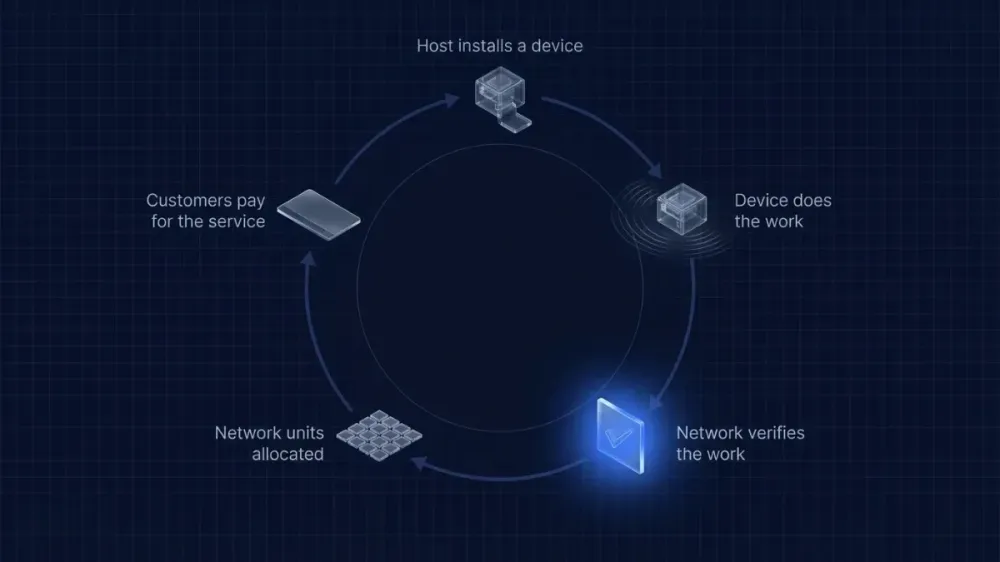
A DePIN network runs as a loop that credits only the physical work it can check. Here is how it works.
- A host installs a device. A device host mounts a hotspot, a sensor, or a storage server.
- The device does the work. It provides coverage, takes readings, stores files, or runs compute jobs.
- The network verifies it. Helium's proof of coverage checks each hotspot's uptime, speed, and claimed location.
- The protocol allocates network units. Units go only to verified work.
- Customers pay. A carrier, a mapping firm, or a developer pays for the output.
An academic survey of DePIN sorts networks by whether location matters.
- Physical resource networks. Wireless, sensor, and energy networks depend on where each device stands. They can cover a city, block by block, but not a block where no host lives.
- Digital resource networks. Compute, storage, and bandwidth networks pool capacity that works from anywhere, but can't prove anything about a particular place.
Verification is the weak link.
Picture a school register where pupils mark their own attendance (fine until one signs in an absent friend). In 2022, Hivemapper checked each dashcam's location against the Helium hotspots it passed and sent mismatches for manual review.
Hardware is the easy part.
What are the main categories of DePIN?
We group DePIN examples by what each device supplies, not by which blockchain runs the network.
- Wireless. Helium hotspots carry mobile and Wi-Fi traffic, but only where hosts install them.
- Sensors and mapping. Hivemapper dashcams map roads, WeatherXM stations log weather, and GEODNET stations sharpen GPS positioning. Each network needs devices spread evenly, yet hosts choose their own spots.
- Energy. Daylight connects home batteries, solar inverters, and thermostats, and $60 million of its $75 million raise in October 2025 was project finance secured against infrastructure assets.
- Compute. Render pools idle graphics processors (GPUs) for 3D rendering and AI imaging, competing with cloud giants.
- Storage. Filecoin stores files across independent providers, and its 2026 strategy shifts focus from adding storage to finding customers, a sign that capacity came first.
- Bandwidth. Grass uses spare internet bandwidth to gather public web data for AI training, so supply depends on users' own connections.
The venture firm a16z's six use cases for DePIN slice the same field by industry.
Which DePIN projects show the model working in 2026?
DePIN projects show the model working when customers outside their networks pay for the service. Most lists of the top DePIN crypto projects for 2026 rank them by token value instead.
Messari's DePIN Leaders Index is stricter, with thresholds such as at least $500,000 in annual recurring revenue and $30 million raised. The best DePIN projects below have paying customers.
- Helium. Mobile carriers such as AT&T pay Nova Labs, Helium's developer, per gigabyte of phone traffic on Helium hotspots, and Helium's network figures show about 128 terabytes carried a day in May 2026. Yet only about 40,000 of its 141,000 Wi-Fi hotspots actively carried traffic, Light Reading reported in September 2026.
- GEODNET. Its reference stations correct GPS positioning for drone, farming, and surveying firms that pay for the data. GEODNET passed 22,000 stations by September 30, 2026, though many figures come from GEODNET itself, and rivals include Trimble and Hexagon.
- WeatherXM. Its home stations feed weather data to customers such as Google DeepMind and PG&E. WeatherXM has deployed more than 9,500 stations, but its August 2026 snapshot counted more than 5,900 active.
Pro tip: Check who pays for the service before you look at anything else.
How big is the DePIN sector in 2026?
Messari's State of DePIN 2025, published in January 2026, put the sector at about $10 billion.
So what is DePIN crypto worth? That depends on which tokens each tracker counts, and when.
A July 2026 CryptoRank update put the sector far lower, at $3.46 billion, down from $20.2 billion in March 2024. CoinGecko's DePIN category keeps a third total that moves daily.
For 2025, Messari also counted $72 million of onchain revenue, while projects raised about $1 billion. Token value and funding outran revenue.
How is DePIN different from RWA tokenization?
What goes onchain decides the DePIN vs RWA question. DePIN records what a device did, and RWA tokenization records a legal claim on an asset.
What the record says. A DePIN record says that a hotspot carried traffic. An RWA record says who holds a claim on a property. Neither record can do the other's job.
How it is checked. DePIN relies on onchain verification, such as location checks, while tokenized property relies on a land registry and legal paperwork. A land registry can't check a hotspot.
What sits behind it. Hardware sits behind a DePIN. A legal entity, often a real estate SPV (special purpose vehicle) that owns the building, sits behind tokenized property, as our guide to how real estate tokenization works explains.
What it proves about a building. A DePIN record can show that the roof's panels produced power but not who owns the roof. An RWA record shows who holds a claim but not what happens inside.
An RWA-DePIN pairing could record who holds the claim and what happens at the property. Same building, two records.
Where is DePIN reaching real estate?
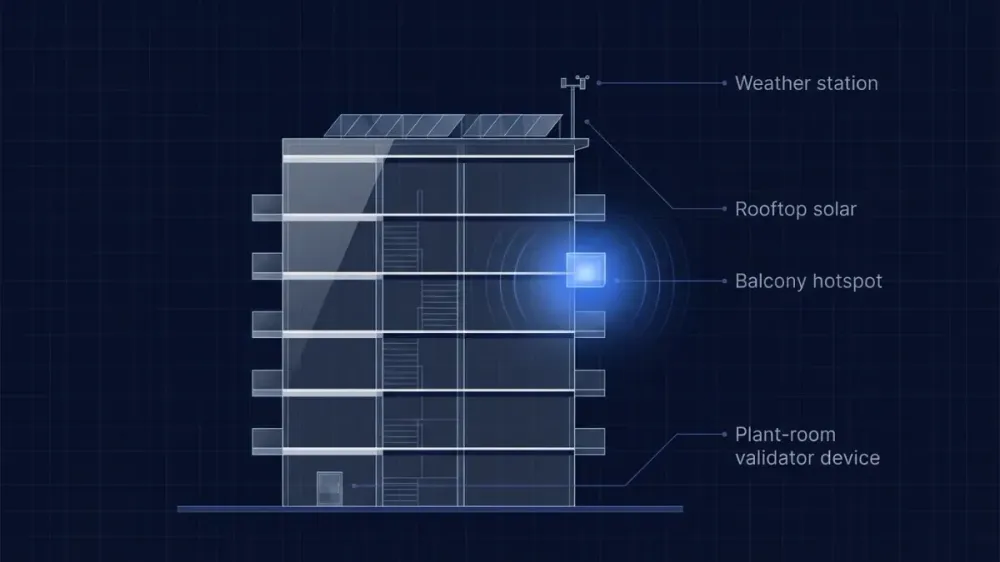
Every DePIN device occupies physical space, so property is the network's first dependency.
Property as host. Rooftops carry weather stations and GPS base stations, while balconies and storefronts hold hotspots. In Helium's Wi-Fi model, businesses such as coffee shops and airports host the access points, Light Reading reported. Leases, landlord consent, and strata or homeowners association (HOA) rules govern what a device host can mount on a wall or roof.
Pro tip: Read the lease clause on rooftop and balcony equipment before hosting any device.
Building data. Sensor networks can report air quality, weather, occupancy, and energy use. Think of a building's shared water tank. Every apartment draws from it, but nobody knows the level until someone reads the gauge. A sensor network reads that gauge all day. Smart-building sensors already count as proptech. DePIN adds independently owned sensors and an onchain record of the readings.
Energy. Rooftop solar and home batteries across many homes can be scheduled as one supply.
Verification. Device data, such as meter readings, could feed a building's property record, and devices could act as validators securing a property network. Onchain land records are already among the blockchain use cases in real estate, and device reports could sit beside them.
All of this is early. Few DePINs are built for property, and "DePIN real estate" is barely a phrase yet.
Explore the network architecture behind onchain property records
What are the challenges and limitations of DePIN?
Five problems hold DePIN back.
- Incentive dependency. When a network allocates more in network units than customers pay in fees, growth depends on newly issued units, not paying customers.
- Verification attacks. False locations and fake coverage claims are hard to catch without checking every roof.
- Hardware churn. Hosts unplug, devices age, and coverage maps go stale, as WeatherXM's gap between deployed and active stations shows.
- Regulation. The US securities regulator (SEC) sued Helium's developer, Nova Labs, in January 2025, then dismissed the case that April but settled one claim over equity-financing statements with a $200,000 penalty. SEC staff later issued a no-action letter to DoubleZero and another to Fuse, both DePIN projects, in late 2025. Each states an enforcement position, not a legal determination. In March 2026, SEC guidance backed by the CFTC (the US derivatives regulator) said that tokens tied to a working network's operation are not securities in themselves.
- Property-side friction. Leases, building insurance, and privacy rules for in-home sensor data can stop a device before it switches on.
Fixes take years.
Our perspective
We think a property network needs physical presence as much as legal structure, which is why device-based validation fits real estate better than Bitcoin-style proof of work. Property is physical, and the network securing its records should be too.
Mey Chain, our network architecture, is designed so that physical devices act as validator nodes instead of proof-of-work miners. That spreads validation across many devices. Validators take part in network security, and $MEY is the chain's network unit.
The design has real limits.
A validator network's strength depends on how widely its devices spread, how well each is secured, and how many stay online. We expect to be judged on all three.
Read the Mey Chain documentation at docs.mey.network
Back on that fourth-floor balcony, the white box is still blinking. Ask "What is DePIN?" and the honest answer starts there, with a device, a balcony, and someone's permission. We're building our property network around that answer.
Explore it as part of your own research process
Frequently Asked Questions
What is DePIN?
DePIN, short for decentralized physical infrastructure network, is a network of independently owned devices supplying a physical service, such as wireless coverage, sensor data, or storage. Onchain verification checks each device's work, the protocol allocates network units for it, and customers pay for the service. Helium is the best-known example.
What is DePIN in crypto?
DePIN in crypto refers to networks that use tokens to coordinate real-world hardware instead of one company building it all. The blockchain records verified work, the network allocates units for it, and the service itself happens offchain. Helium's hotspots, for example, carried about 128 terabytes a day in May 2026.
What does DePIN stand for?
DePIN stands for Decentralized Physical Infrastructure Network. In the DePIN meaning, "physical" is the key word because the network depends on hardware in real places, such as hotspots on walls or weather stations on roofs. That sets it apart from crypto networks that exist only to keep records of transactions.
How does a DePIN network work?
A DePIN network works in a loop. Hosts install devices, the devices do physical work such as providing coverage or storing files, the network verifies that work, and the protocol allocates network units for it. Customers pay for the service. Verification, such as proof of coverage, is the hardest step.
What are examples of DePIN projects?
Common DePIN examples include Helium for wireless coverage, Hivemapper for street mapping, WeatherXM for weather data, GEODNET for satellite positioning, Filecoin for storage, and Render for GPU compute. Each supplies a different physical or digital resource. Check each project's current status before relying on it, since DePIN projects shift often.
What are the main types of DePIN?
Decentralized physical infrastructure networks split into two types. Physical resource networks depend on location, as with wireless, sensor, and energy networks. Digital resource networks work from anywhere, as with compute, storage, and bandwidth networks. This guide sorts them into six categories by what each device supplies, from wireless to bandwidth.
What is the difference between DePIN and RWA?
DePIN and RWA tokenization differ in what goes onchain. DePIN records what a device did, while RWA tokenization records a legal claim. A tokenized building relies on a legal structure, such as a special purpose vehicle (SPV), while a DePIN relies on hardware and proofs. One building can carry both.
How is DePIN related to real estate?
DePIN is related to real estate because every device needs a physical site, usually a rooftop, balcony, storefront, or utility room. Device networks can also report building data, such as rooftop solar output, occupancy, or air quality. Property-specific DePINs remain rare in 2026, and leases often decide where devices go.
Do you need permission to host a DePIN device in a building?
Hosting a DePIN device in a building usually needs permission from whoever controls the space, whether that is the landlord, the strata or homeowners association, or the building manager. Leases often restrict rooftop and balcony equipment, and building insurance terms can matter too. Read the lease before you install anything.
How big is the DePIN sector in 2026?
DePIN's size depends on which tracker you read. Messari's State of DePIN 2025, published in January 2026, put the sector at about $10 billion, while a July 2026 CryptoRank update showed $3.46 billion. Messari also counted $72 million of onchain revenue in 2025. Token value and revenue tell different stories.
Are DePIN tokens securities?
Whether DePIN tokens are securities depends on each token and how it is offered. In March 2026, SEC guidance backed by the CFTC said that tokens tied to a working network's operation are not securities in themselves. SEC staff no-action letters to DoubleZero and Fuse express enforcement positions, not legal rulings.
How does Mey Chain use physical devices?
Mey Chain, our network architecture, is designed to use physical devices as validator nodes instead of proof of work. Those devices validate transactions and help maintain the chain's integrity, and $MEY is its network unit. The design is set out in our documentation at docs.mey.network, the place to check first.
