

A tokenized listing shows the building, the units issued, and the words “held via SPV” in small type. One unit is yours, yet the listing never explains what sits between your unit and the building.
So what is an SPV? A real estate SPV is a separate legal entity that holds one property, isolates its liabilities, and administers its participants’ interests to keep that asset ring-fenced from the sponsor, the deal’s organizer. SPV stands for special purpose vehicle, and unlike a fund, it exists for that single asset alone. Participants hold interests in the company, the company holds the deed, and that chain makes the SPV the legal layer under most real estate tokenization. One building, one company.
Key Takeaways
- A real estate SPV holds one property’s deed, leases, and accounts, and onchain units stand for interests in the SPV.
- Staff at the SEC, the US securities regulator, said on January 28, 2026, that tokenizing a security does not change how federal securities law applies.
- Outlier Media reported in July 2025 that RealT collected over $2.72 million for units tied to 39 Detroit homes whose deeds named another owner.
Table of Contents
- What is an SPV in real estate?
- Why is property held in an SPV instead of directly?
- How is a real estate SPV different from an LLC, an SPE, or a REIT?
- How does an SPV link to tokenized property units onchain?
- What does a real estate SPV protect, and what doesn’t it?
- What are the red flags when a real estate SPV is missing or weak?
- What are the challenges and limitations of SPV structures?
- Our perspective
- Frequently asked questions
What is an SPV in real estate?
An SPV in real estate is a separate company set up to hold one property and nothing else.
Picture a labeled lunchbox holding one meal. The box (the legal entity) keeps the meal (the property) apart from everything else. A Delaware company formed for one apartment building is that box.
A special purpose vehicle is defined by its purpose rather than its form and can be a partnership, trust, corporation, or limited liability company (LLC), the usual US choice.
What does an SPV actually hold?
A typical property SPV holds five things.
- The title deed, or a land-use right where land cannot be held outright
- Tenant leases
- Building insurance
- A bank account
- The management agreement
The deed matters most, since the SPV holds the property only once the land registry says so.
Why do lawyers call it “bankruptcy remote”?
Bankruptcy remote means that the SPV and its sponsor sit apart, like apartments on separate electricity meters, so neither side’s creditors should reach the other. Yet one sponsor, General Growth Properties, pulled over 160 solvent property-level subsidiaries into its bankruptcy, and secured lenders still rank ahead of unit holders.
Safer, but not risk-free.
Why is property held in an SPV instead of directly?
Property is held in an SPV because changing who holds a membership interest is faster and cheaper than changing the name on a deed. A deed transfer can need a notary, a registry filing, and transfer taxes, while a membership change is one register entry. Easier transfer is why SPVs often hold a single building, and hundreds of participants make cheaper transfers essential.
Deloitte’s April 2025 forecast puts tokenized real estate at $4 trillion by 2035. Behind those assets, SPVs do four jobs.
- Liability isolation. A claim against one building stays ring-fenced in its company.
- One-asset clarity. Accounts, insurance, and audits cover one property.
- Lender requirements. Mortgage lenders often insist on a single purpose entity (SPE).
- Cross-border holding. A local SPV for real estate can hold land that a foreign person cannot.
Forming the SPV is the cheap part. Delaware’s August 2026 LLC certificate of formation carries a $110 filing fee, and the rest of the budget goes to offering documents, legal opinions, and structuring.
Pro tip: Ask which jurisdiction the SPV sits in and why, before anything else.
How is a real estate SPV different from an LLC, an SPE, or a REIT?
A real estate SPV names a purpose, while an LLC is a legal form, an SPE is a lender’s label, and a REIT is a regulated product.
SPV vs LLC
SPV vs LLC is a false choice, since most real estate SPVs are LLCs. Their members hold membership interests, the usual form of fractional ownership in one building. An LLC can hold title and admit members, but nothing in LLC law limits it to one asset. A series LLC splits one company into series with separate rights over specified property, though many states do not recognize that separation.
SPV vs single purpose entity (SPE)
A single purpose entity is the lender’s term for a company restricted to owning one property, usually with an independent director and separateness covenants (promises to keep its own books and name). Every SPE is an SPV, so the single purpose entity vs special purpose entity distinction turns on the covenants. In single purpose entity real estate loans, lenders write the covenants to protect their collateral, so an SPE can keep a property’s debts apart from an affiliate’s but cannot put participants ahead of the lender.
SPV vs REIT
A REIT is a company that owns many properties, is often registered with the SEC, and has tax rules of its own. Our REITs vs tokenized real estate comparison shows how pooling many buildings differs from tying your unit to one.
How does an SPV link to tokenized property units onchain?
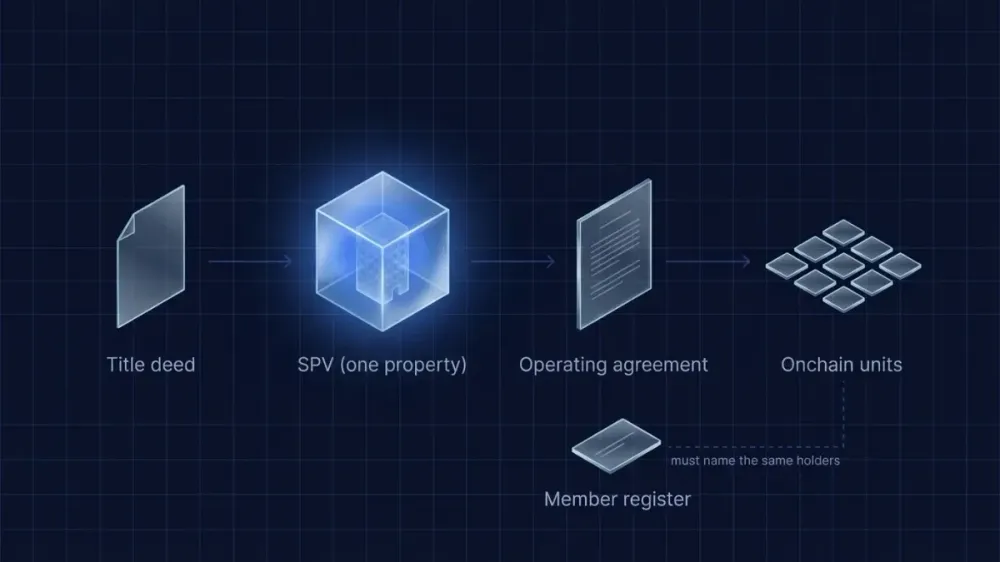
An SPV links to onchain units through its operating agreement, which defines the membership interest each unit represents. Here is how it works.
- Title moves into the SPV. The deed is registered in the SPV’s name.
- The operating agreement defines interests. It sets how many exist and what each carries.
- Units go onchain. Each unit stands for one interest or part of one.
- Transfer restrictions run in the smart contract. Know-your-customer (KYC) whitelists admit only verified wallets, as the ERC-3643 standard requires.
- The registers are reconciled. The member register and the onchain record must name the same holders.
Those five steps are SPV tokenization in practice, and our guide to how real estate tokenization works covers the rest.
The January 28, 2026, SEC staff statement on tokenized securities says that a security’s format does not change how federal securities law applies. In issuer-sponsored models, the issuer can keep the official holder record onchain, while in third-party tokenization, the token may or may not carry rights in the underlying interest.
Switzerland goes further. Its distributed ledger technology (DLT) Act allows a ledger-based security, a token that is itself the legal membership right, though land still moves through the land register. Elsewhere, the unit points at a legal interest held offchain, which limits what the onchain record can prove.
- It can prove who holds units and every transfer since issuance. It cannot prove that the deed is in the SPV’s name.
- It can prove that only whitelisted wallets received units. It cannot prove that the building matches the listing.
Like the outside of a sealed envelope, the record shows the address and the date, never what is inside.
Read the protocol documentation at docs.mey.network
What does a real estate SPV protect, and what doesn’t it?
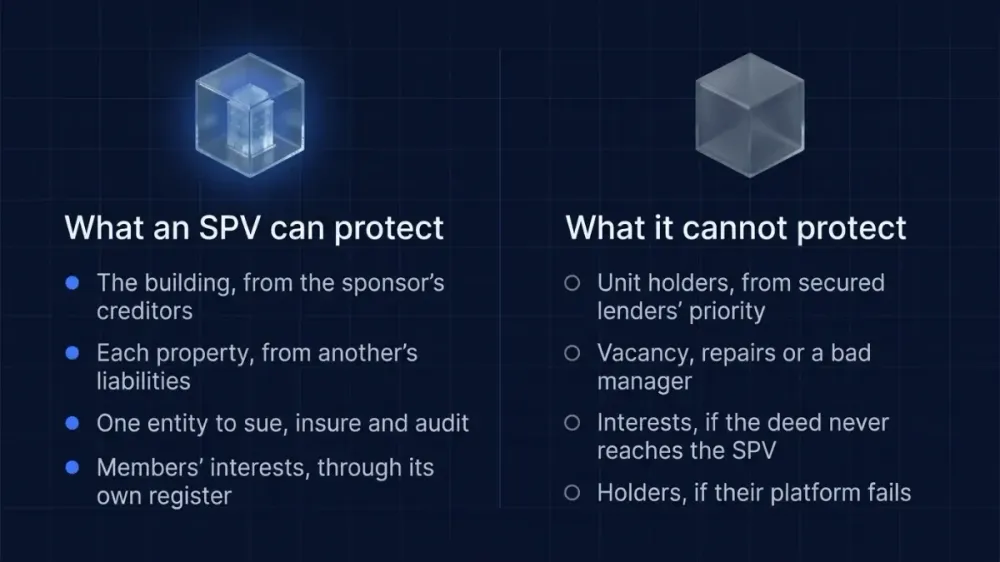
A real estate SPV protects a property from other people’s problems, but not from its own.
What it can protect
- The building, from the sponsor’s creditors
- Each property, from another property’s liabilities
- Accountability, with one entity to sue, insure, and audit
- Members’ interests, through its own register
What it cannot protect
- Unit holders, from secured lenders’ priority
- The building, from vacancy, repairs, code violations, or a bad manager
- Members’ interests, if the deed never reaches the SPV
- Third-party holders, if their platform fails
A sturdy box can still hold a bad meal.
What are the red flags when a real estate SPV is missing or weak?
The clearest red flag is a deed held outside the SPV, as RealT’s Detroit case shows.
Outlier Media reported in July 2025 that from July 2023 to March 2024, RealT issued units tied to 39 Detroit homes and collected over $2.72 million. The deeds still named the existing owner because the deal never closed. Detroit’s July 2025 nuisance suit covered 408 properties and named 165 RealT affiliates. In April 2026, a judge-approved agreement put RealT’s whole Detroit portfolio, about 700 properties, under an outside manager, and in July 2026, the company announced a voluntary wind-down.
Check any listing for seven red flags.
- Deed not in the SPV’s name. Only the land registry can confirm the owner.
- No published operating agreement. Without one, nobody can say what a unit represents.
- Many properties in one entity without a series LLC. One failing building can drag down the rest.
- Rights only against an intermediary. Your claim may run only to the platform.
- No named manager or audited accounts. Without them, nobody answers for the company.
- A clash with local land rules. Vietnam’s land-use rights system, for one, bars foreigners from holding those rights in their own name.
- A unit count that does not match. Onchain supply should match the member register.
Compliance is not optional. It is your first line of defense against fraud.
Pro tip: Request the land-registry extract, not a screenshot of it.
See how the coordination layer handles property verification
What are the challenges and limitations of SPV structures?
Even a well-drafted SPV leaves three problems open.
- Cost and administration. Each SPV needs its own filings, accounts, and manager, a cost that small properties rarely justify.
- Cross-border friction. Tax treatment varies by jurisdiction, and foreign-ownership limits can shape or block the SPV route.
- Regulatory uncertainty. US federal rules for tokenized assets stayed unsettled after the CLARITY Act, a digital-asset bill, failed a procedural Senate vote 49 to 50 on September 15, 2026.
An SPV simplifies transfers on paper, yet it creates no demand for anyone’s unit.
Our perspective
We think the SPV is necessary but not sufficient. It cannot keep checking that the deed, the member register, and the onchain record still agree after launch. That is a blockchain coordination job.
In Mey Real, each property sits in its own local SPV, a limited liability company that holds legal title. Under our legal framework, a licensed custodian or law firm keeps the title deeds, every wallet passes KYC and anti-money-laundering (AML) checks before holding a unit, and a smart contract enforces transfer restrictions.
Go back to that listing’s small print. In any SPV real estate structure, the documents behind “held via SPV” decide what your unit represents, and we built Mey Real to keep checking them.
Explore it as part of your own research process
Frequently asked questions
What is an SPV?
An SPV, or special purpose vehicle, is a separate legal entity created for one narrow job, such as holding a single property. Keeping that job inside its own company ring-fences the asset from the sponsor’s other businesses and creditors. Most SPVs are limited liability companies (LLCs), corporations, trusts, or partnerships.
What is a special purpose vehicle in real estate?
A special purpose vehicle in real estate is a company set up to own one property and nothing else. The property’s title, leases, and insurance sit inside it, and participants hold membership interests in the company rather than holding the deed. That structure is the legal layer behind most tokenized property.
What is an SPV in real estate tokenization?
In real estate tokenization, an SPV holds the property, and onchain units represent membership interests in that SPV. The operating agreement sets out what each unit represents. Switzerland’s distributed ledger technology (DLT) Act lets the token itself be the legal membership right, though land still transfers through the land register.
Is an SPV the same as an LLC?
An SPV is not the same as an LLC, because “SPV” names a purpose, and “LLC” names a legal form. Most real estate SPVs are LLCs, often formed in Delaware, or local companies elsewhere. The special purpose comes from the single asset and the narrow charter in the SPV’s documents.
What is a single purpose entity in real estate?
A single purpose entity (SPE) in real estate is a company restricted to owning one property, usually because a mortgage lender requires it. Separateness covenants, promises to keep separate books and accounts, shield the company from affiliates’ debts. Every SPE is a kind of SPV, but its covenants protect the lender first.
What does bankruptcy remote mean for an SPV?
Bankruptcy remote means that an SPV is structured so the sponsor’s insolvency should not reach the property inside it. Separate accounts, independent directors, and restricted activities create that distance. Remoteness is a design goal rather than a guarantee, and secured lenders still rank ahead of unit holders if the SPV fails.
Do token holders hold the property title in an SPV structure?
Token holders in an SPV structure usually hold interests in the SPV, not the property’s title. On January 28, 2026, SEC staff distinguished issuer-sponsored from third-party tokenization, noting that a third party’s token may or may not carry rights in the underlying interest. Read the operating agreement for what each unit represents.
Does a real estate SPV need to be a local company?
Whether a real estate SPV must be local depends on where the property sits and who may hold land there. Some countries restrict foreign holding of land or land-use rights and can require a local entity, while others let foreign companies hold land. Confirm the rule with counsel in the property’s jurisdiction.
How much does it cost to set up a real estate SPV?
Setting up a real estate SPV can be inexpensive, since Delaware’s limited liability company (LLC) certificate of formation carries a $110 filing fee as of August 2026. Most of the cost sits elsewhere, in offering documents, legal opinions, structuring, and yearly administration. Ask any sponsor which jurisdiction it chose and why.
How does Mey Network approach SPV verification?
We treat the SPV as one link in a chain that needs ongoing verification, from deed to member register to onchain record. In Mey Real, each property sits in a local SPV. A licensed custodian or law firm keeps the title deeds, and a smart contract blocks transfers to unverified wallets.
