

Most decentralized finance (DeFi) runs a closed loop. You lock a token, and the protocol issues more of the same token. MeyFi starts somewhere else. What you stake or lend there is a property token tied to a real building with an address, a title, and a tenant.
Tokenized real-world assets passed $38 billion on-chain in August 2026, and property is the slowest, most paperwork-heavy corner of that total. DeFi for real estate exists because a tokenized building needs something to do besides sit in a wallet.
If you hold a Property Token Offering (PTO) unit, or soon will, the next question arrives fast. Stake it, lend against it, or leave it alone. This guide covers what MeyFi is, how staking and lending work, where participation benefits come from, what can go wrong, and how to start. For the ground floor, read what a Property Token Offering is.
This guide explains how MeyFi's staking and lending tools work. It is an overview of platform mechanics, not financial advice, and participation benefits are not guaranteed.
Key Takeaways
- MeyFi is Mey Network's DeFi participation layer, where holders of Property Token Offering units stake, lend, or otherwise activate them.
- Participation benefits come from two sources: rent-linked distributions tied to the building and protocol incentives funded by tokenomics. Knowing which one you are getting changes what to expect.
- MeyFi and Mey Real are live. Mey Land is a roadmap item, and treating it as live misstates what exists today.
- Every MeyFi flow carries lock-up or unbonding terms and platform risk. Check both before committing.
Table of Contents
- What is MeyFi?
- How does staking work on MeyFi?
- How does P2P lending work on MeyFi?
- How do you get started on MeyFi, step by step?
- What participation benefits are realistic on MeyFi?
- What are the risks, and what should you verify?
- How does MeyFi compare with other ways to access tokenized real estate?
- What do real MeyFi scenarios look like?
- How do you start using MeyFi today?
- Frequently asked questions
What Is MeyFi?
MeyFi is the on-chain participation layer of Mey Network that accepts verified property tokens, routes them into staking or peer-to-peer lending, and settles each position by smart contract, so tokenized real estate does more than sit still.
It is a real estate DeFi platform with a narrow door. Crypto-native protocols accept whatever assets a pool supports. MeyFi takes only units from Mey Network's own Property Token Offerings, each traceable to a building that passed valuation and legal review. The collateral is a building, so the protocol runs on property timelines rather than on-chain ones. Slower, and much easier to trace.
New to the category? Start with what real estate tokenization is.
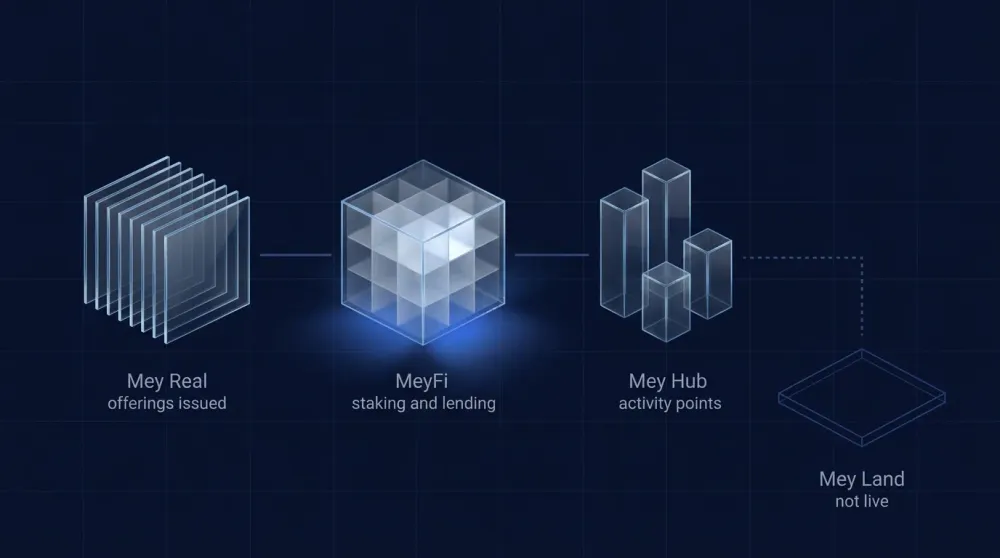
MeyFi vs. Mey Real vs. Mey Hub
Three names, three jobs. Confusing them is the most common mistake.
- Mey Real, the real estate tokenization platform where Property Token Offerings are listed and issued.
- MeyFi, the participation layer, where property tokens are staked or lent under contract.
- Mey Hub, the points layer, where ecosystem activity is scored and ranked.
- Mey Land, not live. Mey Network lists it as coming soon, so treat it as a plan.
How Does Staking Work on MeyFi?
Staking on MeyFi commits a token for a defined term, locked until maturity.
What Can You Stake?
Two things: Property Token Offering units and $MEY. Mey Network documents four $MEY staking tiers, Dolphin, Shark, Whale, and SVIP, from a 10,000 token minimum upward, but lists the feature as coming soon with no rate published. Documented is not live.
Property token staking is the half most people arrive for. You stake property tokens from a completed offering, not a general-purpose pool.
Where Do Participation Benefits Come From?
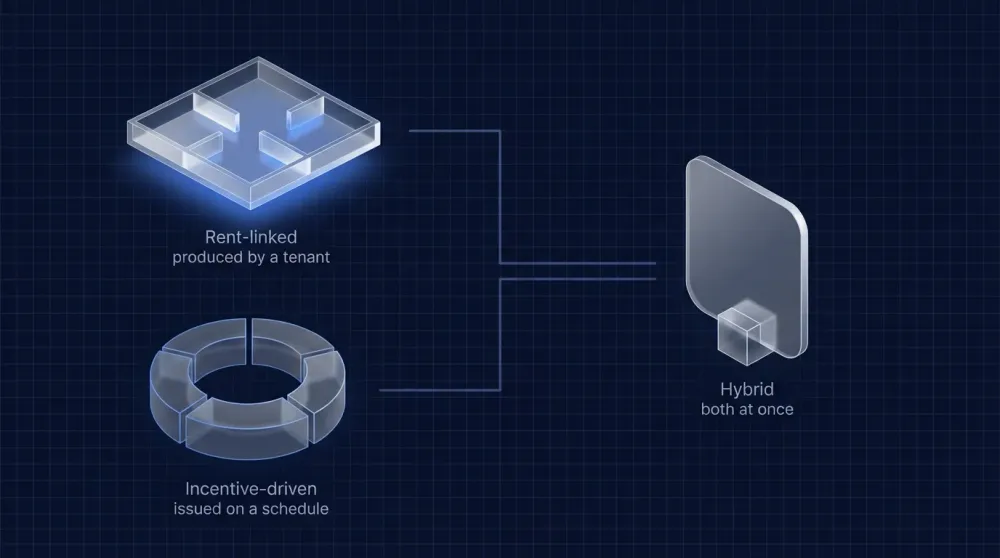
Participation benefits on MeyFi come from two places, and a platform that will not say which is which is one to avoid.
- Rent-linked distributions. A tenant pays, costs come off, and the remainder splits across holders in proportion to units held. The source is a lease, so it moves with occupancy.
- Protocol-level incentives. The network assigns units on its own schedule, funded by tokenomics rather than a tenant. A schedule can be revised.
- Hybrid. Both at once, easy to misread, because a generous incentive schedule makes a half-empty building look productive.
Rent is produced. Incentives are issued.
What Are the Lock-Up and Unbonding Terms?
A stake runs to its maturity date, and unbonding is the wait between requesting your tokens and receiving them. Both terms are defined in the crypto and real-world asset (RWA) glossary.
Pro tip: Confirm the maturity date and unbonding window in the MeyFi interface before committing.
See how the participation layer handles staking at https://meyfi.io.
How Does P2P Lending Work on MeyFi?
Peer-to-peer lending on MeyFi puts a property owner on one side and a funding participant on the other, with a tokenized building as collateral.
Meey Finance verifies the property, certifies its appraised value, and holds it under contract for the term. The owner converts it into non-fungible tokens (NFTs) and lists them with the amount, rate, and duration attached. A smart contract locks the NFTs as collateral, and funding participants review the listed loan terms before providing capital.
Repayment of principal and interest releases the collateral. Default is handled by the contract, not a committee. If a borrower cannot repay, Meey Finance takes the property to sale and compensates the funders.
Most summaries miss one detail. $MEY takes no part in lending, so P2P lending real estate tokens and staking network units are separate flows with separate exposure.
How Do You Get Started on MeyFi, Step by Step?
Five steps stand between you and a live MeyFi position.
- Obtain a unit on [Mey Real](https://meyreal.io). Token count and unit price are stated up front.
- Connect a wallet and complete whitelisting on MeyFi. Verification comes before participation.
- Choose staking or lending. One commits the unit for a term. The other funds a collateralized loan.
- Track the position on-chain. Read contract activity on a block explorer, not the dashboard.
- Confirm the exit terms first. Maturity and unbonding windows decide when you can get out.
Walk through the participation requirements at https://mey.network.
What Participation Benefits Are Realistic on MeyFi?
Realistic expectations start with the source, not the number.
Rent-linked benefits are bounded by what one building produces after vacancy, maintenance, tax, and currency conversion. Incentive-driven benefits are bounded by a schedule somebody wrote and somebody can revise.
Here is the red flag that matters most in DeFi for real estate. Sustained double-digit participation benefits with no real asset behind them are funded by new arrivals, not a tenant. A figure that never moves with occupancy describes a building that does not exist.
What Are the Risks, and What Should You Verify?
Four risks sit under every MeyFi position. Only one is about code.
Settlement and Counterparty Risk
The gap between rent collected off-chain and a distribution settled on-chain is the weakest link in any real estate DeFi platform.
Rent is collected in local currency by a manager or a special purpose vehicle, a bankruptcy-remote entity holding one asset. A blockchain can prove that funds entered a contract. It cannot prove that the tenant paid. Ask for one full cycle of evidence before deciding.
Smart Contract and Platform Risk
Code holding collateral is a target. Chainalysis attributes $2 billion stolen in 2025 to North Korean hackers alone.
Mey Network documents third-party audits and formal verification, a mathematical check on contract behavior. Request the reports, check their dates, and confirm the audited address matches your contract.
Compliance is not optional. It is your first line of defense against fraud.
Exit and Lock-Up Risk
A locked position cannot be exited early, and few counterparties exist for a single-property token. An offering of 2,000 tokens leaves a small pool on the day you want out. Size the position to survive the lock-up.
Regulatory and Tax Considerations
Treatment varies by country, and no general guide can answer for yours. The European Union's Markets in Crypto-Assets Regulation sets out what a compliant operator owes participants. The United States Internal Revenue Service treats digital assets as property rather than currency.
Check the rules where you live, with a qualified professional.
How Does MeyFi Compare With Other Ways to Access Tokenized Real Estate?
Four routes into tokenized real estate, separated by where the benefit starts and what breaks first.
- Holding a PTO unit passively. The benefit source is rent alone, no lock-up beyond the offering's terms, and risk confined to the issuer and the SPV. It cannot compound.
- Staking property tokens on MeyFi. The benefit source is rent plus a protocol layer, lock-up runs to maturity, and platform risk now includes the staking contract. It cannot release the unit mid-term.
- Lending on MeyFi. The benefit source is a loan agreement, not a lease, so occupancy does not drive it, and exposure sits with the borrower. It cannot settle quickly on default.
- Generic crypto-native RWA DeFi. The benefit source is usually a mixed pool with incentives on top, and risk spreads across assets nobody showed you. You cannot name the building behind it.
What Do Real MeyFi Scenarios Look Like?
Three frameworks, three sets of numbers to ask for.
Framework 1: Rent-Linked Property Token Staking
Mey Network's Chuong My offering in Ha Noi, Vietnam, gives a real structure to work from. It issued 2,000 property tokens at 50 USDC per unit and has since closed, so treat it as a worked example, not an open offering.
Measure four things in any property token staking arrangement. The base distribution schedule, the staking terms on top, the split between rent-linked and incentive-driven benefits, and the history across cycles.
Framework 2: Peer-to-Peer Lending Against a Property Token
Measure the pool terms, the borrower profile against the appraisal certificate, and the collateralization ratio between the requested amount and appraised value. Comparing P2P lending real estate tokens with a crypto-native pool comes down to that ratio and who holds the asset.
Then ask the recovery question. How long does a property sale take in that jurisdiction?
Framework 3: The Activation Journey, Pending Team Data
No public record shows a full MeyFi journey from acquisition to first distribution, so treat this as an evidence checklist until the team supplies a real one. The acquisition receipt, the whitelisting date, the staking confirmation, the first distribution hash, and the time between each. Ask for the dates. Those are hard to fake.
How Do You Start Using MeyFi Today?
Mey Network is an RWA tokenization ecosystem that converts verified real estate into onchain Property Token Offerings (PTOs), giving participants borderless, transparent access to real estate through MeyFi's staking, lending, and participation tools.
Our view is narrower than the category's marketing. Tokenized real-world assets stood at $38.3 billion on 22 August 2026, and Citi Institute forecasts $5.5 trillion by 2030. Tokenization fixes the settlement leg. It does not fix vacancy, and it will never make a tenant pay.
Start narrow. Take one unit, open one position, and read the contract activity on chain before scaling. How tokenized real estate works, step by step, covers the structure underneath.
Explore the staking and lending mechanics at https://meyfi.io.
Frequently Asked Questions
What is MeyFi in simple terms?
MeyFi is the part of Mey Network where property tokens actually do something. After obtaining a Property Token Offering unit, you connect to MeyFi and either stake that unit for a fixed term or put capital behind a loan secured by tokenized property. Smart contracts govern every position, not paperwork.
What is the difference between MeyFi and Mey Real?
Mey Real is where you obtain a property token, and MeyFi is where you activate it. Mey Real lists and issues Property Token Offerings, showing the token count and unit price for each building. MeyFi then accepts those same units for staking or peer-to-peer lending. Acquisition comes first, participation second.
What can you stake on MeyFi?
Two things. Property Token Offering units from a completed offering, and $MEY, the network's own unit. Mey Network documents four $MEY staking tiers named Dolphin, Shark, Whale, and SVIP, starting at a 10,000 token minimum. That particular feature is currently listed as coming soon, with no rate published anywhere yet.
Where do MeyFi participation benefits come from?
Two places, and telling them apart is what protects you. Rent-linked distributions originate with a tenant paying to occupy the underlying building, reaching holders once costs come off. Protocol-level incentives originate with tokenomics and a schedule the network sets. Many arrangements combine both, which is exactly why the split matters.
Is there a lock-up period when you stake or lend on MeyFi?
Yes. Every MeyFi stake runs to a maturity date, and tokens cannot be withdrawn before it. Unbonding then adds a waiting period between requesting tokens back and actually receiving them. Lending terms are fixed by the loan itself. Confirm both numbers in the platform interface before committing any property token.
How do you start using MeyFi?
Five steps. Obtain a Property Token Offering unit on Mey Real, connect a wallet and complete whitelisting on MeyFi, choose between staking and peer-to-peer lending, track the resulting position on a block explorer, and confirm the maturity and unbonding terms well before you need them rather than after the fact.
Related Reading
- What real estate tokenization is, the pillar guide underneath this whole topic.
- How tokenized real estate works, step by step, the end-to-end structure MeyFi sits on top of.
- What a Property Token Offering is, for the offering mechanics behind every MeyFi position.
- Crypto and RWA glossary, for unbonding, participation unit, and fifty other terms.
- Mey Real, where Property Token Offerings are listed and issued.
