

You can buy real estate with crypto in 2026, and it comes down to three routes. Convert to cash at closing, borrow against your coins with a crypto-backed mortgage, or buy a fraction of a property on-chain without converting at all. The first two end with the seller taking cash. The third does not, and it is the one most guides skip.
This guide walks through all three, in order, with what each one costs, who accepts it, and where it can go wrong. Buying real estate with crypto here means using coins you already hold to buy property, not buying a coin with a property theme. If the mechanics are new, start with what real estate tokenization actually is and come back.
Key Takeaways
- Three routes exist. Only one never converts to local currency.
- In June 2026, Better and Coinbase funded what they call the first Fannie Mae-backed mortgage secured by bitcoin. Three months earlier, very few lenders offered it.
- Converting crypto to fund a closing counts as a sale. The IRS treats digital assets as property, so the conversion is taxed separately.
Table of Contents
- Can You Buy Real Estate With Crypto in 2026?
- What Are the Three Ways of Buying Real Estate With Crypto, and What Does Each Cost?
- Which Path Fits You? A Two-Question Test
- How Do You Buy Real Estate With Crypto Step by Step on the Tokenized Path?
- What Are the Challenges and Limitations of Buying Real Estate With Crypto?
- Our Perspective
- Frequently Asked Questions
Can You Buy Real Estate With Crypto in 2026?
Yes, and the honest qualifier is that almost every closing converts to local currency somewhere along the way, through a title office, an escrow agent, or a land registry. The exception is the on-chain route, where a fractional purchase is settled and recorded without a conversion to cash.
The marketing says you pay for a house in bitcoin. What happens is narrower. A service sits in the middle, the seller takes cash, and you carry the tax bill. New American Funding, writing in July 2026, describes two routes, selling crypto for the down payment or pledging it as collateral.
Direct acceptance is real but thin. BitPay keeps a directory of title and escrow firms that take crypto (a short list, not an industry). Lending moved faster. Fannie Mae backs much of the US mortgage market, and in June 2026 Better and Coinbase funded what they call the first Fannie Mae-backed mortgage using bitcoin as collateral. A first, not a market.
Possible. Rarely simple.
What Are the Three Ways of Buying Real Estate With Crypto, and What Does Each Cost?
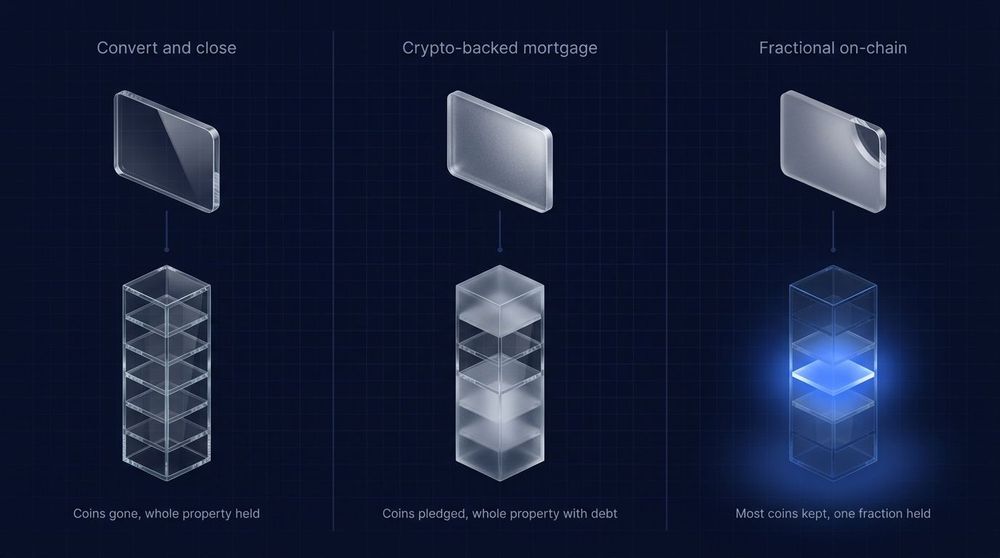
The routes differ on one axis, how much crypto exposure you give up to get the property. Convert, and you give up all of it. Borrow, and you keep the coins but add debt. Buy a fraction, and you add none.
Path 1: Convert and Close (Buy a House With Crypto Through a Conversion Service)
How it works. You want to buy a house with bitcoins. The seller wants dollars. A conversion service verifies your holdings, issues the proof-of-funds letter a seller wants before accepting an offer, and converts your coins at closing. RealOpen advertises proof of funds in about 15 minutes, and Propy handles closings.
What it cannot do. Spare you the tax event. The IRS treats digital assets as property, so selling them for dollars is a disposal reportable that year.
The real cost. The conversion spread, the capital gains bill, and friction nobody advertises. Withdrawal limits throttle six-figure transfers, and a closing agent can refuse a crypto wire. The route works only at whole-property size, six figures or nothing.
Path 2: Crypto-Backed Mortgage (Buying Houses With Crypto as Collateral)
How it works. You pledge crypto as collateral instead of selling it, the way you pawn a watch you intend to get back. The lender holds a claim on the coins until you repay the loan. Milo lends against bitcoin and ether, and Ledn runs the general version.
What it cannot do. Protect you from the collateral falling. Ledn calls for more collateral once the loan reaches 70 percent of the coins' value, and sells them at 80 percent. A fall mid-mortgage costs you coins.
The real cost. Interest, a collateral haircut (you pledge more than you borrow), and a thin field. MortgageResearch counted very few lenders in March 2026, naming Milo, Figure, and Ledn, who aim at luxury real estate for crypto investors.
Path 3: Buy Property With Crypto On-Chain (Tokenized Fractional Purchase)
How it works. A property token offering, or PTO, is a purchase structure that verifies a buyer, assigns fractional ownership of a specific property through a legal entity, and records that ownership on-chain. The fraction is what you buy, not the building.
Two different things go by the name property crypto. One is a coin whose price tracks sentiment. The other is a claim on a named building held by a named company. A REIT share is different: a slice of a fund holding many buildings, while a property token records fractional ownership of one specific asset.
What it cannot do. Give you the keys. You cannot live in it or renovate it, and the legal structure varies by platform, so only the offering documents tell you what you hold.
The real cost. Platform fees, network gas (the chain's own transaction fee), and a minimum worth checking twice. For how units are issued, read what a property token offering is.
Lowest minimum. Most steps on-chain.
See how a property token offering handles this at [Mey Real](https://meyreal.io).
Which Path Fits You? A Two-Question Test
Two questions settle it.
Question one. Do you want to live in the property? If yes, paths one and two are your only options because a fraction buys an interest, not an address.
Question two. Do your holdings cover the price of a whole property where you are looking? If not, path three is the only one open.
With a few hundred or a few thousand dollars, path three is the only one you can act on. Arithmetic, not a pitch.
How Do You Buy Real Estate With Crypto Step by Step on the Tokenized Path?
Here is how it works, in seven steps that fit any compliant tokenized property platform. Mey Real is the worked example because its documentation is public.
Step 1: Verify the Platform Before You Verify Yourself
Before you upload a single document, find out who holds the title, who audited the contracts, which regulator applies, and whether the team is named.
RealT is why. The tokenized real estate platform's payouts had largely stopped by the end of 2025, and a court appointed a fiduciary in April 2026. Mey Real names CertiK, QuillAudits, and SolidProof as its auditors. Compliance is not optional. It is your first line of defense against fraud.
What you should now have: a named entity, auditor, regulator, and team.
Step 2: Complete KYC and Connect a Wallet
KYC is the passport check at a border. Know Your Customer means that the platform verifies your identity documents first, and Mey Real's documentation states that no wallet can hold or move Mey Real tokens until the holder passes KYC.
A self-custody wallet keeps the keys with you, and an exchange wallet does not. Mey Real asks for a multichain wallet with USDC and ether for gas.
Pro tip: Test the wallet connection with a zero-value action before you move any funds.
What you should now have: a verified account and a self-custody wallet.
Step 3: Fund the Wallet (Buy Property With Bitcoin or With a Stablecoin?)
You may be here to buy real estate with bitcoin, but most tokenized platforms settle in a stablecoin, a token pegged to the dollar. Mey Real settles in USDC, with ether for gas.
Holding bitcoin means one extra hop, and you pay a spread and a network fee on each leg. On a $50 unit those fees are not small. Send USDC on the wrong network and it is gone, so copy the network name from the offering page.
What you should now have: a stablecoin balance and gas in the wallet.
Step 4: Choose a Property and Read the Offering Documents
A good offering page shows you six things. Those are the asset identifier, the entity holding it, the total units, the price per unit, the fee schedule, and the transfer rules. Check them on the live property token offerings page.
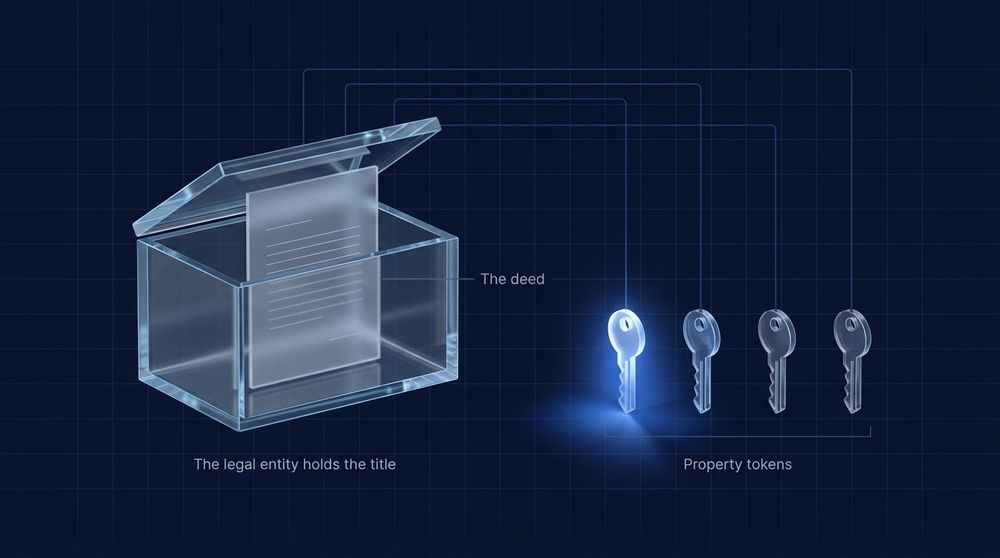
Think of the entity as a deed box. It holds the deed, and the tokens are numbered keys to a share of the box. Mey Real's legal framework documentation describes one special purpose vehicle, or SPV, per asset, deeds held by a licensed custodian, and a token that does not convey ownership of the land title.
On-chain transparency is not the same as off-chain competence. The chain shows every transfer and nothing about whether the roof leaks or the tenant pays.
What you should now have: a property chosen and its transfer rules read.
Step 5: Execute the Purchase On-Chain
Select the units, approve the transaction, and wait for confirmations. Approving a spend and buying are two transactions. Only the second gets you units.
On-chain settlement means that the purchase is recorded and confirmed on the chain, minutes against the weeks a conventional closing runs. It does not compress the valuation and legal review done beforehand.
Pro tip: Screenshot the transaction hash and the offering document the same day. That pair is your receipt.
What you should now have: confirmed units and a saved record.
Walk through the participation requirements before you go further, in [Mey Real's documentation](https://mey-real.gitbook.io/meyreal-docs/8.-mey-real-faq/frequently-asked-questions).
Step 6: Confirm What You Now Own
This is the step where first-time buyers are surprised. You own a fractional interest in the company that owns the property, not a slice of a house you can visit.
Mey Real's legal framework page calls the token a digital certificate of contractual rights under an agreement with the SPV, plus the participation and transfer rights the documents grant. The documents, not the chain, define what you hold.
What you should now have: a plain answer to what you own.
Step 7: Know Your Exit Before You Need It
Mey Real's documentation states that the platform imposes no mandatory lock-ups, that units transfer freely once received, and that any restriction is disclosed upfront. No platform can promise a buyer on the other side when you want one.
A conventional sale takes months, and several US fractional platforms lock your money in for a fixed period. Removing a lock does not create demand.
What you should now have: the exit rules in writing, and no guarantee beyond them.
What Are the Challenges and Limitations of Buying Real Estate With Crypto?
- Price movement before settlement. Prices move while you complete KYC, fund a wallet, and read documents, so what you spend is not what you planned.
- Tax on any conversion or swap. A conversion at closing is a capital gains event, and so is a swap from bitcoin to a stablecoin.
- Platform risk outranks price risk. RealT is the case. The Howey Test, from a 1946 court case, decides whether a US offering counts as a security, which sets what protection you get.
- Jurisdictional gaps. A token is recorded globally, and a deed is enforced locally, so disputes are heard where the building stands.
- No occupancy on the tokenized route. You cannot move in, and no on-chain record changes that.
The whole-property routes start at six figures. Those routes were built for large holders. Whether tokenized real estate is safe turns on structure, not the chain.
This guide is educational and is not financial, legal, or tax advice. Tokenized property carries risk, including loss of principal. Confirm the rules that apply in your jurisdiction before you proceed.
Our Perspective
The industry spent years making a whole house payable in bitcoin, and solved the wrong problem. Payment was never the hard part. Ticket size was.
Look at what the whole-property routes ask. One asks you to sell a position you have held for years. The other asks you to borrow against an asset that can fall 30 percent in a month. Both frame it as crypto or property.
The decision is not crypto or property; it is how large a piece you buy at once. A small fractional purchase gives you both. You keep most of your holdings and still take a real position in a real building. That is the logic behind passive real estate investing for people who never wanted to be landlords, and we built Mey Real on it.
Buy your first PTO at [Mey Real's live property token offerings](https://app.meyreal.io/pto).
Four years of holding, a house still out of reach, and a way to own a piece of one without selling most of it.
Frequently Asked Questions
Can you buy real estate with crypto?
Yes, you can buy real estate with crypto in 2026, by converting to cash at closing, by borrowing against your coins, or by buying a fraction of a specific property on-chain. Most whole-property purchases still end with the seller receiving local currency. The on-chain fractional route never converts to cash.
How do you buy real estate with crypto step by step?
To buy real estate with crypto on-chain, you verify the platform, complete KYC and connect a wallet, fund that wallet, choose a property and read its offering documents, execute the purchase, confirm what you own, and know your transfer options. Each of those seven steps has one thing to verify.
Can I use crypto to buy a house I will live in?
Yes, but only through the two whole-property routes, which are converting crypto to cash at closing or taking a crypto-backed mortgage against coins you keep. A tokenized fractional purchase gives you an economic interest in a property rather than the right to occupy it. Occupancy needs whole ownership or a tenancy.
Do I need to pay taxes when I buy a house with bitcoin?
In most jurisdictions, converting bitcoin to cash to buy a house is a taxable disposal of the bitcoin, separate from any property tax on the purchase. The IRS treats digital assets as property for federal tax purposes. Rules differ by country, so confirm them with a tax professional where you live.
Can I buy a house with XRP or other altcoins?
Conversion services and some tokenized platforms accept a range of assets, but most settle in a stablecoin or in cash. Check the accepted-assets list on the service's own site before you fund a wallet. Swapping into an accepted asset usually takes one extra step, and that swap carries its own cost.
What is a property token offering?
A property token offering is a purchase structure that verifies a buyer, assigns fractional ownership of a specific property through a legal entity, and records that ownership on-chain. It differs from a REIT in that the token maps to one named property held by one named company, not a managed fund.
How much crypto do I need to buy property on-chain with Mey Real?
As of September 2026, Mey Real's documentation states that the minimum purchase starts at $50, paid in USDC from your own wallet. You also need enough ether in that same wallet to cover network gas fees. Confirm the current price per unit on the offering page before you send funds.
Is buying real estate with crypto safe?
Buying real estate with crypto is as safe as the platform's legal structure, audits, and regulator, and no safer than that. Check who holds title, who audited the contracts, and which jurisdiction enforces your rights before you complete KYC. A platform that will not answer those three is the answer.
