

A residential plot in Chuong My, on the edge of Ha Noi, Vietnam, was cut into 2,000 digital units, each priced at 50 USDC. No mortgage, no legal fees, no flight to Vietnam. The plot did not get smaller; the amount needed to hold a verified claim on it did.
That arithmetic is why people look up how to buy property tokens instead of how to save a deposit. A property token records a fractional claim on one specific, verified property, and a Property Token Offering, or PTO, is the process that issues it. One token, one slice, one named building.
The category is no longer small. Tokenized real-world assets stood at $38.51 billion on August 27, 2026, and Citi Institute puts the 2030 base case at $5.5 trillion.
Nothing here assumes you have held a token, completed a crypto identity check, or opened a wallet. The guide covers what you need first, the six steps in order, the real minimum, what happens afterward, and what can go wrong. Any term that stops you is in the crypto and RWA glossary.
This guide walks through how to access property tokens on platforms like Mey Real. It is educational, not financial advice, and token value or participation benefits are not guaranteed.
Key Takeaways
- A property token is a fractional, verified claim on one real property, issued through a Property Token Offering (PTO).
- Three things get you started: a wallet, a completed identity and whitelisting check, and a funding method. No real estate or crypto background required.
- Mey Real's verified example was priced at 50 USDC per token across 2,000 tokens, a figure you can check rather than a vague claim.
- Once you hold property tokens, three paths open: keep holding, stake through MeyFi, or transfer under the platform's distribution model.
Table of Contents
- What Are Property Tokens?
- What Do You Need Before You Start?
- How Do You Buy Property Tokens Step by Step?
- How Much Do You Need to Get Started?
- What Happens After You Hold Property Tokens?
- What Risks Should Beginners Know First?
- How Do Property Tokens Compare to Other Ways to Access Real Estate?
- What Do These Steps Look Like in Practice?
- Where Should a Complete Beginner Actually Start?
- Frequently Asked Questions
What Are Property Tokens?
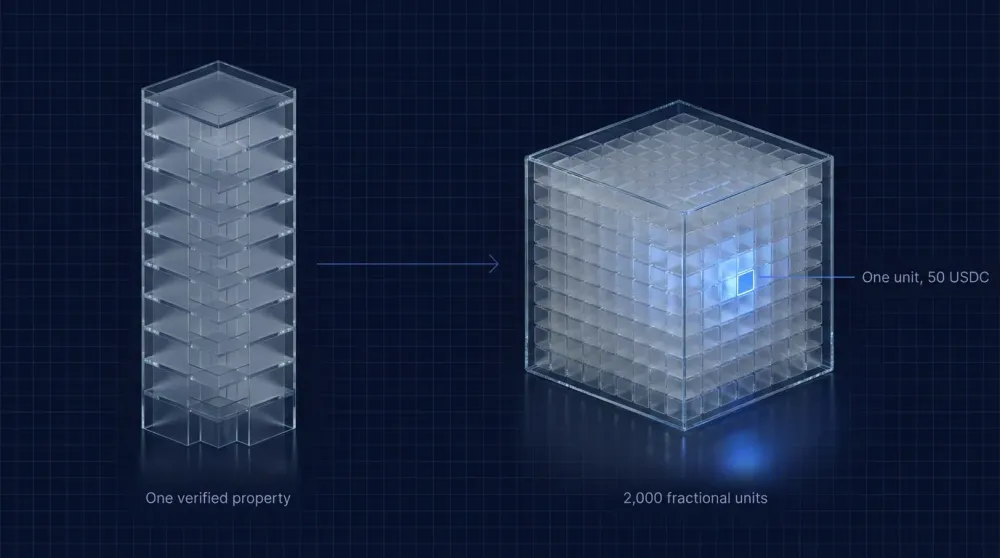
A property token is a digital unit that records, verifies, and transfers a fractional claim on one specific property, so access no longer depends on raising the asset's full price.
It is not a stake in a company holding dozens of buildings. That describes a real estate investment trust. The dividing line sits underneath: one address, one title, one valuation.
Two words do the real work. "Fractional" means the property is cut into a fixed number of units before anything is issued, so supply is set in advance. "Verified" means an off-chain entity checked the title and valuation before any tokenization of property happened. On Mey Real, Meey Finance runs that check and holds the property under contract.
A smart contract keeps the register of which wallet holds which units, so the record updates in minutes with no title office involved.
One building, many units.
Property is the slowest-moving corner of the $38.51 billion now tokenized, and the piece carrying the most friction before Citi Institute's $5.5 trillion base case for 2030 looks reachable.
Start with the foundations in what real estate tokenization is, then see how to tokenize property from the owner's side in the step-by-step breakdown.
What Do You Need Before You Start?
Three things, and none require prior crypto experience.
- A wallet. A crypto wallet is software holding the keys that prove which units are assigned to your address. Think of it as a keyring rather than a bank vault: the wallet keeps the keys, and the network keeps the record. Ethereum's wallet primer covers the difference between one you control and one a platform controls.
- A government ID for KYC and whitelisting. KYC (short for "know your customer") is the identity check a regulated platform runs before you participate. Whitelisting comes next: your wallet address goes onto the approved list for a given offering. Mey Real's first PTO split its 2,000 units into 1,400 whitelisted and 600 on a first-come, first-served basis, so the bigger tranche goes to whitelisted wallets.
- A funding method. Most Property Token Offerings are priced in USDC, a stablecoin issued by Circle and pegged to the US dollar, so a unit's price holds steady while you get ready.
Pro tip: Finish KYC before an offering opens, never on the day. Verification can run for days, and tranches close.
How Do You Buy Property Tokens Step by Step?
Here is how it works. Six steps, in order. Beginners usually skip the first two.
Step 1: Choose a platform and confirm it is audited and compliant
Start with the boring checks. They are the ones people skip. Confirm that the platform names the entity handling off-chain custody, publishes its smart contract audits, and states which jurisdictions it accepts participants from. Compliance is your first line of defense against fraud.
Step 2: Complete KYC and get whitelisted
Upload your identification and complete the identity check. Whitelisting follows approval and ties your wallet address to a named, verified person, which lets a compliant offering allocate units to you. Expect days, not minutes.
Step 3: Set up and fund your wallet
Create a wallet, write the recovery phrase on paper, and store it somewhere a fire would not reach. Fund the wallet with the stablecoin the offering uses, and keep a buffer above the token price for network fees (the per-transaction cost of recording a change on-chain).
Step 4: Browse available Property Token Offerings
Read each listing the way you would a rental agreement. Check the location, the units issued, the value per unit, the valuation date, and who verified it. A listing naming none of these is one to walk away from.
Step 5: Obtain your property tokens
Confirm how many units you want, approve the transaction in your wallet, and wait for the network to settle. The smart contract assigns those units to your address and records the change publicly, so anyone can check it.
Step 6: Track, stake, or hold your tokens
Your wallet now shows the units. From here, you can leave them alone, stake them, or transfer them.
Walk through the participation requirements on Mey Real before going further.
How Much Do You Need to Get Started?
Less than most people assume, and more than the token price alone.
Mey Real's verified example puts a number on it: the Chuong My plot was divided into 2,000 tokens at 50 USDC each. One token was the floor. Budget two costs on top of that: network fees every time the chain records something, and the spread or flat charge on converting local currency into a stablecoin.
The minimum is small. The homework is not.
What Happens After You Hold Property Tokens?
Most beginner guides stop when the units land. Three paths open next.
Hold. You keep the units and receive participation benefits under the property's distribution model, which is linked to the rent the building produces.
Stake. MeyFi carries a staking layer, though the published detail covers $MEY rather than property tokens. The documentation sets out four tiers, and the homepage lists $MEY staking as coming soon. Treat it as a design, not a live feature.
Transfer. Smart contracts make the units transferable, and the documentation describes a route back to the platform.
Governance sits apart. A DAO, or decentralized autonomous organization, lets $MEY holders vote on features and upgrades. No published document gives property token holders a vote on individual buildings.
What Risks Should Beginners Know First?
Every route into real estate carries risk. Property tokenization changes which ones you carry, and it removes none of them.
- Platform and custody risk. An entity off-chain still holds the deed, and its failure becomes your problem. On-chain transparency is not the same as off-chain competence.
- Transfer risk. A unit moves only when somebody takes the other side. Never assume that a token converts back to cash on demand.
- Regulatory risk by jurisdiction. Rules differ by country. The European Union regulates crypto-assets under the Markets in Crypto-Assets Regulation, the United States treats digital assets as property for tax purposes, and many jurisdictions have settled neither the rules nor the tax treatment.
- Property-specific risk. A tokenized building is still a building. The tokenization of property changes the wrapper, not the roof, so vacancy, damage, a falling local valuation, and a bad tenant all pass straight through.
- Fraud risk. Chainalysis recorded at least $14 billion received by crypto scams on chain in 2025, with the average scam payment up 253 percent year on year. Verify the platform before you verify the property.
Pro tip: Ask any platform for the audit report, the custodian's name, and the valuation date before committing a unit.
How Do Property Tokens Compare to Other Ways to Access Real Estate?
Four dimensions separate the routes. Read each as a compromise, not a ranking.
- Capital required. Direct property means a deposit, a mortgage, legal fees, and taxes. Entry to a real estate investment trust is one share, and property crowdfunding sets a platform minimum. Fractional property tokens start at one unit, 50 USDC on the verified Mey Real example. None of them changes what the building costs.
- Complexity. Direct property is the most demanding and the best understood. Trusts are the simplest to reach and the furthest from the asset itself. Property tokens sit between them: one address you can inspect, wrapped in onboarding with a wallet and an identity check.
- Transfer speed. A traditional transfer runs on a registry calendar, measured in weeks. An on-chain transfer settles in minutes, and the record is public the moment it lands. It cannot compress the off-chain work that comes first. Registration still moves at registration speed.
- Control. Direct property gives you every decision and every repair bill. Trusts and crowdfunding platforms hand decisions to a manager (the point, for some people). Property tokens give a claim on one named asset without the operational load. No route here lets a fractional holder pick the tenant.
What Do These Steps Look Like in Practice?
Three worked frameworks, each measuring something different.
Framework 1: A first-time participant, start to finish
Measure three things: the time to clear KYC, the smallest amount committed, and the units received. On the verified example, that came to 50 USDC plus network fees for one of the 2,000 fractional property tokens on the Chuong My plot. Verification, not funding, is the slow step.
Framework 2: Staking after you hold
Measure how a passive holding becomes an active one. A unit in a wallet does nothing until it is committed to a network function, where protocol rules and a maturity date govern it, not your timing. Less flexibility, more participation.
Framework 3: Transferring the units later
Measure three things: settlement time, the network fee for recording the change, and whether the units land with another participant or go back to the platform. Only the first is fixed by the chain.
Where Should a Complete Beginner Actually Start?
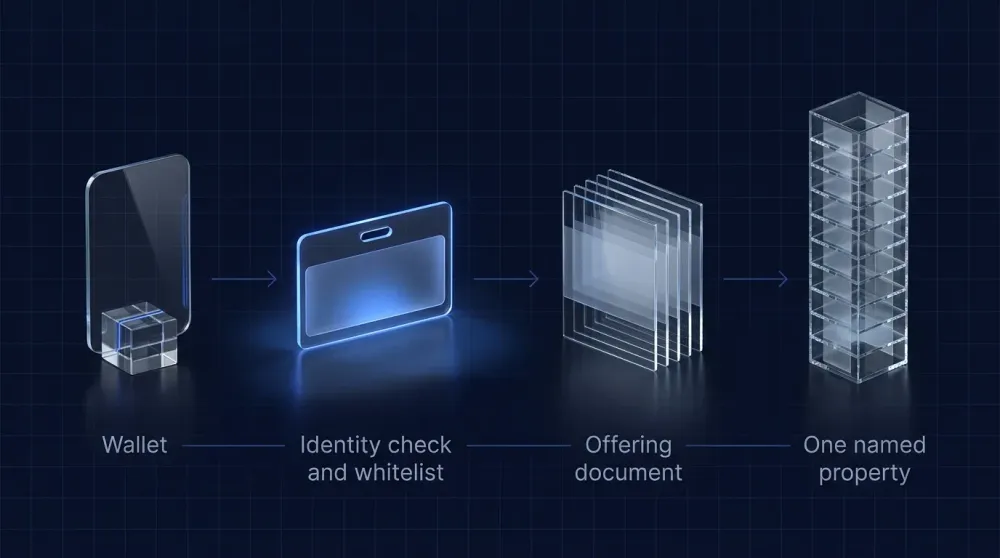
Our view, plainly: start with the checks, not the listing.
Tokenized real estate for beginners is less a technology problem than a sequencing one. Most people run it backward, finding a property they like, then scrambling through the wallet and the identity check while a whitelist tranche fills. Reverse it. Build the wallet, clear KYC, read one offering document end to end, then look at what is available. Owners asking how to tokenize property walk the opposite path, starting with a valuation.
Mey Network is an RWA tokenization ecosystem that converts verified real estate into onchain Property Token Offerings (PTOs), giving participants borderless, transparent access to real estate through MeyFi's staking, lending, and participation tools.
Property tokenization has made the entry small. It has not made diligence optional. A 50 USDC unit in a property you have not researched is still 50 USDC you chose not to think about.
Browse the live Property Token Offerings and complete whitelisting on Mey Real.
Frequently Asked Questions
What exactly is a property token?
A property token is a digital unit recording a fractional, verified claim on one specific real property, and a Property Token Offering is the process that issues it. Each unit points at a single named asset with a title and a valuation, rather than at a company or a fund holding many buildings.
How do I buy property tokens as a complete beginner?
Choose an audited, compliant platform, complete its KYC identity check, get your wallet address whitelisted, fund the wallet with the stablecoin the offering uses, then confirm how many units you want. The smart contract assigns them to your address and records the change publicly within minutes. Verification is usually the slowest step.
Do I need crypto experience to get started?
No. The three requirements are a wallet, a government ID, and a funding method, and platforms aimed at tokenized real estate for beginners assume no prior crypto knowledge. The learning curve sits almost entirely in the wallet setup and the recovery phrase, both of which any onboarding guide walks through. Everything else is form-filling.
How much money do I need to start?
Mey Real's verified example listing was priced at 50 USDC per token across 2,000 tokens issued on the Chuong My plot, so one unit was the floor. Budget slightly above that figure for network fees and for the spread charged when converting local currency into a stablecoin. Nothing else is required upfront.
What happens after I hold a property token?
Three paths open. You can keep holding and receive participation benefits under the property's rent-linked distribution model, use MeyFi's staking layer, or transfer the units later. Mey's published staking detail covers $MEY rather than property tokens, and the documentation also describes a route back to the platform. Governance voting sits with $MEY holders.
Can I transfer property tokens later?
Yes. The Mey Network documentation describes smart contracts that make units transferable, plus a published route to hand them back to the platform. Timing depends on how many participants are active at that moment, so treat a secondary transfer as possible rather than instant, and never assume same-day settlement. Fees apply on every recorded change.
Are property token offerings safe?
Safety depends on the structure, not the technology. Confirm that an audited smart contract governs the units, that a named entity holds the property off chain, and that the platform states which jurisdictions it serves. Regulation differs by country, and tax treatment remains unsettled in several of them. Verify all three before committing anything.
