

A tenant transfers rent to a landlord's bank account on the first of the month. Three weeks later and a continent away, a wallet balance updates for someone who has never stood outside the building. Tokenized real estate rental income is everything between those two moments, and most coverage skips it.
That middle stretch is where the real risks live. Rent is a physical-world payment, collected in local currency by a person with keys and a phone number. A distribution is an on-chain event, settled by code. Something has to carry the money across the gap, and how clearly a platform describes that crossing tells you most of what you need to know.
With tokenized real-world assets now above $38 billion on-chain, that question has stopped being academic. So this guide walks the literal path. Rent collection, then expense netting, conversion, and a pro-rata distribution. After that, the three distribution models, timing, and what can interrupt a payment. If you want the ground floor first, start with how tokenized real estate works.
This guide explains the on-chain mechanics behind rental income distributions for tokenized real estate. It is educational, not financial advice, and distributions are not guaranteed.
Key Takeaways
- Rent is collected off-chain by a property manager or special purpose vehicle, and netted against expenses before any on-chain distribution exists.
- Platforms run three distribution models: direct stablecoin payout, rebasing, and reinvestment, and which one they use changes what reaches your wallet.
- Distributions are not guaranteed. Vacancy, maintenance, tenant default, and currency conversion can each interrupt or shrink them.
- The off-chain-to-on-chain boundary is the point worth scrutinizing. Everything before it is a promise, and everything after it is a public record.
Table of Contents
- What is tokenized real estate rental income?
- How does rent become an on-chain distribution?
- Where does the on-chain part actually start?
- What distribution models do property tokens use?
- How often are distributions paid, and how much?
- What can interrupt a distribution?
- What does a rent-to-wallet cycle look like?
- How do property distributions compare with other participation benefits?
- What should you measure in each distribution model?
- How do you track and verify your distributions?
- Our perspective
- Frequently asked questions
What Is Tokenized Real Estate Rental Income?
Tokenized real estate rental income is the cash a tenant pays for a specific tokenized property, collected off-chain in local currency before any conversion or on-chain settlement happens.
Wallets, units, and blockchains are not involved yet. Rent is an asset-level fact, like the building having a roof and twelve apartments.
Keep two ideas apart, and the rest of what real estate tokenization is gets easier. Rent belongs to the property. A distribution is what the structure above it assigns to holders after costs.
The building earns. The holder receives.
How Does Rent Become an On-Chain Distribution?
Rent becomes an on-chain distribution in four steps, and only the last happens on a blockchain.
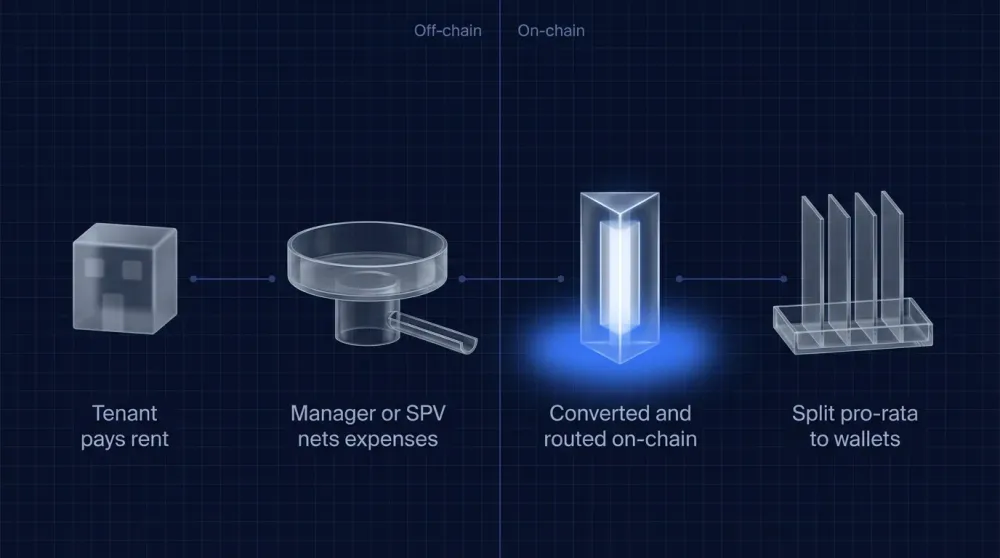
Step 1: The Tenant Pays Rent, Off-Chain
A tenant pays the ordinary way, by bank transfer, standing order, or cash to an agent. No smart contract is watching, and no wallet holder can check it.
The first link in the chain is a person keeping a promise.
Step 2: A Property Manager or SPV Collects and Nets Expenses
Rent lands in an account run by a property manager or a special purpose vehicle (SPV), a bankruptcy-remote legal entity built to hold one asset and nothing else. Costs come off here, and there are more than most explainers admit. Management fees alone run 8 to 12 percent of monthly rent on smaller residential property in the United States, before taxes, insurance, repairs, and debt service.
What is left is net rent. Everything downstream flows from that number, not the lease.
Step 3: Net Rent Is Converted and Routed On-Chain
Net rent is a bank balance in dong, dirhams, or dollars. It has to become an on-chain asset before a smart contract can touch it, which usually means converting it into a stablecoin such as USDC and routing it to a distribution contract. Both steps cost money.
Fiat leaves. Stablecoin arrives.
Step 4: The Distribution Is Paid Pro-Rata by Units Held
The contract splits the amount across every wallet holding participation units in that property, in proportion to units held. A pro-rata distribution is arithmetic, not discretion. Hold one hundredth of the units issued, and you receive one hundredth of what entered the contract that cycle.
Only this step leaves a record a blockchain can prove.
Where Does the On-Chain Part Actually Start?
The on-chain part starts at Step 3, when converted funds reach a distribution contract. Everything before that runs on ordinary off-chain trust.
Most coverage of on-chain real estate income blurs that line, and the blur flatters the technology. A blockchain can prove that 4,000 USDC entered a contract on a Tuesday and left it in 2,000 pieces an hour later. It cannot prove that the tenant paid, or that the deductions were honest.
Call it the off-chain-to-on-chain gap. Every diligence question points at that seam. Who holds the collection account? Who signs off the deductions? What gets published in between?
On-chain transparency is not the same as off-chain competence.
Pro tip: Ask any platform for the full expense breakdown behind one past cycle before anything else.
What Distribution Models Do Property Tokens Use?
Property token distributions run on three models, and platforms rarely say which one they use. Each sends on-chain real estate income somewhere different, into your balance, into the unit, or back into the structure.
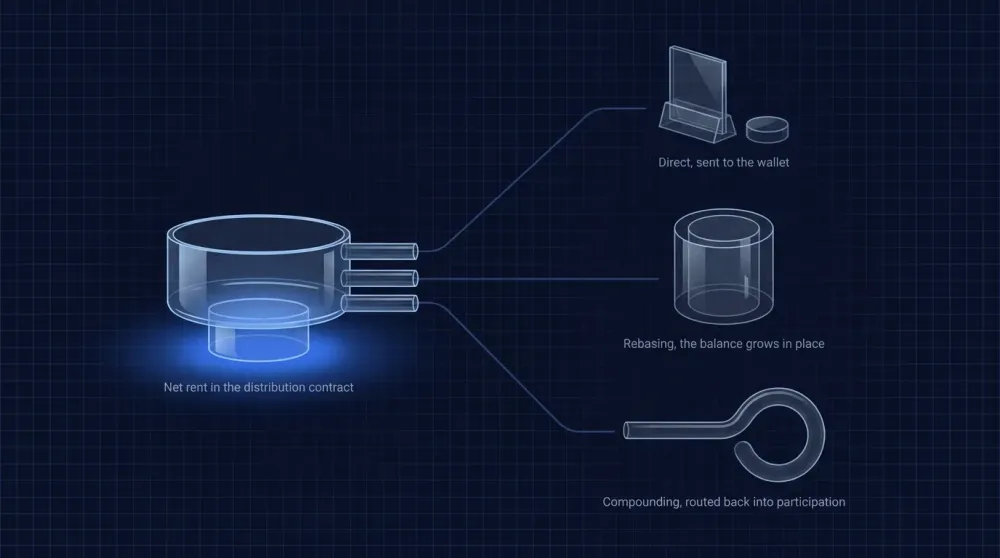
Direct distribution, a periodic stablecoin payout. Net rent is converted and sent to holder wallets monthly or quarterly. Your unit count never changes, and each distribution arrives as a separate timestamped transaction. What it cannot do is smooth a bad month, because a smaller pool means a visibly smaller transfer.
Rebasing, or balance accrual. Rebase tokens adjust holder balances automatically rather than through explicit transfers, so the units in a wallet rise without anyone sending anything. What it cannot do is hand you a spendable stablecoin, and it makes record-keeping harder.
Reinvestment through staking on MeyFi. Rather than arriving as spendable value, a distribution is routed back into protocol participation, and MeyFi is where that happens. You forgo immediate access in favor of compounding participation. What it cannot do is help anyone who needs funds now.
Pro tip: Read the documentation, not the homepage. A platform that will not name its distribution model has told you something.
How Often Are Distributions Paid, and How Much?
Most tokenized real estate platforms distribute monthly or quarterly, and the amount moves with occupancy and expenses.
Monthly cycles suit single-tenant residential property. Quarterly cycles suit multi-unit or commercial assets, where reconciliation takes longer and batching cuts conversion costs.
As for how much, nobody can quote a reliable number in advance. Rent varies with occupancy, expenses vary with the building's age and the season, and conversion varies with the currency. A platform promising a fixed figure regardless of occupancy is claiming somebody else absorbs the variance. Ask who, and with what.
Variable is normal. Guaranteed is a warning.
What Can Interrupt a Distribution?
Five things interrupt distributions in practice, and every one sits off-chain, upstream of code.
- Vacancy. An empty unit generates no rent, and the United States rental vacancy rate ran at 7.3 percent in the second quarter of 2026. Vacancy is a baseline condition, not an edge case.
- Maintenance and capital costs. A boiler replacement lands in one cycle and can absorb the whole of it. Well-run structures hold a reserve, so a cycle comes in smaller rather than skipped.
- Tenant default. Rent owed is not rent received, and recovery runs on court calendars.
- Currency conversion. Where rent is collected in one currency and distributed in another, the rate on distribution day matters.
- Platform and legal risk. The SPV, the licensing, and the jurisdiction all have to hold. Frameworks such as the EU's Markets in Crypto-Assets Regulation set out what a compliant operator owes you.
Compliance is not optional. It is your first line of defense against fraud.
What Does a Rent-to-Wallet Cycle Look Like?
Mey Network's Chuong My listing in Ha Noi, Vietnam, gives a real structure to walk. That offering issued 2,000 property tokens, and one unit cost 50 USDC. It has since closed, so treat the numbers as illustration.
Trace one cycle. A wallet holding 20 units holds 1 percent of the 2,000 issued. Rent is collected off-chain, expenses and fees come off, and the remainder is converted into USDC and sent to the distribution contract, which splits it by unit ownership. The same 1 percent applies on the way out.
The arithmetic is trivial. The trust is not, because three of those four stages happened out of sight.
Read the structure of a Property Token Offering, then see how property token distributions work on MeyFi at https://meyfi.io.
How Do Property Distributions Compare With Other Participation Benefits?
Property distributions are one of three participation-benefit mechanisms in the Mey ecosystem, and mixing them up creates bad expectations.
Where the value comes from. A property distribution starts with a tenant paying to use a building. Staking mechanics start with protocol design and are denominated in network units. Peer-to-peer lending on MeyFi starts with a borrower and a loan. Different origins, different failure modes.
Timing. Rental distributions follow a property calendar and vary with occupancy. Staking follows protocol rules, not a calendar.
Current status. $MEY staking is documented across four tiers, Dolphin, Shark, Whale, and SVIP, but Mey Network lists it as coming soon and publishes no rate. Documented is not live.
What Should You Measure in Each Distribution Model?
Three frameworks, three sets of numbers. Use the one matching the model in front of you.
- Framework 1, direct-payout distribution. Measure payout frequency against the documentation, the gap between gross and net rent, and the distribution history. A missing month is a question worth asking.
- Framework 2, the rebasing model, industry-general. Measure how often the rebase executes and whether your wallet reconciles against the contract's published events.
- Framework 3, one cycle recorded end to end. Measure whether the off-chain leg is evidenced at all, meaning a collection statement, an expense breakdown, a conversion record, and a transaction hash.
Most platforms publish the last one and stop.
How Do You Track and Verify Your Distributions?
Verify a distribution the way you would any on-chain settlement, by reading it on a block explorer rather than a dashboard.
Start with the property's contract address and the wallet holding the units. A distribution appears as a transaction into the contract, then transfers out to holder wallets, dated and visible to anyone who looks. Check those dates against the schedule.
Then ask for the half an explorer cannot show you. Request the collection and expense statement for that cycle, and if a platform treats that as unusual, treat the platform as unusual. Rebasing and pro-rata distribution are defined in the crypto and RWA glossary.
A dashboard shows what a company chose to display. An explorer shows what happened.
Our Perspective
Mey Network is an RWA tokenization ecosystem that converts verified real estate into onchain Property Token Offerings (PTOs), giving participants borderless, transparent access to real estate through MeyFi's staking, lending, and participation tools.
Tokenized real-world assets stood at $38.3 billion on 22 August 2026, and Citi Institute forecasts $5.5 trillion by 2030 in its base case. Our view is narrower than the category's marketing. Tokenization fixes the distribution leg, turning a slow, opaque settlement into a public one anyone can audit. It does not fix property management or tenant screening.
Almost everything that makes a tokenized real estate distribution trustworthy happens before a blockchain is involved. Judge a platform on its off-chain half. The on-chain half is the easy part.
Walk through the participation requirements and the current Property Token Offerings at https://mey.network.
Frequently Asked Questions
How does rental income work with tokenized real estate?
Tenants pay rent off-chain in local currency to a property manager or special purpose vehicle, which deducts management fees, taxes, insurance, and repairs. The remaining net rent is converted into a stablecoin and sent to a distribution contract, which then splits it across holder wallets in proportion to participation units held.
How often do tokenized real estate distributions get paid?
Most platforms run monthly or quarterly cycles. Monthly suits single-tenant residential property, where rent arrives on a fixed date each month. Quarterly suits multi-unit and commercial assets, where reconciling expenses takes longer and batching several months of conversion reduces cost. Always confirm the published schedule in a platform's documentation before participating.
What happens to the rent if a property is vacant?
No tenant means no rent, so that cycle's distribution shrinks or disappears entirely. Vacancy is a normal operating condition rather than a rare failure, running at 7.3 percent nationally in the United States in the second quarter of 2026. Well-structured offerings hold a reserve specifically to absorb vacancy across cycles.
Are tokenized real estate distributions guaranteed?
No. Every distribution depends on rent actually being collected, expenses staying within budget, and currency conversion holding up. Vacancy, tenant default, maintenance, and legal or platform failure can each interrupt a cycle. Treat any platform promising a fixed figure regardless of occupancy as making a marketing claim rather than describing a mechanism.
What is the difference between property distributions and staking rewards on MeyFi?
A property distribution starts with a tenant paying to use a physical building, and reaches holders after costs come off. Staking mechanics start with protocol design and are denominated in network units. They fail for completely different reasons. Note also that $MEY staking is documented across four tiers but listed as coming soon.
How can I verify a tokenized real estate distribution is real?
Read it on a block explorer rather than on a dashboard. Look for the incoming transaction to the distribution contract, then the outgoing transfers to holder wallets, and check the dates against the published schedule. Then request the off-chain half, meaning the collection statement and the expense breakdown for that same cycle.
Do I pay tax on tokenized real estate distributions?
Very likely, though treatment varies widely by jurisdiction and by how an offering is structured. The United States Internal Revenue Service treats digital assets as property rather than currency for tax purposes. Rebasing models complicate matters further, since balances change without a transaction. Take advice from a qualified local professional.
Related Reading
- What real estate tokenization is, the pillar guide underneath this whole topic.
- How tokenized real estate works, step by step, the breakdown of the structure this article sits inside.
- What a Property Token Offering is, for the offering mechanics behind a distribution.
- Crypto and RWA glossary, for rebasing, pro-rata distribution, and fifty other terms.
- MeyFi, for the staking and lending mechanics compared above.
